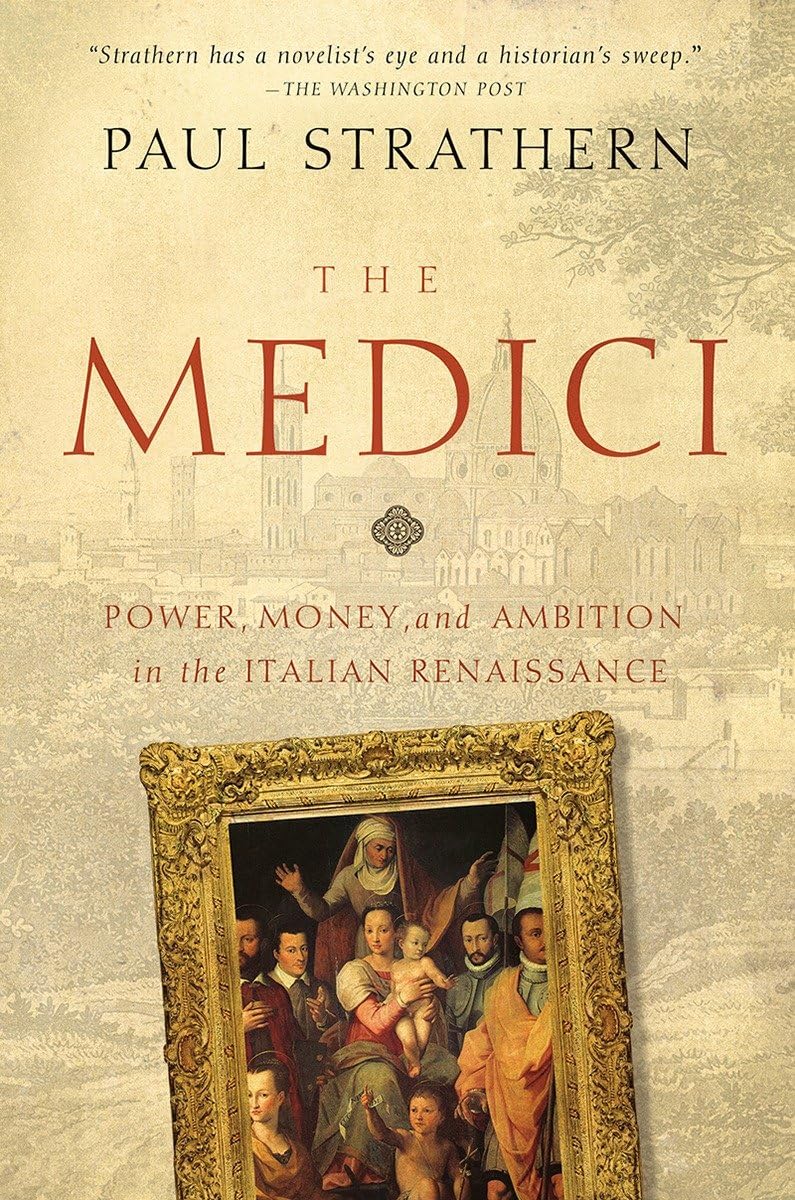
The origins of the Italian Renaissance have been debated since the mid-nineteenth century, but one thing is relatively certain: the Medici family of Florence had a lot to do with it. British novelist Paul Strathern tells the remarkable story of this remarkable family in “The Medici: Power, Money, and Ambition in the Italian Renaissance” (2016).
The Medici family first appears in the records of Florence in 1201. By the end of the thirteenth century they had achieved the office of gonfaloniere, chief of the nine-man executive council known as the Signoria and the highest civic position in the Florentine republic. In 1396, Giovanni di Bicci set up the Medici bank with a capitalization of 10,000 florins. Giovanni placed a strategic bet on an impoverished but ambitious Neapolitan nobleman named Baldassare Cossa who was climbing the ranks of the Roman Catholic Church. The bet paid off in 1410 when Cossa was elected pontiff, becoming Pope John XXIII. He quickly appointed the Medici to handle the church’s finances. By 1420 the Medici bank had accumulated 150,000 florins in profit since its founding, half of it derived from the branch in Rome. The Medici family lost the papal banking relationship to the rival Florentine Spini family when Martin V was elected pontiff in 1417. The Medici would reclaim the financial affairs of the Curia a few years later when the Spini went bankrupt, but would lose the account in the last year’s of Eugenius IV pontificate.Giovanni di Bicci poured money into civic patronage projects in a bid for a social status to match the family’s growing fortune and political influence. On his deathbed, in 1428, Giovanni di Bicci urged his supremely talented son Cosimo (ruled 1434-1464) to “Keep out of the public gaze, and never go against the will of the people.”
The Medici retained management of the papal Curia’s financial affairs during most of Pope Eugenius IV sixteen-year pontificate (1431-1447), but their political position in Florence was unstable. In 1433, Cosimo was exiled for “attempting to raise himself above the rank of an ordinary citizen.” It would prove to be a short exile. “Out of defeat had come victory,” Strathern writes. Cosimo returned to Florence in triumph and secured leadership of the city, including control over the tax-assessing and tax-gathering apparatus, which gave him the power to destroy political rivals. Also, like his father, Cosimo placed a strategic bet on the mercenary leader Francesco Sforza, which would prove to be as momentous as his father’s bet on Baldassare Cossa. “Cosimo would transcend himself,” Strathern says, “emerging as the richest man of his age, the founder of a dynasty, the man who encouraged the first flowering of the Renaissance.” In 1440, Cosimo commissioned the sculptor Donatello to produce a bronze statue of the Biblical figure David, a symbol of the triumph of justice over tyranny and the embodiment of Florence’s deeply held republican values. Moreover, Strathern says that “The Medici were among the first to understand, and publicly acknowledge, that artists were more than craftsmen.”
Strathern credits Cosimo with fostering humanism in Quattrocento Florence. In addition to patronizing the arts through generous commissions to Donatello, Brunelleschi, Fra Angelico, Michelozzo and others, Cosimo also financially supported Niccolo Niccoli, Florence’s “unofficial minister of culture”, who used Medici funds to hire Poggio Bracciolini and others to track down ancient manuscripts all over Italy (when Niccolo died in 1437 he bequeathed his library of 800 manuscripts to his patron). Between 1434 and 1471, Cosimo invested over 650,000 florins on art commissions and the construction or renovation of buildings ranging from palaces and libraries to churches and monasteries. A truly staggering sum. It is said that Cosimo received 100,000 florins inheritance from his father, Giovanni di Bicci, and even after spending over half a million florins on civic patronage projects in Florence, still managed to leave his son, Piero, over 200,000 florins. When Cosimo died in 1467 the Signoria ordered that “Pater Patriae” (Father of the Country) be carved on his tombstone.
Cosimo’s son and brief successor, Piero the Gouty, served unobtrusively but ably during the five-year interlude (1464-1469) between the prudent rule of Cosimo and the more flamboyant era of his grandson Lorenzo the Magnificent. Strathern says that Piero’s tenure in leadership was significant. Most notably, the Medici bank secured a monopoly position on the trade in alum, a chemical compound used in dyeing and printing textiles. The alum trade was generating 70,000 florins per year, an enormous sum that made up for the loss of the papal account in 1465 when Pope Paul II transferred the account to a relative.
Lorenzo the Magnificent (ruled 1469-1492) was a child of the Renaissance. He loved art, hunting, and Plato – but not the business of banking. Lorenzo married into the powerful Orsini family of Rome. His marriage to the frumpy Clarice Orsini was unhappy but fecund – they produced ten children together. The Medici bank continued to hum along on a combination of handling the Church’s financial affairs (retained when Sixtus IV, of Sistine Chapel fame, became pontiff in 1471) and monopoly control of the alum trade in northern Italy. Both cash cows would prove to be unstable. When Lorenzo refused to extend a loan of 40,000 florins to Sixtus IV (at a time when a Botticelli painting cost 100 florins), the pontiff withdrew the Church’s business from the Medici bank and gave it to the rival Pazzi family in Florence, setting the stage for one of the most notorious episodes of the entire Renaissance – the Pazzi conspiracy on Easter 1478. The plot was foiled, but an enraged Sixtus IV excommunicated Lorenzo and all the inhabitants of Florence. Lorenzo responded by doubling down on his patronage of the arts; he was a major supporter and influence on Botticelli, Leonardo da Vinci, and, above all, Michelangelo.
All that Lorenzo the Magnificent had achieved was threatened with annihilation by a radical Dominican monk named Savonarola, a Rasputin-like character whose prophecies seemed to come true. As Lorenzo lay on his deathbed, Savonarola preached that humanism and Renaissance art was pure evil and against the will of God. Lorenzo’s 21-year-old son, Piero the Unfortunate, took over upon his death in 1492. Strathern says that Piero completely misjudged the true nature of Medici power and suffered almost immediately because of it. Piero thought he was a prince when, in fact, he was the boss of a vast political machine that required constant care and management. Worse still, the Medici bank, the irreplaceable source of funds to buy off friends and enemies alike, was teetering on the brink of insolvency thanks to the absentee mismanagement of Lorenzo the Magnificent. The Medici political machine simply disintegrated. The Florentine masses, the “popolo minuto,” once a bedrock of Medici popular support, abandoned them. After a botched attempt to negotiate with Holy Roman Emperor Charles VIII, the SIgnoria exiled Piero and the Medici family from Florence and even put a 4,000 florin bounty on his head. Charles VIII entered Florence on November 17, 1494 and shook down the Signoria for 120,000 florins.
In the wake of this political and economic humiliation, Savonarola declared Florence a “City of God” and sought to expunge luxuries from the city. He also implemented sweeping democratic reforms: the tax system was overhauled to the benefit of less wealthy merchants; broad political amnesties were granted; and the franchise was extended to any man over the age of thirty who came from a family that had served in government. Even leading humanists, such as Pico della Mirandola and Poliziano, and the painter Botticelli were swept up in the hysteria surrounding the Bonfire of the Vanities on Shrove Tuesday in 1497 in the Piazza della Signoria. A year later Savonarola would be tortured and hung on the same exact spot.
The post-Savonarola Florentine government whip-sawed back in an autocratic direction. The executive leadership position of gonfaloniere was extended from a two-month tenure to a lifelong position, like the doge of Venice. The man selected for this unprecedented position was Piero Soderini, who had the good sense to bolster civic pride and commitment by commissioning Michelangelo to sculpt a giant statue of David, “the brave symbol of Florence’s republican pride,” according to Strathern. Amazingly, Michelangelo completed the statue, known throughout Florence as “Il Gigante,” in just eighteen months. For political advice, Soderini turned to an astute and ambitious young man named Niccolo Machiavelli. He would serve Soderini loyally for fourteen years, later managing foreign relations for the Florentine republic and serving as secretary of its Council of War where he formulated Florence’s military strategy. (Machiavelli recommended creating a standing army of citizen-soldiers to replace the city’s reliance on mercenary troops.) In the course of his duties, Machiavelli observed at close order the utter ruthlessness of Cesare Borgia and came to believe that amoral behavior was essential to prevail in the internecine warfare endemic to the Italian peninsula.
The Medici bank was sinking fast by the end of the fifteenth century. Once important profit centers in Milan, Bruges, and Venice were all closed around 1480. Strathern hypothesizes that the Medici, their political power base in Florence and their economic power base of their bank both lost, turned to Rome and the Church to recover their power and fortune. Rather than profiting by serving the Church as bankers, the Medici would now attempt to profit by infiltrating and controlling it. In 1489, Lorenzo the Magnificent succeeded in getting his thirteen-year-old son Giovanni appointed a cardinal. Cardinal Medici would emerge as an influential protege to Pope Julius II, elected pontiff in 1503.
Sodernini (and Machiavelli) were overthrown in 1512. Cardinal Medici returned to Florence and placed his younger brother, Giuliano, in charge of the government. Meanwhile, Cardinal Medici became Pope Leo X in December 1513. “God has given us the Papacy,” he is said to have told his brother Giuliano, “Let us enjoy it.” According to Strathern, Leo X was a mouth-breather, obese and agnostic. His favorite dish was peacock tongues; his favorite pet was an Indian elephant named Hanno; his favorite artist was Raphael. (Raphael would paint a life-sized portrait of Hanno for his patron.) Leo X had a deep interest in the classics and art, but “a rather shallow artistic taste,” according to the author. The new pontiff created thirty new cardinals and began appointing Medici family members to these and other lucrative positions across the Church hierarchy, fulfilling Lorenzo the Magnificent’s Machiavellian long-term grand strategy to enrich the Medici clan, although Strathern is quick to point out that this is only speculation. Leo X’s foreign policy was to seek alliances with Spain and the Holy Roman Emperor. In 1515, Francis I of France crossed the Alps with an army of 100,000 men, the largest army yet seen in Italy. Leo X was forced by events to alter his course, reaching a deal with Francis I that required the papacy to give up all future church appointments in France to the French king, which required a immense loss of revenue and influence. Meanwhile, the costs of building the new St. Peter’s Basilica, begun by Julius II in 1506, was spiraling out of control. The Church teetered on the edge of bankruptcy. Banks demanded 40 percent interest on new loans, which Leo X blithely accepted. To cover the sky-rocketing expenses Leo X made a fateful decision: dramatically increase the sale of indulgences.
The aggressive sale of indulgences in Germany triggered an aggressive response from a monk named Martin Luther, which in turn triggered the Protestant Reformation. Leo X leaned heavily on Holy Roman Emperor Charles V to crack down on dissent in his German territories. Charles V agreed, but in exchange extracted the pope’s support of his move against Milan, then in the hands of the French king Francis I, a staunch ally of Leo X’s. Leo X had the good fortune to die in 1521 just as things were coming apart at the seams. After a two-year interregnum under the shockingly pious and frugal Pope Adrian VI, Cardinal Medici of Florence was elected Pope Clement VII in 1523. It would prove to be one of the most eventful and disastrous pontificates in history. Clement VII promoted the career of Benvenuto Cellini and commissioned Michelangelo to paint the Sistine Chapel. He was bright and thoughtful, but timid and indecisive and lacked any sort of coherent vision for Italy and the Church in a period of profound upheaval. The vertiginous system of alliances swung back against Charles V, now known as the League of Cognac. When the 30,000 mercenary troops serving Charles V crossed the Alps in 1527 and went unpaid for their exertions, they marched on Rome and sacked the Eternal City. Erasmus remarked: “Truly, this is not the ruin of one city, but of the world.” It was at this time that a delegation from English King Henry VIII arrived seeking a divorce from Catherine of Aragon, Charles V’s aunt. Clement VII, with Charles V’s heel virtually on his throat, had no choice but to refuse the request.
In 1531, Clement VII named his illegitimate twenty-year-old son Allesandro as ruler of Florence. Allesandro represented the last of the major branch of the Medici family descended from Cosimo to rule Florence. A year later Allesandro was named Duke of Florence, the city’s first hereditary ruler. The boorish and licentious Duke quickly alienated himself from most of the Florentine population. “The last semblance of democracy, or even the pretense of it, had disappeared,” Strathern writes. Clement VII also arranged for Catherine de Medici, great granddaughter of Lorenzo the Magnificent, to be married to the Duke of Orleans, the second son of Francis I. Thus, for all of the tragedy of his pontificate, Clement VII did see the Medici family raised to nobility in their hometown of Florence and directly into the royal family of France. Duke Cosimo I, descended from a younger brother of Cosimo Pater Patriae, ruled for almost four decades (1537-1574).
By the late sixteenth century Strathern says that “the republican spirit of old [Florence] was now a spent force.” Florence was now little more than a vasslate of Emperor Charles V; the beaten populace fully acquiscent to Medici autocracy. However, by the mid-sixteenth century, the seat of Medici power had moved from Florence to France. Catherine de Medici married Henri de Valois, Duke of Orleans, in 1533. She would end up being married to one king of France (Henri II) and the mother of three more (Francis II, Charles IX, Henri III). For long periods of her life she was the virtual ruler of France. Catherine, once dismissed by French nobility as “a tradesman’s daughter,” is widely credited with the origins of French cuisine. Italian culinary traditions, including the fork, were introduced to the French, as were new forms of art and architecture, such as ballet and the Tuileries. Strathern writes that Catherine de Medici “remains one of the great figures of French history: respected and reviled by many, loved by few.” (The author doesn’t really explain why she would be “loved by few.”)
Grand Duke Cosimo III was the second to last of the Medici family to rule Florence. The only thing exceptional about his reign was its length – 53 years (1670-1723), “the longest and most ruinous Medici reign.” Strathern says that Florence was in a “pitiful state of decline.” The population declined by roughly 40 percent during his rule. By the time he died, it is estimated that 12 percent of the female population were nuns. Cosimo III’s son, Gian Gastone, ruled weakly for 13 years before dying in 1737, the last of the Medici rulers of Florence.
 What's Tim Reading Now?
Leave a comment