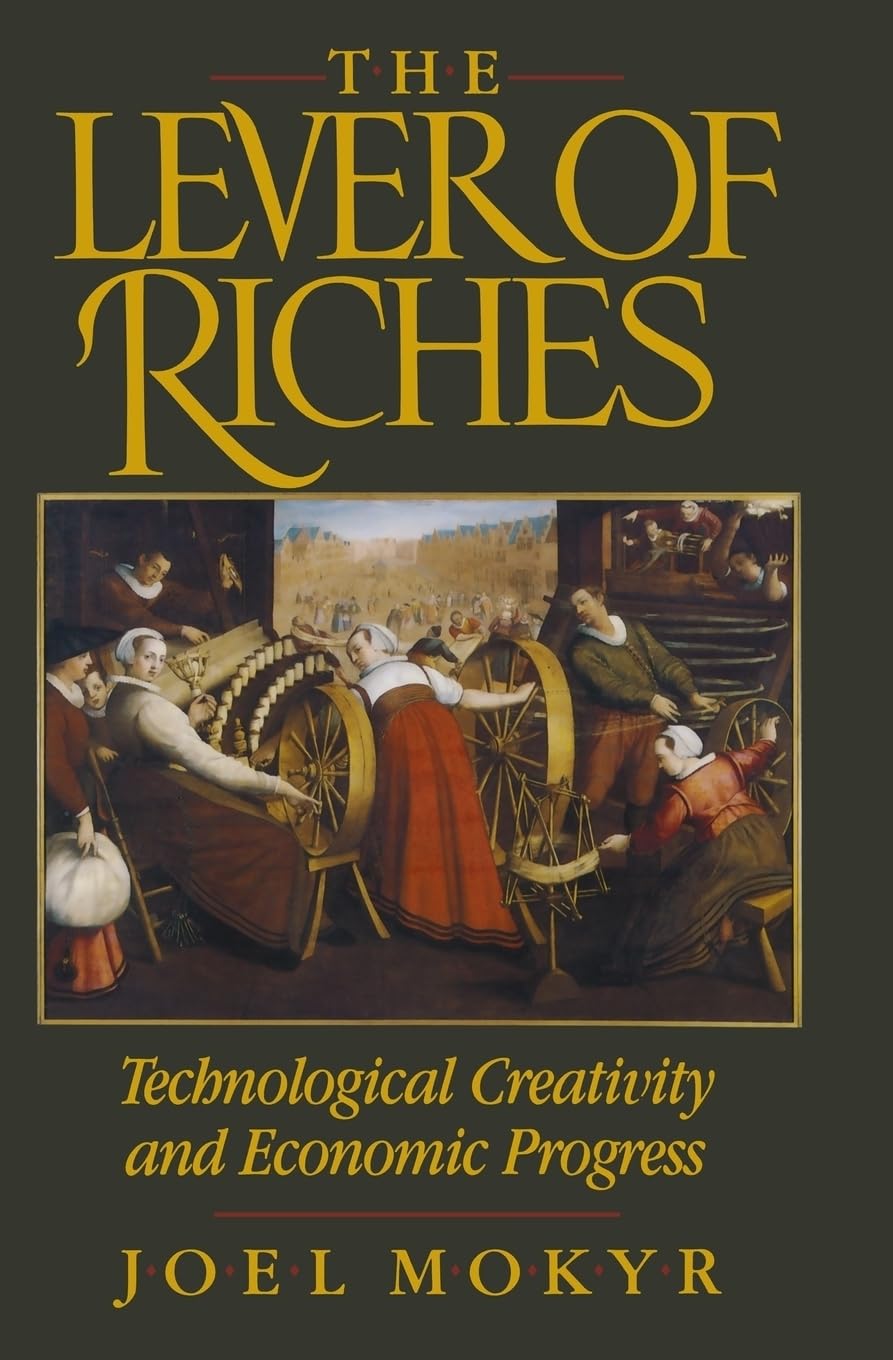
Joel Mokyr is known today primarily for his thesis that northwest Europe’s tradition of free inquiry and a culture marked by contestability and doubt is responsible for the remarkable period of technological innovation and economic growth known as the Industrial Revolution. However, in “The Lever of Riches: Technological Creativity and Economic Progress” (1990), he ultimately argues that evolutionary biology is the best model to understand technological innovation over time, particularly those of rapid change such as was experienced in the late eighteenth century. He also upholds Cardwell’s Law, which states that no economy remains technologically creative for extended periods.
In the words of economic historian Ross Thomas, “technical change is like God. It is much discussed, worshiped by some, rejected by others, but little understood.” In an effort to understand technical change, Mokyr says it is helpful to distinguish between invention and innovation. Invention is the creation of a new product, process, or idea; that is, something that didn’t exist before. Innovation, on the other hand, involves the application and development of inventions to bring about improvement or commercialization; in other words, finding new ways to improve existing inventions or applying them to new use cases. “The basic premise of this book,” Mokyr writes, “is that invention and innovation are complements.” He also argues that meaningful and sustained technological progress is historically rare and extremely fragile.
The first part of “The Lever of Riches” is a crisp review of technological invention and innovation across over two thousand years of history, broken down into five parts. The first is antiquity, a period of astonishingly little technological innovation. Besides cement masonry and the waterwheel, Mokyr says the Greeks and Romans achieved little of note. This may have been because the educated class was completely segregated from the working class, the vast majority of whom were slaves with little incentive to innovate.
Surprisingly, the Middle Ages (500-1500), including the Dark Ages (500-1150), were far more technologically innovative than the Classical period. The heavy plow and three-field system dramatically increased agricultural production. Several innovations increased the efficiency of the horse: horseshoes, the stirrup, and the modern horse collar. The windmill was developed in 1185 and rapidly spread across Europe, as did the printing press in 1453. The spinning wheel, blast furnace, and the fully rigged ship are all inventions of this supposedly backward era. Medieval technology may not have been “grandiose or extravagant,” according to Mokyr, but it was effective and led to significant improvements in food production, transportation, clothing and shelter.
The third historical period that Mokyr reviews is the “Renaissance and Beyond” (1500-1750). Innovation in this period was at first mainly agricultural, particularly improvements in husbandry that led to better-fed and more productive animals. After 1450, Mokyr says, mining operations dramatically improved thanks to “an endless succession of anonymous improvements on the margin.” But the defining feature of the period was the Age of Discovery and the author notes that discovery was propelled forward by increasingly advanced instrumentation, many of which had important spillover effects in manufacturing, such as innovations with the lathe. By the end of this period, Mokyr says that Western society had become “permeated with technology,” even though very few macro-inventions were made, and slowly began to recognize “the infinite possibilities that technology promised for human welfare.”
The final two historical epochs that Mokyr reviews are the First (1750 to 1830) and Second (1830 to 1914) Industrial Revolutions. These two chapters are over seventy pages combined. Mokyr calls the First Industrial Revolution “The Years of Miracles.” Sustained technological progress in the Muslim world ceased around 1200. Something similar happened in China in 1450 and Japan in 1600. Northwest Europe, on the other hand, would experience “accelerating and unprecedented technological change” beginning around 1750, and it has never stopped. Mokyr cites the rich diversity of progress achieved in the latter half of the eighteenth century. It was neither the Age of Cotton or of Steam, he says, but rather the age of general improvement, much of it owing to innovation and micro-inventions. These sustaining technological developments occurred across three main groups: power technology, metallurgy, and textiles.
Power technology was driven, of course, by the steam engine, “the first economically useful transformation of thermal energy (heat) into kinetic energy (work).” Invented by Savery, improved by Newcomen, transformed by Watt, and perfected by Trevithick, it took over a century of tinkering and occasional leaps of technological genius for the steam engine to eventually transform the economy. Indeed, according to Mokyr, “The gains that the steam engine provided relative to waterpower before 1850 were fairly small.”
Henry Cort’s development of the puddling furnace in 1784 and the introduction of coke (purified bituminous coal) in the smelting process transformed metallurgy in the late eighteenth century, just as the water frame, spinning jenny, and the mule transformed the textile industry during the same time period. Cotton fibers lent themselves to industrialization much better than linen or wool. The time required to spin 100 pounds of cotton dropped from 50,000 hours to 135 by the year 1800. The price of cotton cloth fell by 85 percent between 1780 and 1850. At the end of the period under review, Great Britain had over 250,000 power looms weaving cotton, but 42,000 working in wool and just 1,000 working in linen.
Mokyr emphasizes the distributed and largely anonymous nature of technological innovations during the Industrial Revolution. He thinks the “superstars,” like Watt and Trevithick get too much exposure and too much credit. “By adapting, modifying, improving, debugging, and extending earlier inventions,” Mokyr writes, “[anonymous technicians and entrepreneurs] were indispensable to the success of the uncoordinated, unconsciously joint project called the Industrial Revolution.”
After 1850, “science became more important as a handmaiden of technology,” according to the author. The late nineteenth century was a “technological avalanche” led by advances in steel and chemicals in particular, but also electricity, transportation, mass production, and food processing. Steel production was propelled forward by the invention of the Bessemer process in 1856. Classically trained chemists, often led by the Germans, developed a variety of commercially successful products, including dynamite in 1867, one of the greatest labor-saving inventions of all time. Electricity spawned a number of commercial innovations, including the telegraph, which Mokyr claims had an impact at least as large as the railroads. According to the author, “The telegraph, like the railroads, was a typical nineteenth century invention in that it was a combination of separate technological inventions that had to be molded together.” The cumulative economic impact of railroads, ocean-going steamships, electrified streetcars and subways, and the internal combustion engine are likely incalculable. More quotidian inventions, such as the sewing machine and typewriter, also had significant impact. Mokyr’s core argument is that this technological innovation and change accounted for the sustained economic growth experienced during these final two periods. “It was not caused by economic growth,” he says, “it caused it. It had no substitute.”
The second part of “The Lever of Riches” tries to explain why technological innovation happens in some societies, but not others. Mokyr immediately rejects as “clear nonsense” the notion that “necessity is the mother of invention,” the “demand drives technological innovation” argument most closely associated with New York University’s Robert Allen, one of Mokyr’s fiercest academic rivals. Based on close analysis of all eighteenth century patent applications, Mokyr says that British entrepreneurs were focused mainly on new machines that promised to save capital or improve product quality, not reducing labor costs. Rather, Mokyr says, it is far more likely that “invention is the mother of necessity” (i.e. new products generate unrecognized desires). He similarly rejects other popular explanations, such as the essential benefits of a robust patent system (“clearly not a necessary factor,” he says, and whose effect on the rate of technological progress was “ambiguous” and “decidedly mixed” and differed from industry to industry), scientific advancement, or the technological spillover effects of war (“peace, not war, was the innovating force in manufacturing”).
So then where does invention come from? The author argues that it comes from a combination of “luck, brilliance, and perseverance,” mainly in the form of talented entrepreneurs willing to absorb large risks with delayed (or possibly no) payoff. So then where do these exceptional individuals come from? Mokyr says that they most often come from healthy societies with an established culture of risk tolerance and a veneration of wealth and inventiveness. Mokyr notes that the ancient Greeks admired athletic prowess and learning while the Romans emphasized military and administrative skill, whereas eighteenth century Britain celebrated the successful entrepreneur and self made man.
If explaining invention is difficult, explaining the Industrial Revolution is almost impossible, according to Mokyr. How does one disentangle urbanization, enclosures, population growth, wars, mercantilism, industrial policy, and social change from technological innovation, and then compare the outcome with what happened elsewhere? That said, Britain did possess a few crucial advantages in the eighteenth century. One of the most important was a relatively large concentration of skilled workers, particularly in clock and watch-making. “The mechanical skills of clockmakers became one of the cornerstones of the new industrial technology,” Mokyr says. Shipping and mining also produced notable skilled labor.
Mokyr claims that Britain possessed no meaningful advantage in raw science, but did have a different kind of science, one that was more empirical and experimental than mathematical and deductive. Baconian ideas of progress were increasingly accepted by the British intellectual elite. Thus, Mokyr argues, the British excelled in the early, less sophisticated, “amateur stage” of technological innovation and commercialization.
Finally, when it comes to explaining how sustained technological innovation works, Mokyr embraces a dynamic model based on the theory of evolution. It is a model that is governed by mutation and selection, and prone to experience dramatic changes, a phenomenon known as “saltation” in the field of evolutionary biology. “Evolution,” he says, “like technological progress, is creative destruction.” It is also, he continues, closely related to an invisible hand. Mokyr evidently sees technological innovation and invention as rooted in both Joseph Schumpeter and Adam Smith. The knowledge of how to produce a good or service in a specific way is analogous to a species in biology, he says. Thus, invention (i.e. the emergence of a new technique) is equivalent to speciation (i.e. the emergence of a new species). Most attempts at invention, like mutations in species, are stillborn. Those that survive come in two varieties. Borrowing from the early twentieth century geneticist Richard Goldschidt, Mokyr differentiates between micro-inventions and macro-inventions. The former are small and cumulative changes. The latter are few and far between, but represent dramatic leaps forward. “Without macro-inventions,” Mokyr writes, “micro-inventions are likely eventually to run into diminishing returns.” According to this theory, extended periods of technological (or biological) stasis and stagnation are punctuated by periods of rapid and intensive change, such as the Industrial Revolution, which included such macro-inventions as gaslighting, the breastwheel, the Jacquard loom, chlorine bleaching, and ballooning. The problem with Mokyr’s biologically-inspired model, of course, is that it lacks any predictive power. It is a stochastic model that may help explain what happened, but not why it happened when and where it did.
In closing, “The Lever of Riches” presents a great summary of technological innovation throughout history, but is light on explanation. It is noteworthy that Mokyr never further developed his thesis that technological change is analogous to evolutionary biology. His future books, such “The Enlightened Economy” and “A Culture of Growth,” take a more deterministic approach and point to northwest Europe’s culture of free expression, inquiry, and contestability as the main drivers of technological innovation beginning in the mid-eighteenth century.
 What's Tim Reading Now?
Leave a comment