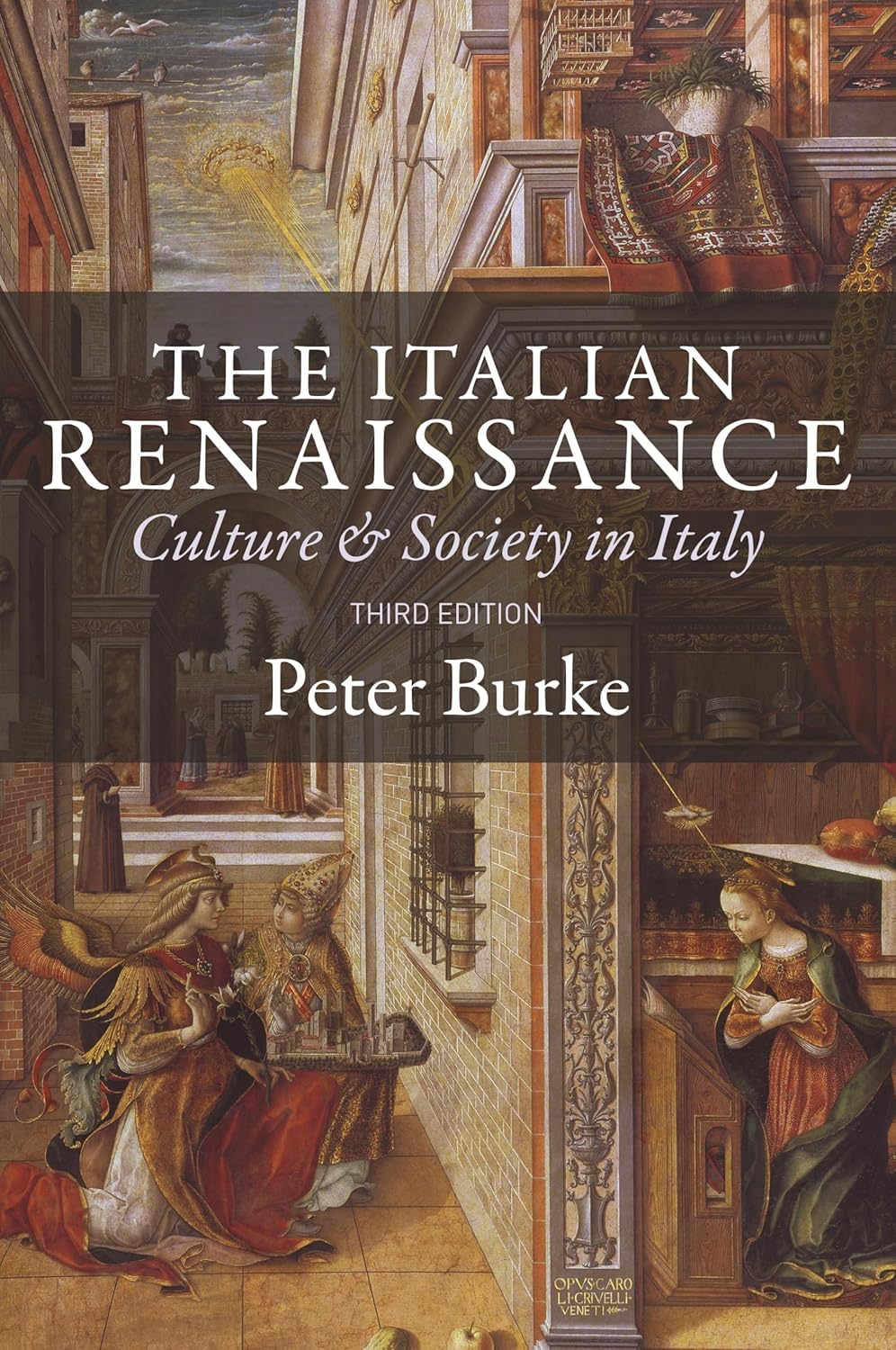
“The Renaissance movement was a systematic attempt to go forward by going back.” So writes Peter Burke in his classic analysis of cultural and social dynamics in Renaissance Italy, “The Italian Renaissance: Culture and Society in Italy” (1964). Burke takes as his point of departure “The Civilization of the Renaissance in Italy” (1860) by Jocob Burckhardt, “still the greatest historian of the Renaissance,” in his opinion. Burckhardt’s work stands as the first in a long tradition of attempts to relate culture to society. (By culture, Burke means attitudes and values and their physical expression in art. By society, he means political, economic, and social institutions and structures.)
Burke confines the cultural movement known as the Renaissance to two centuries: 1350 to 1550. He says it was driven by two distinct revolutions. The first was the commercial revolution of the thirteenth century. Italian city-states had emerged as the pivotal merchant middleman between East and West. By the late Middle Ages, northern Italy was experiencing strong economic growth and significant urbanization. By 1300, there were 23 Italian cities with a population of over 20,000, which is larger than Boston was in 1776. The population of Florence grew from 40,000 in 1425 to 70,000 in 1550; Naples exploded in size from 40,000 to 200,000 over roughly the same time period. The second revolution was philosophical: the humanist revolution, which began with Petrarch and Dante in the fourteenth century. These were the preconditions to the Renaissance, Burke says, just as urbanization, high wages, and an early consumer economy were preconditions for the Industrial Revolution of the eighteenth century. The wealth and learning of these two separate revolutions propelled society and culture forward, creating the masterworks of the Renaissance in the process.
Awareness of differences in social status was unusually acute in fifteenth century Italy. Men from different social strata performed different roles in society. According to Burckhardt, a thirst for fame was a relatively unique phenomenon that emerged at this time. Alberti famously observed “life is a regatta in which there are only a few prizes.” This was especially pronounced in Florence, where competitiveness, envy, and social mobility all flourished. Burke says, “It is no surprise to find a relatively mobile society like Florence associated with respect for achievement and also with a high degree of creativity.” This passion for fame played a central role in both artistic innovations and its fabulous patronage. Burke notes several times that architects were different from the other creative arts. To begin with, there was no professional guild of architects as there was with painters and sculptors. In fact, no one was formally trained as an architect. Other skilled artisans simply dabbled in architecture. For instance, the famed Bruneleschi was trained as a goldsmith.
Burke cites a prosopography of 600 artists from Renaissance Italy to learn more about their social and geographic origin. Almost 100 came from artisan or shopkeeper families. In just 36 cases (6%), the artist was a son of an artist, such as Raphael in Urbino or the Bellini family in Venice. At the beginning of the Renaissance, a career in the creative arts was discriminated against at the top and bottom of the social ladder. A “mechanical occupation” in retail trade and one without learning was considered beneath a well-born young Italian (although it must be recognized that Michelangelo was the son of a patrician while Massacio, Leonardo, and Brunelleschi were all sons of notaries). Therefore, Burke says that artists suffered from “status insecurity” in status obsessed Renaissance Italy. Peasant children, on the other hand, could not afford the requisite training, which involved an extensive apprenticeship in a master’s workshop, just like any other craft profession. Burke suggests that Florence emerged as a leader in Renaissance art specifically because it was a craft-industrial production center (woolens and cloth) with a high concentration of skilled artisans with weak guilds, allowing for outsiders to more easily work in the city. The author says it was only when Venice shifted from trade to industry at the end of the fifteenth century that her production of leading artists, such as Tintoretto and Titian, caught up with that of Florence.
The other important professional category in Renaissance Italy were humanist scholars. They attended formal Latin schools and one of Italy’s thirteen universities. Higher education was reserved for the wealthy. The tuition cost was 20 florins a year, enough to keep two full time servants. Burke says that Renaissance Italy involved two cultures and two systems of training: “manual and intellectual, Italian and Latin, workshop-based and university-based.” It is interesting to ask if any of these men overlapped. Did the Renaissance have Renaissance Men? That is, artist-scholars with broad talents and wide interests, from architecture to sculpting and painting to poetry. Interestingly, Burke says no. Men like Leonardo and Michelangelo, are the exception rather than the rule of the period.
The commercial success of the Italian city states generated great wealth. Some of the wealth was funneled into the arts by various groups of patrons. Artists received patronage and commissions from numerous sources, each with their own motivations. Burke says that the emergence of new kinds of patrons has played an important role in promoting the elevation and innovation of art throughout history. He cites Renaissance Netherlands and Japan during the Genroku era (1688 to 1703) as supporting examples. The author says there were really only three motivations for commissioning artwork during the Italian Renaissance: piety, prestige, and pleasure. He says there is no evidence that anyone acquired art as a speculative investment until the eighteenth century, although that is precisely what Lisa Jardine argues in “Worldly Goods: A New History of the Renaissance” (1998). Wealthy individuals or families – such as the Medici in Florence, the Sforza in Milan and the d’Este in Ferrara – played important patronage roles. “Rising families saw art patronage as a way of showing the world that they had reached the top,” Burke writes. For those with a strong humanist education along with wealth, such as Isabella d’Este, pleasure may have also been an important factor in acquiring art.
Other important patrons of the arts were economic and civic organizations. For instance, the Florentine wool guild (Arte della Lana) commissioned sculptures from Donatello and Michelangelo; the cloth guild (Calimala) was responsible for Ghiberti’s famous doors on the Baptistry of the Duomo. Religious fraternities played similarly outsized roles in commissioning masterpieces, such as Leonardo’s “Virgin of the Rocks.” Burke says that the importance of these organizations is that they enabled the participation in patronage of people who couldn’t afford it on their own. Another kind of corporate patron was the state. The Florentine government, known as the Signoria, commissioned significant works from Leonardo (“Battle of Anghiari”) and Michelangelo (“Battle of Cascina”), while Giovanni Bellini and Titian both held the quasi-official role of Protho (painter to the Venetian Republic) and made major contributions to the Hall of the Great Council in the Doge’s Palace.
These patrons played a large role in defining the artwork they would receive. In fact, the details of the commission would be spelled out in an official contract that established several important points concerning the creation of the art-object, including: 1) materials to be used, especially the use of expensive pigments; 2) price to be paid, including the form of currency; 3) delivery date, 4) dimensions of the piece; 5) assistants to be used (or not used); and 6) the specific contents of the picture. By the late fifteenth century, when the status and prestige of certain artists grew considerably, the balance of power between the patron and artist began shifting in the artist’s favor; they were consequently allowed more creative freedom in their work. Moreover, by the sixteenth century, particularly in Venice, there emerged a market for ready-made art, such as woodcuts or engravings of popular images or scenes like the Virgin Mary, the Crucifixion, and St John the Baptist.
Burke stresses that “work of art” is a modern concept. Renaissance Italians did not regard these art-objects the same way we do today – as priceless masterpieces. More often than not, they were viewed as religious objects, and often expendable ones at that. Many works of art had a thaumaturgic function (i.e. performed miracles). For instance, it was believed that an image of the Madonna or St Sebastian could serve as protection against the plague; it’s even been argued that Botticelli’s famed “Primavera” (1482) may have been a talisman. Religion played a dominant role in society – roughly 10% of the population of Florence was a priest, monk, friar, or nun – and religious fraternities and the festivals celebrating the city’s patron saint (St John the Baptist for Florence and St Mark for Venice) were central to society. Religious artwork was important too, and it fulfilled an educational purpose. In a world where the vast majority of the population was illiterate, Biblical lessons and Church doctrine could be illustrated in paintings and frescoes, such as Botticelli’s “Punishment of Korah” (1482) in the Sistine Chapel, which was commissioned by Pope Sixtus IV. Finally, art was often mobilized in an attempt to persuade the public, the Renaissance version of high production value political campaigns, such as Massacio’s fresco “The Tribute Money” (1425) painted in the Brancacci Chapel in Florence that encouraged locals to pay their taxes. Finally, there was a market for portraiture, especially for notable merchants and their marriageable daughters. Burke says that the value of art appreciated significantly during the Renaissance, but it never reached the modern idea of “art of art’s sake.” In many ways, Renaissance art remained “function over form.”
Next, Burke says that “Posterity looks at [Renaissance art] through the keyhole.” In order to better understand these works of art it is critical, he says, to examine the unique Renaissance taste in visual arts. He says that patrons and artists alike valued certain evaluative clusters of terms. First, they placed heavy emphasis on naturalism over idealism, a perspective exemplified by Georgio Vasari’s comment that the Mona Lisa’s mouth “appeared to be living flesh rather than paint.” Second is order over grace. There was a belief, at least in the early years of the Renaissance, that beauty follows rules, and those rules involve symmetry. Burke says that beauty that cannot be reduced to formulas or rules is “grace.” Grace is something spiritual, subjective, and impossible to define; today, it is often associated with Raphael (1483-1520). Third, richness is valued over simplicity. Richness is associated with a cluster of other terms, such as variety, grandeur, and splendor. Burke says that Ghiberti’s Baptistry doors are a good example of the Renaissance concept of richness. Finally, patrons and artists all admired skill, particularly the deliberate and successful overcoming of complex visual challenges. Burke concludes that the vocabulary used to appraise art during the Renaissance shows “a change in taste from the natural to the fantastic [i.e. Mannerism] and from the simple and modest to the complex, difficult, and splendid.” Overall, Burke says that a crude formula for Renaissance taste could be written as follows: “beauty = nature = reason = antiquity.”
We know the subject of over 2,000 Italian paintings from the years 1420 to 1539. The vast majority of them (87%) have religious themes; only a small minority (13%) are secular. Among the religious themed paintings, half represent the Virgin Mary, a quarter show Jesus Christ, and the rest are dedicated to a wide range of saints, a hundred in total, with St John the Baptist, St Sebastian, and St Francis representing the top three most featured saints.
The general worldview of Renaissance Italy also directly and materially influenced art. Burke says that things like astrology, alchemy, witchcraft, and magic were taken very seriously. For instance, the period 1450 to 1536 was the high point of recorded visions of the Virgin Mary in Italy. Fifteenth century Italians saw a divine symmetry in the world around them: there were seven planets, seven metals, and seven days of the week. Early Renaissance art reflected that belief in balance.
Before the Portuguese established an alternative trade route to the East around Africa, Venice was the principal middleman in the trade between Europe and Asia. At its peak in 1500, 2.5 million pounds of spices came to Venice from Alexandria alone, while exporting 10 million ducats worth of goods every year. “Art and ideas often follow the trade routes,” Burke writes, and it was certainly true of Venice.
In the early fifteenth century, Florence and Milan were engaged in a mortal struggle for dominance in northern Italy. The humanist scholar Leonardo Bruni depicted this interstate struggle as a contest between liberty (Florence) and tyranny (Milan). Burke claims that the idea that a “crisis of liberty” successfully surmounted can be a stimulus to the arts can be found throughout history, such as ancient Athens after the defeat of the Persians (490 BC) and Shakespearean England after the defeat of the Spanish Armada (1588). Early fifteenth century Florence consciously cast herself in the image of classical Athens and Republican Rome. These themes were depicted in the art and architecture produced during the period by such notable artists as Brunelleschi, Ghiberti, and Donatello. Indeed, Burke says, “Brunelleschi and Donatello were stimulated by civic patronage, and civic patronage was stimulated by the crisis [with Milan].” This thesis is often attributed to the German-American scholar Hans Baron and this classic history “Crisis of the Early Italian Renaissance” (1955), although the argument that liberty drives commerce, while commerce drives culture has been around since at least the Enlightenment (1685 to 1815).
Burke writes that there were four pivotal years in the history of the Renaissance that fundamentally shaped Italian society and culture. The first is 1402, when the Florentine’s successfully resisted the seemingly unstoppable momentum of the Milanese under the Visconti. Second is 1453, when the fall of Constantinople to the Turks forced an entire generation of Greek scholars to flee westward, bringing with them knowledge of the Greek language and history, and stimulating the revival of classical learning. Third is 1494, when Charles VIII of France invaded the Italian peninsula and conquered the city states of Naples, Florence, and Pisa. An entire generation of Italian scholars, led by Machiavelli, were left to ponder and explain the disaster that had struck them. Finally, in 1527, Holy Roman Emperor Charles V sacked the city of Rome, “the greatest disaster to happen to the city since its sack by Alaric and the Visigoths over 1,100 years earlier,” according to Burke. “The sack put an end to the cultural dominance of Rome,” he says. The 1520s were harsh for the Italians – a “time of troubles” it was called. Perhaps unsurprisingly, art changed along with the times. The classic Renaissance rules of perspective were broken in a new form of artistic expression known as “Mannerism.”
By the end of the Renaissance period (1550 to 1600) a number of trends were apparent in retrospect. First, regional differences in artistic styles were erased and replaced with class distinctions. Second, artists separated themselves from the main body of craftsmen and established their own academies and institutions. Third, the social origin and social status of artists consequently improved dramatically. Finally, art continued to become more and more secular. “In 1400, the social status of art was low, and so were the social origins of artists; each factor helped explain the other,” Burke writes. “By 1600, however, the status of art and the origin of artists had risen together.”
The Italian Renaissance economy was also changing. Burke suggests that by the late sixteenth century there was a “refeudalization” of the economy. The Portuguese, English, and Dutch had cut the Italians out as the middlemen in the lucrative Asian spice trade. Wealthy families shifted their investments from trade and entrepreneurial endeavors to land. Furthermore, the sons of great merchant and banking families became enervated by their humanist education. Burke writes, “[Italian patricians] changed from being entrepreneurs to rentiers; from having a dominant interest in profit to a dominant interest in consumption.” The quantity and quality of art produced in Italy fell in the seventeenth century as demand for Italian artists across Europe led to a “brain drain” from Florence, Venice, and Milan.
 What's Tim Reading Now?
Leave a comment