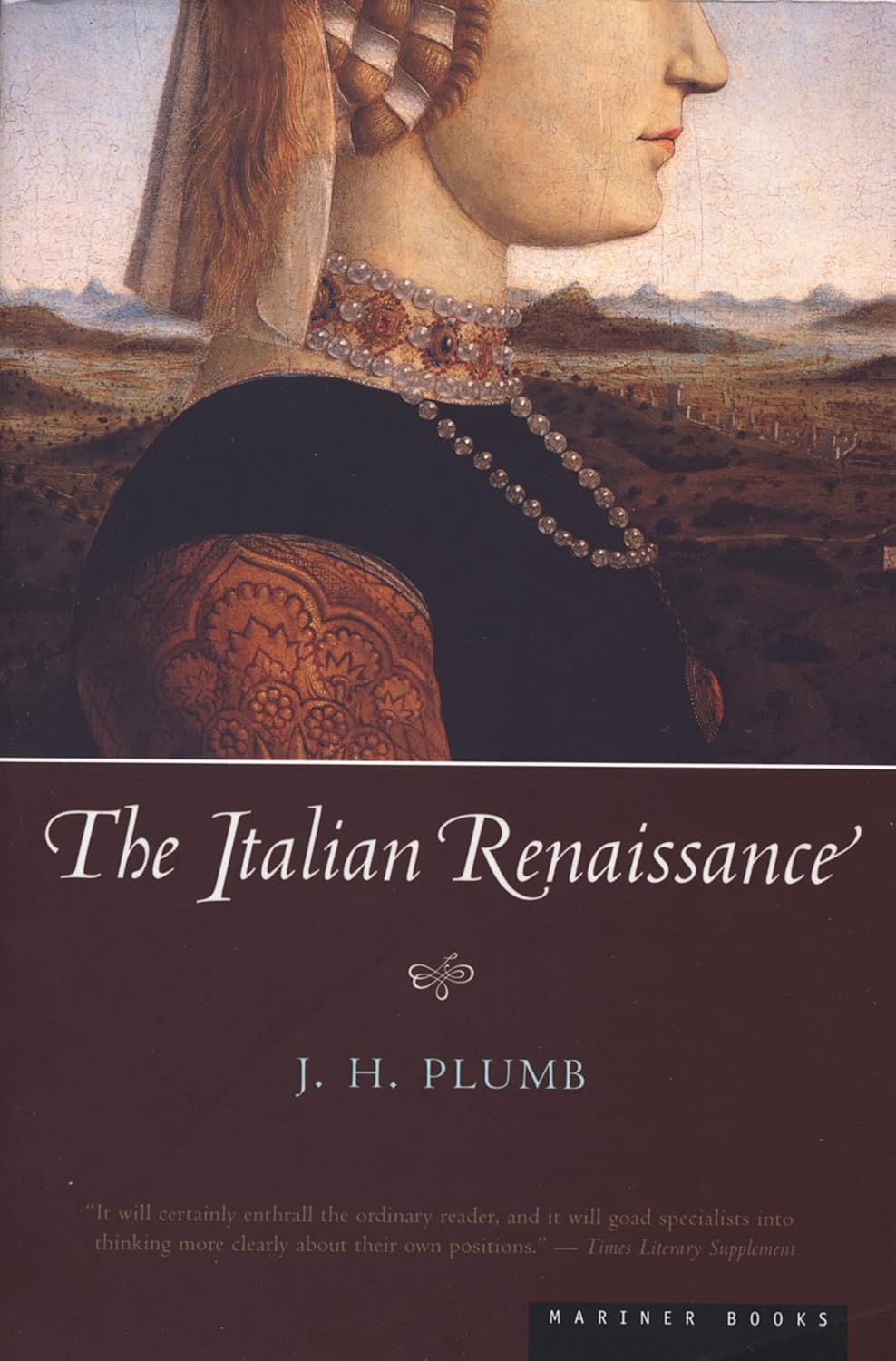
I’ve recently learned that there aren’t many stellar and readable general overviews of the Renaissance. This one, “The Italian Renaissance” by J.H. Plumb (1961), was first published over half a century ago. However, the fact that a new edition was printed in 2001 speaks volumes for the book’s quality, accessibility, and enduring relevance.
“The Italian Renaissance” is broken into two parts. The first includes ten chapters on thematic topics related to the period: government, art, the role of women, and urban profiles of the four leading cities of the Italian Renaissance (Rome, Florence, Milan, and Venice). Part two is a collection of nine biographical vignettes written by contributing authors focused on prominent Renaissance figures, some world famous (Leonardo, Michelangelo, Machiavelli, Petrarch), others more obscure (Doge Francesco Foscari, Federigo da Montefeltro, Isabella d’Este).
Part one begins with the foundational elements of Renaissance society. The early medieval world (500 to 1000 AD) was one of three classes of people: peasants, priests, and warriors. Sometime around the eleventh century a new class of person emerged and ultimately disrupted the entire system: the merchant trader. “Trade, high finance, a largely and partially urbanized population, quickening industry, the absence of a deeply rooted all-powerful political structure – all of these were seminal,” Plumb says. Just like with the Industrial Revolution some two centuries later, the Renaissance would be born of and propelled by ideas. The works of Aristotle were first recovered in the twelfth and thirteenth centuries, forming the intellectual foundation of the burgeoning movement known as humanism. The urban centers of Renaissance Italy would come to revere antiquity, “its wisdom, its grace, its philosophy, and its literature.” Familiarity with the classics – most notably Plato, Aristotle, and Cicero – became “the hallmark of civility,” according to Plumb. The Renaissance, fueled by massive amounts of global trade-generated wealth, ultimately funded artistic expression, intellectual inquiry, and social attainment. “Its ideas and its achievements ran like an ineradicable dye through the fabric of Europe,” Plumb writes, “and its monuments have become a part of the world’s heritage.”
In addition to commerce, warfare was also endemic to the fifteenth century Italian peninsula. Success often depended on the conspicuous display of power and wealth. Increasingly, sumptuous palaces and brilliant works of art – especially tapestries, sculpture, and paintings – became prerequisites for ambitious princes. This competition between rival cities and their rival ruling families propelled the Renaissance forward as the practice and patronage of art became a source of both civic virtue and interstate competition. Again, the parallels between the Renaissance and the Industrial Revolution are many. Money and social capital was poured into art in a way that rivals the mid-nineteenth century’s capital investment in technology. The amazing originality of Donatello’s “David” gave birth to a new age of art in a way analogous to Watt’s introduction of the modern steam engine that gave birth to a new age of industry..
The vast merchant wealth generated by Renaissance Italy funded the traditions of modern Western art: perspective, the use of oils, highly developed landscapes and realistic human bodies. “They pursued physical beauty like a drug,” Plumb writes. Not everyone loved it. In the 1490s a disgruntled Florentine Dominican friar named Savonarola took aim at the libertine excesses of the Renaissance. Plumb says that Savonarola seriously crippled the art movement in Florence before he was executed in 1498, and contributed to its steady decline in the first decades of the sixteenth century as new world colonies, alternative ocean routes to the spice islands, and the loss of the cloth trade to the English all combined to diminish Florence’s wealth, power, and artistic influence. “Florence still produced an astonishing array of genius,” Plumb writes, “and no city of so small a compass has ever, before or since, made a greater contribution to art and letters within the brief span of a hundred and fifty years.”
Meanwhile, in the duchy of Milan, the dictatorships of the Visconti and the Sforza were “the prototype of the Renaissance prince,” Plumb says, “scholarly, remote, and dedicated to the pursuit of power.” A city of vast wealth, Milan was never able to achieve the relative stability of a Florence or a Venice. In the end, Plumb says, the duchy of Milan was much like the unfinished horse that Leonardo never completed for Ludovico Sforza: “conceived in grandeur, executed in clay, never cast, ruined by the French, destroyed by time.”
Rome, on the other hand, was the center of the western world in the fifteenth century and it was ruled by wealthy and venal emperors known as “popes.” They were corrupt and sometimes violent, but Plumb tells us that they were much more than that: “Renaissance popes were worldly men, pragmatic, tough, concerned with power.” They also built the greatest library and architecture in the Western world. The pope’s vast wealth also underwrote and directed some of the greatest artistic masterpieces of all time, including two of Michelangelo’s greatest masterpieces: the ceiling of the Sistine Chapel (1512) and La Pietà (1499). By the sixteenth century, Rome had established itself as the “embodiment of the arts, if not the spirit, of the Renaissance.”
Finally, there was Venice, the greatest market of the Western world and world renowned for its manufacture of books (over 200 printing presses by 1500), glass, mosaics, lace, and silks. In comparison to the other Italian Renaissance city states, Venice was “truly cosmopolitan,” Plumb says, “a mixture of paganism, Christianity, and Oriental splendor … a city of extravagance, urbanity, and sophistication, an aristocratic Bohemia in which the future was forgotten in the day’s delight.” Small wonder artists like Bellini, Titian, Carpaccio, and Tintoretto were drawn there. The Doge, Republican Venice’s modern dictatorship, played a patronage role similar to that of the pope in Rome (or Medici and Sforza in Florence and Milan). Nowhere else did the spirit of the Renaissance permeate daily life so deeply. Indeed, Plumb says “the Renaissance settled on Venice like a golden haze, sweetening life, softening the edges.”
The Renaissance, of course, also had its version of the Renaissance Man. The tastes and style of the era were defined largely by two men: Baldassare Castiglione (“the archpriest of manners”) and Pietro Aretino (“the first Bohemian”). They defined the terms for what it meant to be a gentleman in the fifteenth century, what fields of knowledge one had to be proficient in, the necessary style of one’s clothes or language, even which sports a gentleman could respectfully engage in (fencing, wrestling, horsemanship, and swimming). In all cases, Plumb writes, “ease, grace, nonchalance, nobility must shine through.”
Once it crossed the Alps, Plumbs says, the spirit of the Italian Renaissance “was diverted into new channels, plunging from the broad, sunlit meadows of secular delights into the dark ravines of religion.” The famed Dutch scholar Erasmus was the pivotal link between Italian humanism and the Reformation, a connection best exemplified by his best selling satire, “The Praise of Folly” (1511). For the Italians, discovery meant recovering the past in the art and history of their ancient Greek and Roman ancestors; for the French and Spanish and English discovery also meant something new – new worlds and new ways of thinking and worship.
The biographical vignettes in Part Two are the most satisfying chapters in the book. Plumb’s co-authors offer sharp and insightful perspectives on men (and the occasional woman) who shaped the Renaissance, men like Petrarch (1304-1374), who may be considered the Founding Father of the Renaissance, yet is little remembered today outside a brief mention in high school AP Western Civ textbooks.. Essayist Morris Bishop writes that Petrarch was a first in many ways. He was the first modern man, with an innate love of beauty and knowledge. He was also the first modern scholar, humanist, and philologist, the chief reviver of ancient learning. Petrarch liked to say that Cicero was like his father and Virgil like his brother. In a more pedestrian vein, he was also the world’s first tourist – he traveled all over Europe and even climbed mountains, all for the sheer pleasure of it, a true novelty at the time. Petrarch was the first modern celebrity intellectual, first as a poet and then as a moral philosopher. His “Letters to Posterity” (1370) was the first modern autobiography. Petrarch’s worldview became marked by skepticism and doubt, a perspective that would go on to shape the Renaissance and then utterly dominate the Enlightenment.
Garrett Mattingly provides a gem of an essay on Niccolo Machiavelli (1469-1527). He observes, rather ironically, that the infamous Florentine political advisor was the least Machiavellian of men. Machiavelli, he says, was blunt to the point of tactlessness and incapable of concealing his emotions. He was prone to wishful thinking and was easily deceived. Machiavelli was a devoted and unselfish servant to an ungrateful Florentine republic for fourteen years. “His whole public career was a testimony to the inaccuracy of his own cynical maxims,” Mattingly writes. Machiavelli’s most famous book, “The Prince,” was first published in 1513 and was meant as a “handbook for tyrants” for the returning Medici family. Machiavelli saw politics as an unforgiving jungle, a no-holds-barred winner-take-all competition. Men, he claimed, are “selfish, treacherous, cowardly, greedy, and above all, gullible and stupid.” Leaders should respond with “hypocrisy, cruelty, and deceit.” Machiavelli’s core message that there were no rules of ethics in international politics and the only test was success. It is a worldview that has defined the realist school of international relations ever since.
“The Italian Renaissance” takes a close look at only two great artists: Leonardo da Vinci (1452-1519) and Michelangelo (1475-1564). Leonardo was daringly original. For him the Renaissance was more about discovery than recovery. Author J. Bronowski says that Leonardo left his native Florence for Milan because his hometown was too hidebound by tradition. His passion was for the details, especially those found in the structure and mechanisms of nature. Michelangelo, on the other hand, was “the most concentrated and undeviating of great artists,” according to Kenneth Clark. He was precocious and uncompromising. A passion for anatomy and a consciousness of sin define his art, Clark says.
Plumb and company also profile four merchant princes of the Renaissance: Doge Francesco Foscari of Venice (1373-1457), Pope Pius II (1405-1464), Federigo da Montefeltro of Urbino (1422-1482), and Lorenzo de Medici of Florence (1449-1492).
Doge Foscari held the longest ducal reign in the history of the Venetian republic – 34 years (1423-1457). Chapter author H.R. Trevor-Roper says that the years under Foscari can be summarized in three words: pageantry, war, and dissension. It has been said that the great Doge diverted the attention of Venice from the East to the West. He ruled through climactic events, including the sack of Salonika in 1430, the arrival of the plague in 1438, and the fall of Constantinople in 1452. He made Venice into the dominant power of mid-fifteenth century Italy – and then was tossed aside by his jealous and ungrateful countrymen.
Pope Pius II was not technically a merchant prince, but he was absolutely a gentleman of the Renaissance, according to Iris Origo. “A shrewd statesman, an elegant humanist, an inquiring traveler,” she writes, Pius II was “witty and urbane, skeptical and adaptable,” hardly the profile of the gluttonous and nefarious pontiff so typical of the era. Born Aeneas Piccolomini in a small village in Tuscany, he would not become a priest until he was 43 years old. His ascension to the top of the Catholic hierarchy was dizzyingly rapid. He was anointed Pope Pius II in 1458 after just eleven years as a man of the cloth. He would serve just six years until his death in 1464. Origo says that Pius II was everything a Renaissance man should be – eloquent, scholarly, stylish, and versatile. He is perhaps best known for his unsuccessful attempts to unify Christian resistance to the encroachment of the Ottoman Turks and his celebrated autobiography, known as “Commentaries.”
Next, there is Federigo da Montefeltro, who it is said represented the best of his age. He created the standards of art and manners in Urbino, the native city of Raphael and Bramante. He ruled Urbino for 38 years (1444-1482) and was the greatest of the Montefeltro dynasty, according to writer Denis Mack Smith. Federigo set himself apart from his peers for all the right reasons. He was honest, trustworthy, just, and humane. He was also relatively modest and kind hearted, attributes not typically associated with Italian Renaissance princes. Indeed, “the benevolence of Federigo’s despotism was famous throughout Italy,” Smith says. During Federigo’s reign Urbino became “the light of Italy,” the civilization of the Renaissance at its most admirable,” according to Smith, a celebrated center of culture that attracted men of talent from all over Europe.
Finally, no great Renaissance merchant prince tied their power and wealth so inseparably from that of their city-state than Lorenzo de Medici. “Lorenzo the Great,” as he was called, used his victory in the Pazzi Conspiracy of 1478 (which author Ralph Roeder calls “formidable in its folly”) to cement his grip on Florentine politics and ultimately on the extravagant patronage of the arts, an endeavor in which Lorenzo “set the pace” for the rest of Italy in the late fifteenth century. “Artists flocked to Florence from far and near,” Roeder writes, “attracted by the magnetic name of Lorenzo de Medici.” Savonarola would ultimately complete what the Pazzi could not.
In closing, J.H. Plumb’s “The Italian Renaissance” is a dated, but easy and enjoyable read that provides a pleasant, albeit limited introduction to the Renaissance era of the fifteenth and sixteenth centuries.
 What's Tim Reading Now?
Leave a comment