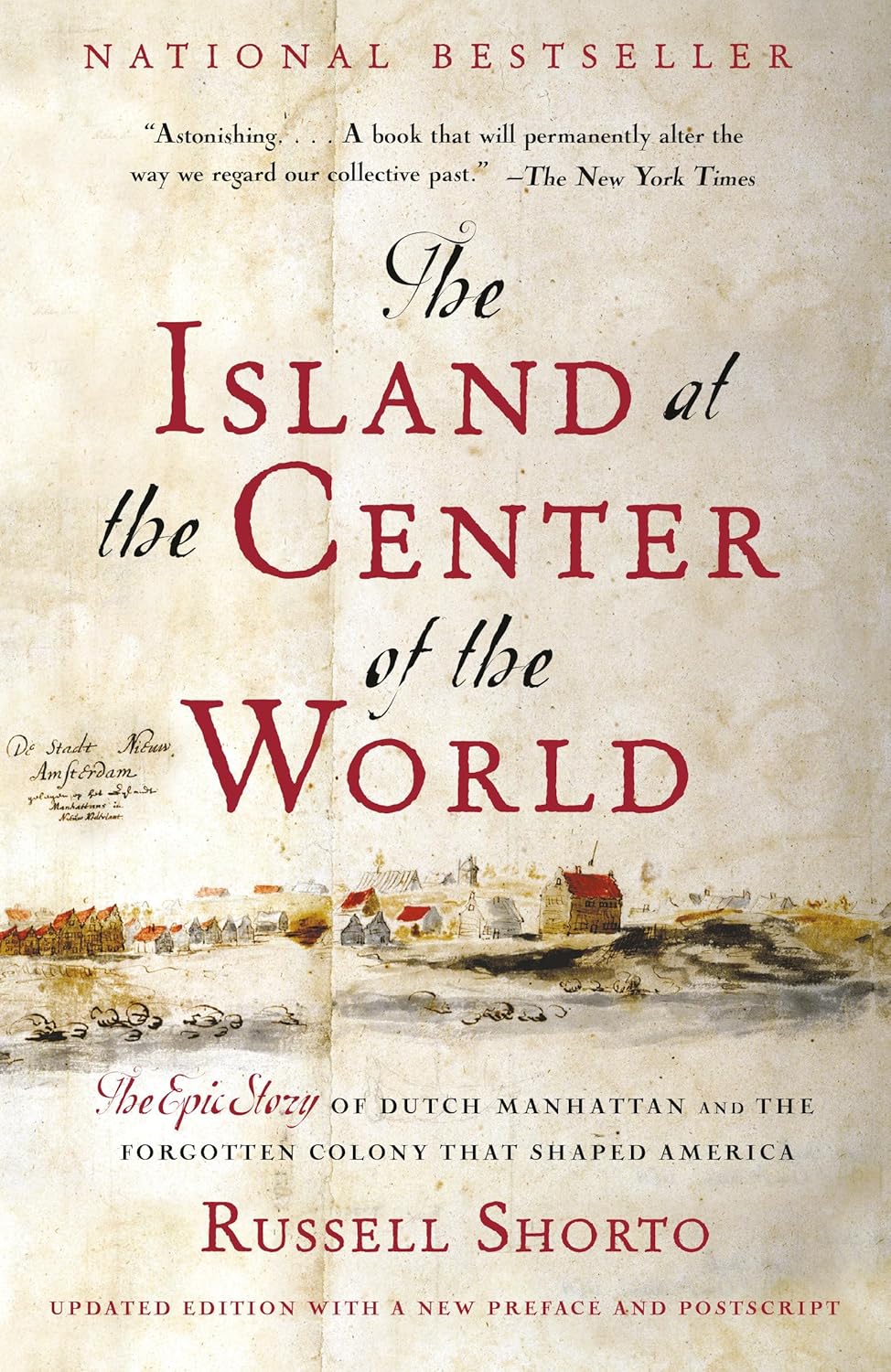
The North Atlantic maritime powers of the sixteenth century were determined to break the stranglehold that Spain and Portugal had on the trade routes to Asia in the southern hemisphere. They were convinced that there was a northwest passage along the northeastern seaboard of North America. It was just a matter of finding it. Roughly a century after Italian Christopher Columbus and the Portuguese Ferdinand Magellan made major discoveries in the service of the Spanish Crown, the Englishman Henry Hudson would do the same for the Dutch Republic. “The Island at the Center of the World: The Epic Story of Dutch Manhattan and the Forgotten Colony That Shaped America” by Russell Shorto (2004) provides a remarkable narrative history of New Netherlands and how Dutch culture left an indelible impression on what would become New York City and the future United States of America.
In a series of “bold, brilliant, and majestically misguided voyages,” Shorto says, Hudson stumbled upon the most strategically important natural harbor and inland waterway in all of North America, known today as New York City and the Hudson River. “The English and the Dutch colonies [in North America] represented the extreme conservative and liberal wings of the seventeenth century social spectrum,” the author claims. The Pilgrim’s story was “simpler, less messy, and had fewer pirates and prostitutes to explain away,” he says. New Netherlands, on the other hand, was “the first multiethnic, upwardly mobile society on America’s shores” (one quarter of the buildings on Manhattan were dedicated to making and selling alcohol). Immigrants to New England were intolerant religious fanatics looking for the proverbial righteous “city on a hill.” Immigrants to New Netherlands, meanwhile, were “a colorful collection of losers and scalawags,” Shorto writes, ”inconsequential and meandering, waiting around for the winds of fate to flow them off the map.” By the middle of the seventeenth century New Amsterdam had approximately 400 residents speaking 18 different languages. It was the first true melting pot in the New World and emplanted a “cultural sensibility that included a frank acceptance of differences and a belief that individual achievement matters more than birthright.”
The Dutch republic in the seventeenth century was the most politically progressive and culturally diverse anywhere in the western world. It would give shelter to religious radicals, such as the English Pilgrims and controversial philosophers, such as Rene Descartes and John Locke. Moreover, the Dutch were, in Shorto’s estimation, “Regular Guys.” They worked hard, lived modestly, were tolerant of different religions and odd balls, and spurned monarchy and nobility. Indeed, it was all very “American,” and Shorto says that Hudson inadvertently carried that progressive cultural Dutch gene to the New World in 1609, the same year that the Pilgrims fled England for the city of Leiden in the Netherlands. Hudson ultimately discovered three major American rivers: Delaware (known as South River to the Dutch), Hudson (North River), and Connecticut (Fresh River). “[Hudson, the explorer] was destined to serve as a pollinator,” Shorto says, hammering home his point, “to bring the spores of a culture not his own to new soil.”
But Hudson isn’t the hero of Shorto’s story. Far from it. In fact, Hudson quickly fades from the narrative after mutineers set him adrift on the icy waters of Hudson Bay in 1611. Rather, a young Dutch attorney by the name of Adriaen Van der Donck emerges as the hero of Shorto’s adventure tale. He was “an early American prophet,” according to the author, but remains largely forgotten today despite playing a critical role in the political and economic development of what would one day become New York City. The idealistic young Dutch lawyer was “the man who first saw the promise of Manhattan Island, dreamed its future, and devoted his life to making the dream real,” Shorto says.
He went to work for the prominent Amsterdam diamond merchant Kiliaen van Rensselaer right after graduating from law school. Rensselaer had purchased a semi-independent fiefdom that surrounded the West India Company’s Fort Orange, a fur trading post located on the Hudson River in the vicinity of modern day Albany. Rensselaer’s domain was a colony-within-a-colony and the young Van der Donck was expected to bring law and order to the sprawling domain, serving as a combination of county sheriff and district attorney. Rensselaer quickly discovered that his young attorney on the scene was all but uncontrollable.
The Dutch East India Company was founded in 1602 to extract fabulous profits out of Asia. It did so mainly by setting up trading posts at strategic locations and letting natives come to them. Thus, the Dutch empire in the East was a successful chain of outposts and forts rather than settlement colonies. Leaders in Amsterdam were confident that the new West India Company, founded in 1621, could replicate that success along the Atlantic Rim. The goal was to establish a monopolistic stranglehold on the so-called Triangle Trade, the circular commerce traveling clockwise from West Africa to the Caribbean and then coastal North America before heading back to Europe. It was a brutal business and the company’s principal objective, at least at first, was to make money from battling the Spanish across the New World.
At first, furs were New Netherland’s entire reason for existing. Beaver felt hats were the fashion rage all across Europe in the early seventeenth century. The hats were incredibly expensive, costing at least three months wages for a typical laborer. In 1625 alone Dutch colonists shipped back 5,295 beaver pelts and 463 otter skins. By mid-century an astounding 80,000 beaver pelts a year passed through Manhattan. But furs weren’t the only source of riches in the West. In 1628, West India Company privateers under the command of Piet Heyn ambushed the Spanish treasure fleet off of Cuba and captured twelve million guilders worth of gold and silver. Yet, somehow, the West India Company was failing.
Relations with the indigenous peoples of the area were complex, shifting, and often violent. Shorto is quick to point out that the Native Americans were not placid rubes easily exploited by the odious Europeans. He writes: “The Indians were as skilled, as duplicitous, as capable of theological rumination and technological cunning, as smart and as pig-headed, and as curious and as cruel as the Europeans who they met.” In August 1641 a callous murder in New Amsterdam followed by a short-sighted and ham-fisted response by the West India Company put the colony into a tailspin.
A garrulous old Dutchman named Claes Swits was beheaded with an ax in his own home in Manhattan by a local Indian he knew and trusted. Willem Kieft, the autocratic Director of New Netherlands from 1638 to 1647, responded with indiscriminate brutality. For several years, the West India Company director led a bloody campaign of near extermination against the indigenous tribes of the lower Hudson Valley in an uncoordinated string of operations known collectively as “Kieft’s War.”
Shorto says a critical and pervasive misunderstanding between the two alien cultures involved different ideas of land ownership. Native Americans had no sense of permanent yet transferable ownership of land. Rather, it was their customer to offer ongoing access to land in exchange for a defensive alliance and gifts, with the land being shared between the two parties. Therefore, when the Indians accepted $24 worth of beads and trinkets for Manhattan, they believed they were entering into a defensive alliance with the technologically advanced Europeans against hostile indigenous tribes in the area and agreeing to allow the Dutch to use the land for the time being. The Indians who “sold” Manhattan to the Dutch fully intended to continue to use the land themselves, and they did. Shorto says that the Indians were “far from guileless dupes” and got as much out of the deal as they gave.
From the very beginning, New Amsterdam (Manhattan) was a business settlement, a company town whose inhabitants were “serfs working at the behest of a multinational company,” Shorto says. There was no civil government to speak of and very few civil rights. By the 1640s the West India Company was floundering and New Netherlands was on the verge of dying out. It was a pluralistic, tolerant republic, Shorto says, but only in the most negative ways. Then the company made a fateful decision: the company gave up on its monopoly over trade in the region and declared New Netherlands a free trade zone, with New Amsterdam the “stable port” through which all trading ships would be cleared and taxes assessed. Shorto says the effect was “electric.”
By the seventeenth century, it was clear that England and the Netherlands, Europe’s two foremost Protestant countries, were also global empires-in-the-making, with the Dutch well in the lead, controlling both the most strategic spice islands in the East Indies and what looked to be the linchpin to the continent in North America. The Dutch dominated trade in some of the most valuable commodities of the day: spices, cotton, indigo, silk, sugar, copper, coffee – and human beings. Moreover, the Dutch were clearly not afraid to throw their weight around. In 1623 the Dutch massacred English traders on the East Indian island of Amboyna, an event that lived on in English collective memory for decades. King Charles I responded with a claim of ownership of all of North America owing to John Cabot’s first landing in Newfoundland in 1497. Shorto calls this line of reasoning an “absurdity” and a “magic wand approach” to international colonial domination. For their part, the Dutch weren’t buying it; in their view the rightful claimant needed to occupy and chart the acquired land. But the Dutch stopped short of articulating a strategic and coordinated plan of empire. The English would not stop short.
Oliver Cromwell was the founding father of British imperialism with his “Western Design,” but it was James who Sporto says “saw the magic in Cromwell’s idea of an English empire.” The author says that the development of the British Empire in the western hemisphere was all “quite calculated” and can be traced to a few meetings among a few men in 1661 and 1662. They saw the enormous economic and military value of possessing vast tracts of North America. However, they had little faith in the Puritan leadership that had developed the New World colonies in the name of the Crown. They also saw that the Dutch West India Company was woefully mismanaged and under funded, and thus a target. The British began by wresting control of the Dutch slave trading ports along the Guinea coast of West Africa, an action led by the new and colorfully named Company of Royal Adventurers Trading in Africa (later known as the Royal African Company) which would go on to be the single largest shipper of slaves to the New World.
New Netherlands lacked many things: a clear strategy; a strong leader; a system of justice. It also lacked attention. The Dutch stumbled upon and claimed arguably the most strategic point in the western hemisphere and never really knew it. The fabulous natural harbor at New Amsterdam was “always an afterthought,” Shorto says. It was just a cog in the huge wheel of commerce that spun from Amsterdam to West Africa to Brazil to the Caribbean to New Amsterdam before heading back to the original point of departure. The sugar cane fields of the southern colonies were more profitable than the furs and tobacco of the north. New Amsterdam was also viewed early on primarily as a staging area for raids on Spanish treasure ships coming from South America and the Caribbean. Establishing a thriving culturally Dutch community on the western shore of the Atlantic was the furthest thing from the minds of the directors of the West India Company.
The Spanish, French, Dutch, and even the Swedish came to North America to exploit. Only the English came to exploit and colonize. In roughly the year 1630, Virginia was far and away the largest European colony in the New World with 1,275 English settlers. There were about 300 English Pilgrims at Plymouth and 500 English Puritans in Massachusetts. In the mid-Atlantic, New Netherlands had 270 colonists, both Dutch and other Europeans of various ethnicities. Even now largely forgotten New Sweden along the Delaware River numbered perhaps one hundred (For seventeen years, in a “queer, little-known sidebar to history,” according to Short, the Swedish maintained a permanent trading presence along the Delaware River.). Quebec, meanwhile, languished with just 55 colonists.
The English Civil War (1641 to 1652) was largely a religious war and the chaos it caused allowed the four colonies of New England (Plymouth, Massachusetts, Connecticut, and New Haven) to govern themselves largely as they each saw fit for over a decade. Moreover, the English Civil War also caused a major disruption to English shipping. English tobacco farmers in Virginia and English fur trappers in New England were forced to use New Amsterdam as their primary distribution hub. By mid-century Manhattan was clearly emerging as the central shipping center of North America. The great English migration began in full and quickly pushed southwestward into Connecticut, which the Dutch had claimed as rightfully theirs since 1610. But the Dutch presence was pitifully light and easily ignored by the swelling mass of English Puritans emigrating from Massachusetts.
Shorto says that New Netherlands finally got the strong leader it needed in 1647 when the one-legged Peter Stuyvesant arrived as the new West India Company director in North America. According to the author, Stuyvesant’s new administration “was a mix of military structure and corporate efficiency, all shot through with a heartfelt Calvinist focus on sinners groveling before a stern God.” Stuyvesant would lead New Netherlands for the next seventeen years until he was forced to hand over the colony to the English in 1664. A martinet to begin with, his leadership would become even more summary and brutal over time. The States General back in the Netherlands were peppered with complaints about Stuyvesant’s administration of New Netherlands, many of the most influential and radical treatises for political change coming from Van der Donck. The Dutch government eventually caved to political pressure and agreed to a massive reorganization of the colony, including the establishment of a municipal government in New Amsterdam, a decision Shorto says “would change history.” The new government planned to establish Manhattan as the free-trading hub of the Atlantic.
But It was not to be. Van der Donck’s dreams were dashed by Oliver Cromwell, whose aggressive “western design” sought to supplant the Dutch as the dominant trading nation of Europe, mainly via legislation rather than arms. For instance, the first Navigation Act, passed in 1651, declared that only English ships could deliver products to English ports, a piece of legislation aimed directly at the Dutch. The Dutch declared war on England in July, 1652. It was literally and figuratively a trade war.
The Dutch West India Company was a commercial enterprise without a hint of democracy. After all, it originated in 1621 as a for-profit company to raid Spanish shipping. Indeed, Peter Stuyvesant once wrote that the directors of the West India Company were the “absolute and general lords and masters of [the province].” But they proved to be lousy entrepreneurs and managers. The share price of the West India Company, which had climbed as high as 206 guilders in 1628, had fallen over 90 percent to 14 guilders by 1674. There was steady pressure, led by Van der Donck, to remove the West India Company from control of New Netherland and establish what amounted to an eighth Dutch province of the Netherlands. Shorto claims that this came very close to coming to pass.
The city of New York dates its founding not to the time when the British took over and renamed the city New York, but rather to February 2, 1653, when New Amsterdam signed a municipal charter that transformed a military and trading outpost into a proper civil municipality with active citizens. The city was framed as much as possible on the political customs of Amsterdam, arguably the most liberal democratic political entity on earth at the time.
Shorto’s core theme is that this liberalism and tolerance has been foundational to the city of New York and helps to explain its incredible success over the past 350 years. From the very beginning under the tolerant (Shorto says this was a very recent and major leap forward in human civilization) and ambitious Dutch, the city that would become New York was “worldly, brash, confident, hustling.” New England, by comparison, was a religious monoculture, “a Calvinist oasis in the New World,” he says. The Puritan possessed many admirable qualities, to be sure – “practical, plain-spoken, businesslike, pious” – but they were also “self-important zealots” and brutally intolerant of any kind of dissent. By the eighteenth century, Englishmen on the home island also developed radical new ideas about self-government that, when combined with the seventeenth century Dutch ideas around tolerance and free trade, created a dynamic new kind of society.
By 1664 New Netherlands was a vibrant, diverse, and relatively wealthy society of some ten thousand inhabitants, with roughly 1,500 in New Amsterdam. The place was chaotic, but somehow it worked, at least economically, almost in spite of itself. But the colony was woefully mismanaged and had been for decades. The cosmopolitan society in the Hudson Valley put up no meaningful resistance to England’s attempted takeover. Shorto credits Dutch multiculturalism with embedding progressive values and economic innovation into New York culture, but West India Company officials at the time, such as Peter Stuyvesant, believed multiculturalism killed New Netherlands because there was no base of loyalty and commitment. Shorto says Stuyvasent was shocked by the lack of patriotism and attributed it to the mongrel nature of the colonial population, but the author thinks it all made perfect sense: “living peaceably under an English prince who promised to continue the way of life they had fashioned was patently better than fighting and dying.”
Dutch America is largely forgotten today. It’s argued that the Dutch presence was long ago, small, short-lived, and inconsequential. Shorto takes issue with this typical contemporary judgment, particularly the last part. Some of the Dutch legacy is direct and significant. For instance, the Van Burens, Roosevelts, and Vanderbilts. (Other Dutch contributions are direct and trivial, such as Santa Claus, coleslaw, and “cookies” rather than “biscuits.”) But more indirectly and much more significantly was the “new kind of spirit” the Dutch brought to the New World and planted in the Hudson Valley, a spirit of tolerance, openness, and uninhibited commerce that defines New York City to this day. New Netherlands was the first American melting pot, the shining pluralistic city on the hill.
The Dutch signed the Articles of Capitulation in 1664. Shorto says it’s a “remarkable document” that enshrined a guarantee of individual rights and free trade that was unparalleled in any English colony. Even the curmudgeonly Peter Stuyvesant, the last Director of New Netherlands for the West India Company, who was prepared to fight the English to the death, ended up staying on in English New York as the Second and Third Anglo-Dutch Wars raged around the world. Stuyvesant died in Manhattan in 1672.
 What's Tim Reading Now?
Leave a comment