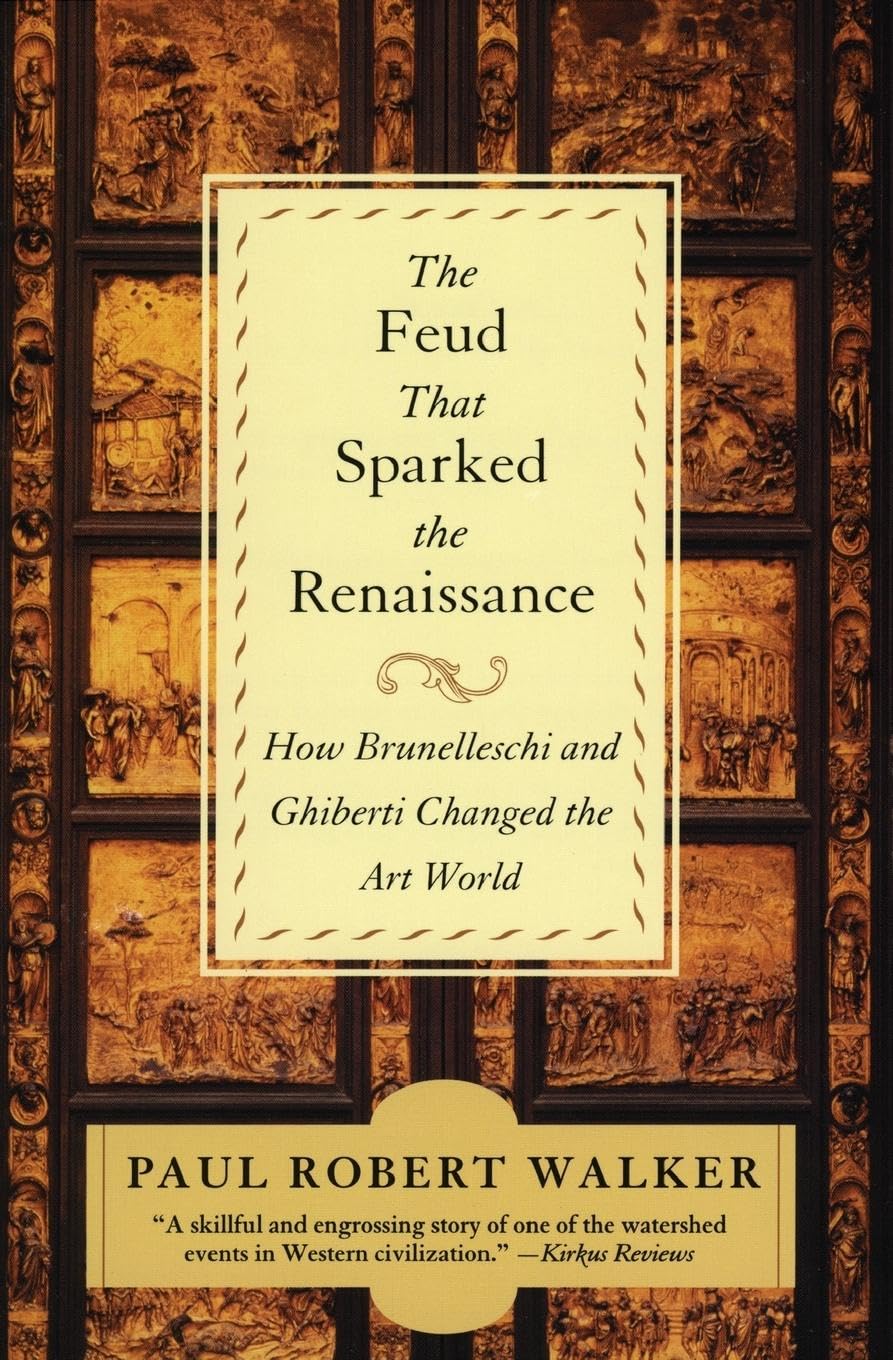
The Renaissance was born in Florence at the dawn of the fifteenth century. Not many people dispute that. How and why that happened when and where it did is much more debated. In “The Feud That Sparked the Renaissance: How Brunelleschi and Ghiberti Changed the Art World” (2003) bohemian author Paul Robert Walker argues that the intense and decades-long rivalry between two Florentine artists from highly different social backgrounds was the spark that ultimately lit the artistic conflagration. After reading “The Feud,” I can’t help but think that it wasn’t very much of a feud at all. Filippo Brunelleschi (1377-1446) was an upper class and notoriously grouchy artistic genius who, on one occasion, lost out to a lower class upstart of middling ability named Lorenzo Ghiberti (1378-1455), and then, on a second occasion, was forced to collaborate with him on a project Ghiberti had no business being part of.
To begin, it must be noted that Paul Robert Walker is in no way a genuine Renaissance scholar. He holds an undergraduate degree in Anglo-American literature from Occidental College and has worked as a high school English teacher, journalist, and rock musician. I’m sure that most tenured professors in the Renaissance Studies department at major universities wrinkle their nose or roll their eyes at this book – but evidently not all. Kenneth Bartlett, a respected Renaissance historian at the University of Toronto, included “The Feud” in his secondary sources for his lecture on Florentine Culture and Society in his course on the Italian Renaissance. I’m glad that he did, because I don’t think I would have discovered this book without his recommendation.
Walker writes that what happened in Florence between 1399 and 1452 was “nothing less than an artistic revolution … the beginning of art with a capital A.” Despite the internecine warfare and political instability that plagued northern Italy during these years, something magical happened in Florence, something unsurpassed even by classical Athens. It all started with a competition to create new doors for the church of Saint John the Baptist, better known as the Baptistry, which was viewed as the official church of Florence and, in a sense, a symbol of the city. At the time, many believed that the Baptistry was actually an ancient Roman temple to Mars that had long ago been converted to a christian church. Thus, the church represented a direct and physical connection to the past glories of ancient Rome.
The Baptistry doors project was sponsored by the merchant’s guild (Calimala), the oldest and wealthiest of Florence’s twenty-one guilds. The Calimala had commissioned bronze doors from Andrea Pisano in 1330 and had long planned to sponsor a second set. The competition was inspired by the writings of Pliny the Elder, who wrote about the great artistic competitions of ancient Greece and Rome. The merchant guild’s decision to fund the Baptistry doors was, Walker says, “a sacrifice on the altar of Republican idealism.”
Walker suggests that Brunelleschi should have been a shoo-in to win the contest. The son of a powerful Florentine notary, Brunelleschi was already by age 25 a master goldsmith and two-time member of important civic councils in Florence. In addition, in Walker’s estimation he was a bonafide genius. Ghiberti, on the other hand, was more pedestrian. The illegitimate son of a goldsmith, Ghiberti was an inexperienced 22-years-old when the competition was announced. Walker says that it is shocking that Ghiberti was even allowed to enter the competition; the fact that he won is “almost beyond belief.” The final vote was razor thin. Walker says that Ghiberti’s sample panel was “more careful and decorative,” a high point in the Gothic tradition; Brunelleschi’s was “bold, experimental, and realistic,” the beginning of Renaissance art. The panel may have asked the two precocious young artists to co-manage the project, but asking these two artists to work together on something would be like asking Pablo Picasso and Norman Rockwell to collaborate. What may have ultimately decided the contest was Ghiberti’s technical superiority in more efficiently crafting the bronze panels. Walker suggests that Ghiberti’s superior craftsmanship would save the Calimala 60 florins in materials costs. The outcome of the contest was the defining moment in both men’s lives. Ghiberti got to work on his “Doors to Paradise” while Brunelleschi reportedly skulked off to Rome with his young friend Donatello, not to be heard from in the historical record for fourteen years.
The Calimala agreed to pay Ghiberti 200 florins a year to work on the doors, a fantastic sum for an artist in the early fifteenth century. (It was equivalent to the salary of a Medici bank branch manager.) It was estimated that it would take Ghiberti a decade to complete the 28 panels depicting the life of Christ; it would take him twenty. When completed in April 1424 the doors featured 175 intricately cast individual figures. Nevertheless, by the time the doors were hung they were already “old fashioned art,” according to Walker. Ghiberti completed a second, even more stunning set of doors for the Baptistry in 1452. The total cost of both sets of doors was a staggering 30,000 florins. In Walker’s estimation, Ghiberti was a hard-working and talented craftsman; Brunelleschi was something more – an “original genius” and “always ahead of his time.” He was not only a gifted and innovative artist, but also a gifted and innovative thinker, embodying the Renaissance movement in both art and humanist philosophy.
Humanism had taken hold in Florence more firmly than almost anywhere else. The defining qualities of Renaissance art are the representation of reality based on classical models. For the first time since antiquity human beings were beginning to be seen as imbued with free choice and almost limitless possibilities. Brunelleschi saw man as an active participant in the Universe capable of shaping events for the better, not the helpless tool of divine will as characterized by traditional Medieval thought. His hands-on approach yielded what Walker calls “the single most important artistic breakthrough of the Renaissance”: the rediscovery of linear perspective. “It is no exaggeration to say that without Brunelleschi’s formulation of perspective,” Walker writes, “there would have been no Renaissance in painting at the time and place that it occurred.” The first Renaissance painter to perfect the unified single-point perspective was Massacio (1401-1428), an artist who dominated early Quattrocento Florentine painting the way Donatello did with sculpture and Brunelleschi did with architecture. The precepts and rules of Massacio’s painting in the Brancacci Chapel, such as the expansive fresco “Tribute Money,” served as a school and inspiration for future generations of Florence artists, including Filippo Lippi, Botticelli, Leonardo, Michelangelo, and Raphael.
In 1406, the Signoria passed a law requiring the guilds of Florence to commission statues representing their patron saints in the niches of the church of Orsanmichele. The Signoria had unleashed an artistic arms race at Orsanmichele with each of the leading guilds competing to outdo one another. (Artists actually belonged to the guild of doctors and druggists, because druggists sold the pigments that artists used.) Donatello’s statue of St. Mark, completed for the linen weavers guild in 1413, was “the most realistic statue created in the western world since the days of ancient Rome.” Four years later he completed an equally remarkable statue of St. George for the armorer’s guild. Meanwhile, the Calimala commissioned Ghiberti, still working on his Baptistery doors, to create an exorbitant expensive (ten times more expensive than marble) full-sized bronze statue of their patron saint, St John the Baptist, also the patron saint of Florence. Not to be out-done, in 1521 the Cambio (bankers guild) commissioned Ghiberti to sculpt a 2,500 pound statue of St Mark for 650 florins.
Into this artistic ferment was added the commission to build the dome of Santa Maria del Fiore. Walker says it was the most important commission in the history of Florence and the greatest engineering project of the age. The dome would be “wider, heavier, and higher than any dome ever created before.” For a century the Florentines built their church without knowing how they would complete the dome. In 1418, the Opera del Duomo, the organization responsible for the building and decoration of Santa Maria del Fiore, opened the competition by offering a 200 florin award for the winning design. Brunelleschi’s design was the only one that did not require supporting structures. Many were incredulous that such an innovative design could be built. His design was clearly the winner, but he never received the 200 florin award. What Brunelleschi did receive from the Opera del Duomo was the forced inclusion of Ghiberti as a co-supervisor on the project with an equal salary to his own. Walker says it is unclear why Ghiberti was included or what his contribution was to the dome, if anything. He was, in short, a fifth wheel.
The author suggests that Ghiberti was far more congenial and good natured than the notoriously crotchety Brunelleschi and had successfully ingratiated himself with the Florentine elite, securing his position as the leading and preferred artist to the establishment. Brunelleschi, on the other hand, was better born and more politically experienced, but also a more challenging personality with a more avant-garde artistic style who had absented himself from Florence for long stretches at a time. Brunelleschi thrived in spite of his disagreeable disposition. In 1424 he was voted to the Signoria, the highest council in Florence. As an artist and architect, he had risen to a position of power and prestige in Florence not seen since the days of Arnolfo di Cambio (1240-1310) and Giotto (1267-1337).
Brunelleschi was also stunningly rich for an artist. In 1427 Florence radically changed its tax system. The old “prestanza” system, which fixed a tax assessment based on the judgment of a committee of neighbors, was scrapped in favor of a new “catasto” system, which was a relatively sophisticated property tax. The tax was calculated on a person’s assets minus his debts plus a 200 florin deductions for each dependent. Walker says that the” catasto” quieted age-old complaints about the inequities in the Florentine tax system. The new tax was a gift to historians because the meticulous records that went with it enable us to reconstruct the socio-economic profile of Quattrocento Florence. Out of over 10,000 tax records, 30 percent were classified as paupers and paid no tax at all. Over 50 percent ran a deficit in their assets-to-debts calculation and could be thought of as lower middle class. This category included many leading artists, including Ghiberti (288 florin deficit) and Donatello (460 florin deficit), and were assessed less than one florin in taxes. Brunelleschi, on the other hand, had a positive balance of over 1,000 florins and was assessed a tax of over five florins. By way of comparison, however, the richest men in Florence in 1427 were bankers with staggering taxable assets, such as Palla Strozzi (100,000 florins) and Giovanni di Bicci de Medici (80,000 florins). All told, the one hundred wealthiest Florentines controlled over 25 percent of the wealth.
The leading artists of Renaissance Italy were occasionally called upon to serve as military engineers. Almost without exception this martial civic duty damaged the artist’s reputation. In 1430 Brunelleschi was drafted into military service and tasked with redirecting the flow of the Serchio River in order to physically isolate the city of Lucca. The celebrated architect was paid handsomely for his efforts – he was paid more in three months attempting to dam the Serchio than he earned in eighteen months building the Duomo – but the episode would prove to be “the most embarrassing episode of his otherwise brilliant career,” according to Walker. In fact, the botched flood at Lucca permanently damaged his political career. The war with Lucca officially ended with a peace treaty in 1433.
In closing, Brunelleschi’s historical legacy towers over that of Ghiberti. “Brunelleschi had single-handedly established the role of the architect as far more than a builder,” Walker writes, “but a visionary, an organizer of space, sacred and profane, an artist whose canvas was the city itself.” Not since Arnolfo di Cambio had a single man exercised such influence over the physical space of Florence, and no one would ever again match him. Indeed, Ghiberti’s most important historical legacy may be the inspiration he provided to Brunelleschi to beat him. In summary, Walker argues that three relationships served as the foundation stones of the artistic Renaissance in Florence: 1) the close relationship (possibly homosexual) between Brunelleschi and Donatello, and their mutual fascination with long forgotten ancient Roman art and architecture; 2) the uneven four decade rivalry between Brunelleschi and Ghiberti; and 3) the timely arrival of Massacio and his application of Brunelleschi’s linear perspective to painting and frescos. All told, the so-called feud doesn’t feel all that important at all.
 What's Tim Reading Now?
Leave a comment