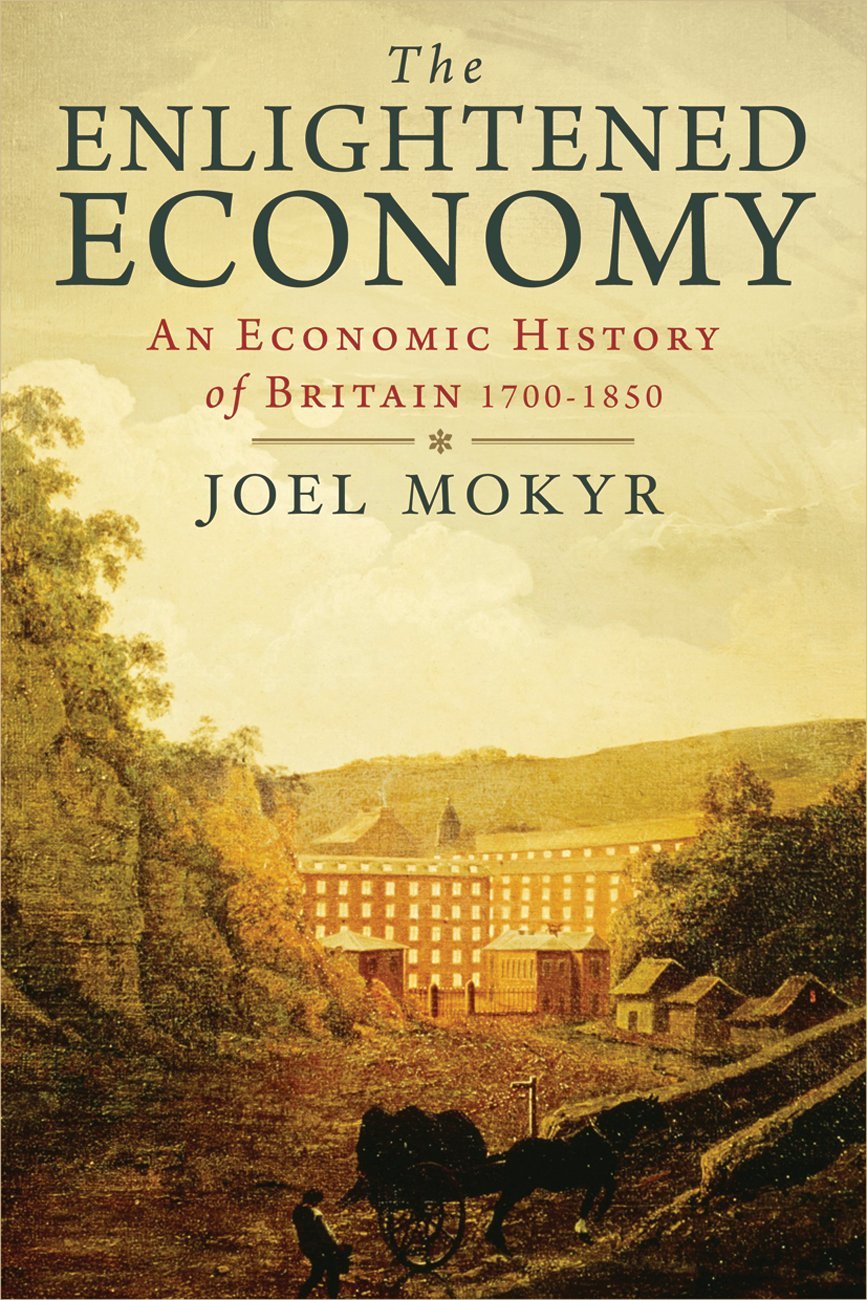
According to acclaimed economic historian Joel Mokyr, “Nothing in economic history is simple, clean, and linear.” The same might be said for Mokyr’s magisterial tome on Industrial Revolution era Britain, “The Enlightened Economy: An Economic History of Britain, 1700 to 1850” (2009). Mokyr throws a lot at the reader in this dense 489-page economic history; I suspect only the most tenacious and dedicated readers will be able to get through the whole thing, but it’s worth it if you do..
Mokyr’s principle hypothesis is that modern economic growth “depended a great deal on what people knew and believed,” and that the eighteenth century Age of Enlightenment is what shaped the knowledge and beliefs that ensured that the Industrial Revolution continued in a self-reinforcing cycle of sustained growth. “The Enlightenment planted the seeds of economic progress in every country in which it was prevalent, but British soil proved to be the most fertile and the one in which they sprouted first,” he says. According to Immanuel Kant, the Enlightenment movement was animated by the spirit of “dare to know,” emphasizing the possibility and desirability of useful knowledge, improvement, growth, and social progress. Mokyr says that the English Enlightenment put special emphasis on empiricism, pragmatism, and individual utilitarianism. It emphasized the generation and dissemination of useful knowledge, whether it was experimental, theoretical, or practical. This was the secret of Britain’s ultimate success.
Mokyr maintains that the unique characteristics of the British Enlightenment spawned something he calls the Industrial Enlightenment, which believed in material progress and economic growth through increasing human knowledge. “The British Industrial Enlightenment was characterized above all by a deliberate attempt to make useful knowledge flow from moral philosophers (scientists) to engineers and technicians (entrepreneurs),” he says. It bridged the gap between the savants and the fabricants. This movement, which he calls “the taproot of long-term progress,” was propelled forward by an informal nationwide program inspired by the work of Francis Bacon. The so-called Baconian program focused on dedicated research into natural phenomena, solving practical problems, and disseminating knowledge as widely and inexpensively as possible. The useful knowledge generated in this system remained cumulative, consensual, and contestable. Surprisingly, Mokyr concedes that the Baconian program was largely a failure, at least in the eighteenth century. In the first Industrial Revolution “experience, dexterity, imagination, and intuition” created new technology more than science. Mokyr says that “The Industrial Enlightenment was the logical continuation of the Scientific Revolution by other means.” Only it was “more concrete and more pragmatic.”
Mokyr is quick to point out that the Enlightenment was surely not THE cause of the Industrial Revolution. Other factors, such as Britain’s favorable resource endowments and a relatively large middle class of highly skilled artisans, played a key role. Nevertheless, “the Enlightenment is the 600-pound gorilla in the room of modern economic growth,” he says. Simply put, “beliefs and ideologies affected economic outcomes.” The Enlightenment may not have actually caused the Industrial Revolution per se, but it is what turned the Industrial Revolution into the “taproot” of sustained economic growth and set Europe on “a different track toward economic modernity.”
The radical changes wrought by the Industrial Revolution unfolded slowly over decades and were imperceptible even to the most thoughtful and observant contemporaries, such as Adam Smith and Daniel DeFoe. “The Baconian program of expanding useful knowledge was at the heart of the Industrial Revolution,” Mokyr says. “Yet the full results in terms of material improvement for the masses did not arrive before 1850.” Yet, by 1850 clearly something extraordinary had happened. At that point, Great Britain had a population of 21 million compared to France’s 33 million. Even with a third less population, Britain’s advantages in industrial production and consumption was stunning: Britain consumed 49 million tons of coal compared to France’s 4 million; Britain consumed almost two million tons in iron to France’s 600,000; Britain possessed 1.3 million total horsepower in steam engines to France’s 370,000; Britain had 10,000 kilometers of railroads to France’s 3,200. Mokyr says that while the Enlightenment was not solely responsible for this industrial transformation, it “must be credited with turning … technical breakthroughs into a sustained stream of innovations and the eventual launching of a new world of continuous economic growth.”
Britain had something of an economic headstart heading into the eighteenth century. The Industrial Revolution did not pull Britain out of some sort of Industrial Dark Ages. Quite the contrary, according to Mokyr. By the dawn of the eighteenth century, Britain boasted an economy that was “sophisticated, prosperous, commercial, and productive – a success story by all accounts.” The first significant reform to this relatively prosperous state of affairs was the slow but steady dismantling of the British mercantilist state. By 1720, the golden age of the great trading monopolies was over. Mokyr says that the slow retraction of mercantilist policies and rent-seeking behavior in Britain beginning around 1700 “was an essential ingredient in the recipe for long-term growth.” Indeed, he says that this liberal political economy was “the Enlightenment’s proudest offspring.”
In addition to a more open political economy, Britain also possessed relatively benign institutions that supported industrial growth when it eventually emerged. “A successful economy depends on good institutions to create the right incentives for commerce, finance, and innovation,” Mokyr says. By the eighteenth century, the British economy was more open, more competitive, offered more choice, and fought rent-seeking guilds and state-sponsored monopolies more than anywhere else in Europe. “[Britain in 1700] was in no way a democracy, let alone a free market economy,” Mokyr writes, but it did embrace a wide range of freedoms (expression, occupation, association) that would prove to be fertile grounds for invention and innovation. According to the author, the British possessed no conspicuous advantage in higher education or human capital, but rather benefited from the active and broad distribution and promotion of useful knowledge across society. From the repeal of the Calico Acts in 1774 to the repeal of the Corn Laws in 1846 and the Navigation Acts in 1849 and 1854, progress in creating a free trade economy in Britain was slow and uneven but inexorable, and the influence of Enlightenment thought on the overall movement was, in Mokyr’s opinion, “undeniable.’
Over the past half century a number of leading scholars have contested the entire idea of an Industrial Revolution. The changes occurred far too slowly over far too long of a period to be considered a “revolution,” they say. Mokyr does not agree. Between 1760 and 1830, “something deep and important changed in Britain,” he says. Three things in particular emerged that were fundamentally new and different: 1) technological change, 2) the factory system, and 3) sustained economic growth. The most important thing about the Industrial Revolution was not how quickly things changed or how fast things grew, he says, but rather that the changes never fizzled out. Sustained economic growth over decades is what marked a sea change in economic history, according to Mokyr, not the rate of economic growth, which was actually quite modest (national income per capita only grew at 0.2 to 0.4 percent per year during the Industrial Revolution).
But why Britain in the mid-eighteenth century? Did the island nation possess any distinct advantages that propelled their economy ahead of continental Europe? Mokyr cites several sources of British advantage. First, he claims that British gentleman culture was instrumental in creating behavior that informally fostered trust, innovation and eventually the open market economy. The English gentlemen (and all the men who wanted to be thought of as such) were polite, well-mannered, trustworthy, and honest. “The prevalence of gentlemanly behavioral codes as a social lubricant and a facilitator of trust and market exchange is remarkable in this age,” Mokyr writes. These social norms were so powerful that the formal criminal justice system was on the whole a measure of last resort.
Next, in addition to trustworthy gentlemen, by the early eighteenth century Britain also produced an extraordinary cadre of highly skilled craftsmen, particularly in clock- and instrument-making, shipbuilding, and mining. “Britain’s position as a technological leader in Europe before 1850 depended to a very large degree on the presence of these artisans,” Mokyr writes. According to the author, eighteenth century Britain just happened to have the right combination of scientists and engineers inspired by a Baconian program to produce the necessary useful knowledge that was used by a relatively large population of skilled craftsmen who, in turn, were encouraged by a supportive government that provided the right protections and incentives to promote entrepreneurial risk taking. Mokyr also suggests that the British were world class tinkerers and improvers, rather than inventive geniuses. Thus, he notes that Britain was largely a net importer of macroinventions and a net exporter of microinventions. “Whatever [Britain] borrowed,” he says, “it improved and refined.”
The Industrial Revolution also coincided with an unprecedented growth in the population. Mokyr believes that industrial progress and population growth are directly connected, although he admits that he cannot prove it. Interestingly, population growth came long before any tangible signs of economic growth appeared. From 1700 to 1750, the British population grew slowly, roughly 0.25 per year. Then, from 1750 to 1800, the growth rate tripled to 0.75 percent, and then exploded to 1.35 percent between 1800 to 1850. The tripling of the total population between 1700 and 1850 was driven by a combination of a growing birth rate and a declining death rate, with the increase in fertility (in turn driven by the five-year drop in marriage age, a reversal of the so-called European Marriage Pattern) accounting for roughly two-thirds of the growth. “The fact that population began to grow rapidly in the 1750s at the very time that technological progress began to accelerate in a few key sectors seems too close to be dismissed as a coincidence,” Mokyr says, but he is unable to casually link the two phenomena.
It is interesting to note that during this period the British government also grew by leaps and bounds. Britain was one of the highest taxed countries in the world in the eighteenth century. It was also one of the most indebted. British national debt rose from £14 million in 1700 to £243 million at the end of the American Revolution in 1783 to a staggering £745 million in 1815. As a percentage of GDP, the national debt increased from about 35 percent to 250 percent from 1700 to 1815. In 1700 the British government collected about 3 percent of the national income in taxes, which grew to 10 percent during much of the eighteenth century, and peaked at 18 percent during the Napoleonic Wars. Most national revenue, about 70 percent, came from customs duties and excise takes; tariffs accounted for another 20 percent. Most of this money went to the military (sometimes as much as two-thirds of government spending) and financing the debt (roughly a third). Only about 10 to 15 percent of the budget was spent on civil government. Almost nothing was spent on state-supported infrastructure and public goods that fostered industrialization. Rather, Mokyr says that the British government was simply a “revenue-raising machine.” Transportation infrastructure grew dramatically, but was driven almost entirely by private investment. Improved roads doubled the speed of stage coaches from 4 miles an hour to 8; total mileage of internal canals more than doubled between 1760 (1,400 miles) and 1830 (3,900 miles); and railroad tracks exploded from 200 kilometers in 1830 to 9,800 kilometers in 1850, but the British government had little to do with it.
Interestingly, the author strongly rejects a number of common explanations for Britain’s Industrial Revolution, particularly the “coal and colonies” thesis put forward by Kenneth Pomeranz, the patent system argument, most recently trumpeted by William Rosen, and the Agricultural Revolution speculated by various scholars over the years.
Mokyr rejects the whole “no coal, no Industrial Revolution” argument, although I found his reasoning a bit weak. He says there is no convincing evidence of a crippling timber shortage in eighteenth century Britain and notes that there were no dramatically new uses for coal beyond steam engines and iron ore smelting. Yet, Britain’s output of coal was astounding, growing from just 3 million tons in 1700 to 15 million tons in 1800 to 60 million tons in 1850. Next, Mokyr dismisses claims that British imperialism created the Industrial Revolution. But then he also shows that colonial markets accounted for between 25 and 40 percent of British exports between 1780 and the 1840s, which feels highly significant and highly important to any industrializing economy. However, Mokyr says colonial and foreign markets were merely a “bonus” for Britain during the Industrial Revolution. “It was ingenuity and innovativeness that drove exports and trade,” he writes, “not the other way around.”
Concerning the British patent system, Mokyr says, “[it] is still the subject of considerable controversy,” but, on balance, it “did not give Britain a positive advantage over its European competitors sufficient to explain its primacy,” To make his point, he notes that the famed Crystal Palace exhibition of 1851 featured 6,377 British inventions, only about 10% of which were patented. “High fees and litigation costs together with hostile or uncertain judges made a patent a costly and insecure property right,” he says.
What about the steam engine, that heavily patented technology at the heart of the Industrial Revolution? The steam engine was “an Enlightenment machine par excellence,” according to the author, and “one of the most remarkable technological achievements humanity has ever made,” and it depended on cheap coal and patent protection during its century-long ascent to market domination. Actually, according to the author, the steam engine’s economic and social impact between 1700 and 1850 was slight, accounting for less than one percent of GDP per year even as late as 1850 and didn’t lead to any labor saving innovation outside of the textile industry. For all of the talk about an Industrial Revolution – and Mokyr’s steadfast defense of that term – he notes that virtually no one living through it recognized that a new economic age had dawned.
One thing is irrefutable: during the late eighteenth century the British experienced a remarkable increase in population and also a dramatic increase in urbanization. Which begs the question: how were all these new, non-agricultural mouths fed? Between 1700 and 1850 over 20 percent of all British land was enclosed, leaving less than 10 percent of land open and accessible. Some have argued that this phenomenon led to a corresponding Agricultural Revolution that supported and literally fed the Industrial Revolution, but Mokyr isn’t buying it. He says “there is little hard evidence to support the hypothesis that enclosures were a necessary condition for the diffusion of better techniques or superior crops, or that they in some other way increased agricultural productivity dramatically.” So how were British farms able to feed a population that tripled from 1700 to 1850? Mokyr suggests that the farmers just got better at farming. “The amount of useful knowledge about plants and animals available in Britain in 1850 was many times larger than it had been in 1700,” he says, and the end result was vastly improved agricultural productivity.
Mokyr is dismissive of the demand-side arguments for explaining the Industrial Revolution. France was larger than Britain, the Netherlands was richer, and Spain had more colonies, which would have given these economies a distinct advantage on the demand side.
During the nineteenth century the family shifted from a unit of production to a unit of consumption. Furthermore, Mokyr says the role of women and children in textile factories was a relatively temporary phenomenon and often exaggerated by scholars hostile to the proletarianization of industry. Even the idea of sprawling industrial textile factories is overblown, the author says. The entire British cotton industry comprised perhaps 900 establishments, the vast majority of them employing less than twenty people.”Smallish workshops remained the rule,” Mokyr writes. Not surprisingly, less than ten percent of the British workforce was unionized during this period.
“The Enlightened Economy” is a lengthy and often tough read. The author’s theses and conclusions are all plausible, but few, if any, are backed by conclusive, empirical evidence. Mokyr is currently the “top dog” in the field today and I suspect his arguments and research will come under withering attack from scholars over the next fifty years. I can only imagine what will remain of his work and reputation when all is said and done.
 What's Tim Reading Now?
Leave a comment