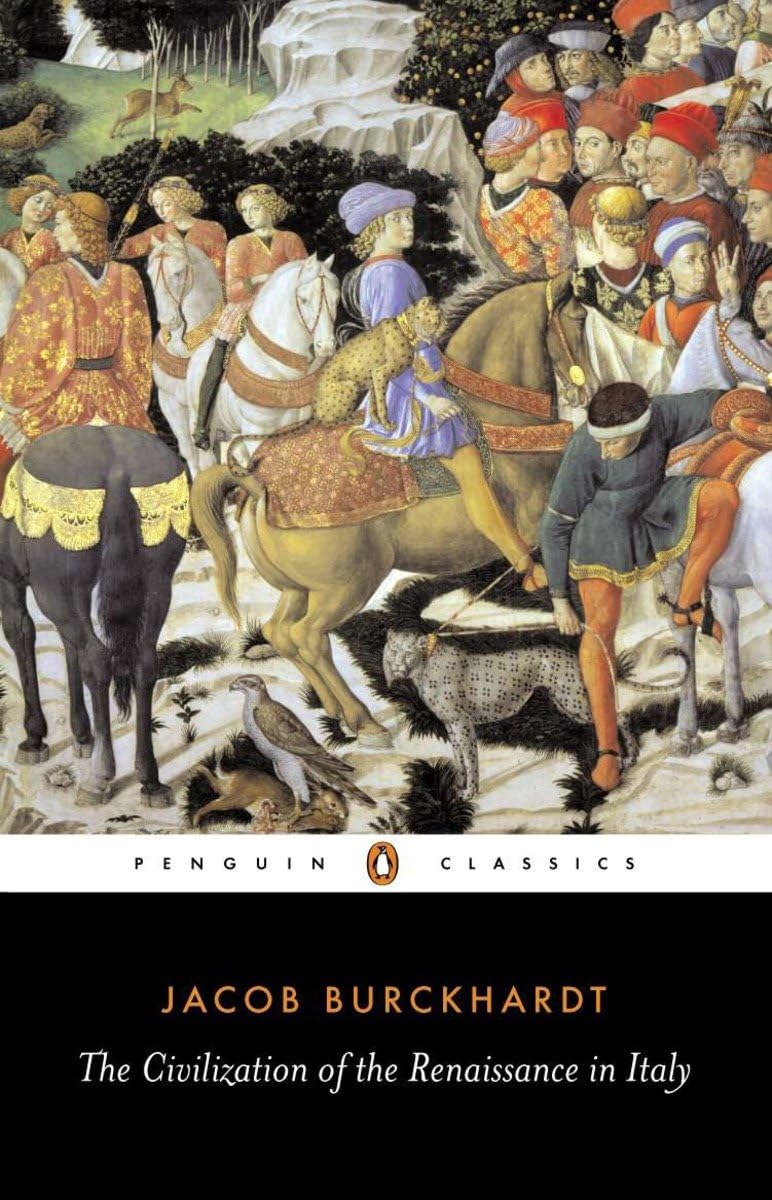
I’m usually quite reluctant to read non-fiction books written in the nineteenth century or earlier. I’ve found that even enduring classics like “The Influence of Sea Power upon History, 1660-1783” (1890) by Alfred Thayer Mahan and “The Decline and Fall of the Roman Empire” (1776) by Edward Gibbon to be painful slogs. Francis Parkman’s “Montcalm and Wolfe” (1884) is probably as readable as they get. Thus, it was with some trepidation that I picked up Jacob Burckhardt’s “The Civilization of the Renaissance in Italy” (1860), a seminal piece of scholarship that is to modern Renaissance studies what Darwin’s “On the Origin of Species” (1859) is to modern evolutionary biology.
Unfortunately, like with other classics of the period, reading “The Civilization of the Renaissance in Italy” is a slog. But it established the intellectual and methodological structure still used today by most Renaissance scholars. In the words of Professor Kenneth Barlett of the University of Toronto: “Seldom can any historical movement be traced to so significant a single source [i.e. “The Civilization of the Renaissance in Italy”] as can the Renaissance.”
Burckhardt saw history as an art form, a kind of imaginative literature. He didn’t want to merely tell a story; he wanted to create a portrait of an age. In Burckhardt’s view, it was the development of the individual and the discovery of the world and of man that really drove the Renaissance, with all of it completely dependent on the “special genius” of the Italian people. The revival of antiquity, the classic conception of the birth of the Renaissance was important, too, Burckhardt says, but only of secondary consideration.
The book is undeniably a foundational text in the study of the Renaissance, presenting a layered portrait of the Italian people and their unique and eventful moment in time. Amazingly, over a century and a half after its original publication, many of Burckhardt’s core themes and arguments about the origin and nature of the Renaissance have endured to this day. Or as Bartlett has written about his profession, “we are all in many ways still Burckhardtians.”
First and foremost would have to be Burckhardt’s emphasis on Individualism and the dignity of man. During the Middle Ages, man was conscious of himself only through some general category (e.g. race, party, family). Beginning in fifteenth century Italy people put a newfound emphasis on personal achievement, self-expression, and the pursuit of glory. The desire to achieve something great and memorable was intense, even “something demonic,” in Burckhardt’’s opinion. No place was more obsessed with glory-hunting than Florence, “the great market of fame,” according to the author. The Italians were also the first among modern peoples to whom the natural world, including everything from mountains to man, was seen and felt as something beautiful, almost sublime, and worthy of appreciation and close study. The upshot of this collective ambition, curiosity, and an unquenchable thirst for greatness was the consistent development of men of great and wide-ranging ability. “The fifteenth century is, above all,” Burckhardt writes, “that of the many-sided man.” A century and a half later, many contemporary scholars still recognize the Renaissance as a period where individual creativity and ambition in the modern sense were first celebrated.
Second, Burckhardt emphasized the revival of antiquity; the Renaissance world’s recovery and veneration of the ancient world. It was “the literary bequests of antiquity, both Greek as well as Latin,” he says, “were of far more importance than the architectural, indeed than all the artistic remains which it had left.” Latin poets, historians, orators, and letter-writers inspired a new generation of humanist scholars and writers, beginning with Petrarch (who was “a kind of living representative of antiquity” in his own time) or Dante and Boccaccio. Cicero was recognized universally as the purest model of prose and tremendously influenced the letter-writing and oratory style of the age. The humanists were held up as the ideal – until they were not. By the end of the sixteenth century and the beginning of the Counter Reformation, humanist scholars were accused of a wide range of sins, including vanity, obstinacy, immorality of all descriptions, heresy, and even atheism. Burckhardt’s perspective has been largely upheld, with modern scholars continuing to explore how Renaissance thinkers, artists, and writers engaged with and were inspired by the classical past.
Third, Burckhardt says that the Renaissance developed the concept of the state as a work of art. That is, as Burckhardt says, “the state as the outcome of reflection and calculation.” This novel approach to government was often aided by another curious aspect of the age: the rise of meritocracy and the public indifference to nobility or legitimacy of birth. “This one single result of the Renaissance,” Burckhardt says, “is enough to fill us with everlasting thankfulness.” Burckhardt claims that Italian politics during the Renaissance was something of a crucible that men of often exceptional ability had to pass. “It is undeniable that the dangers to which these princes were constantly exposed developed in them capacities of a remarkable kind,” Burckhardt writes. Political turmoil was the status quo in fifteenth century Italy. Dante compares the interminable changes to the Florentine constitution to a sick man who is constantly changing position to temporarily ease the pain. Burckhardt’s detailed descriptions of the interplay between city-state politics and culture in Italy remain influential.
Of course, many of the arguments made by a mid-nineteenth century Swiss historian have been vigorously contested by modern scholars. First and most simply, many contemporary historians have taken issue with Burckhardt’s clear-cut definition of the Renaissance as a distinct and decisive break from the Middle Ages occurring between the years 1350 to 1550. This is often referred to “periodization,” a concept widely contested by modern historians. Some recent scholars have suggested that there was actually significant continuity and overlap between the Middle Ages and the Renaissance. Many have also criticized Burckhardt’s concentration on Italy – particularly the city-states of Florence, Venice, and Rome – as the exclusive cradle of the Renaissance, which they argue is both misleading and creates an artificial homogenization of the Renaissance experience. Many modern scholars have expanded the scope to consider the Renaissance as a pan-European phenomenon, with important developments in Northern Europe as well as non-European regions, as well as a non-uniform phenomenon that differed in important social, economic, and cultural aspects depending on the location.
Second, and perhaps most predictably, contemporary scholars have chided Burckhardt’s exclusive focus on the elites—artists, scholars, and political leaders. Modern Renaissance studies have aimed at a more inclusive approach, attempting to recover the experiences and contributions of the broader population, including women, lower classes, and non-Italian regions.
Finally, there is the issue of secularism. Burckhardt suggested that the Renaissance witnessed a shift towards secularism, where life became more centered around human experiences rather than purely religious concerns. This theme has persisted, although it has been nuanced by modern scholarship to acknowledge the continued importance of religion.
In conclusion, Burckhardt’s “The Civilization of the Renaissance in Italy” remains a seminal text, laying the groundwork for Renaissance studies. However, modern scholarship has both built upon and revised his interpretations, seeking to provide a more nuanced and inclusive understanding of the Renaissance. While his emphasis on individualism, the revival of antiquity, and the political landscape endures, his views on periodization, elitism, and the homogeneity of the Renaissance experience have been critically re-evaluated and expanded.
 What's Tim Reading Now?
Leave a comment