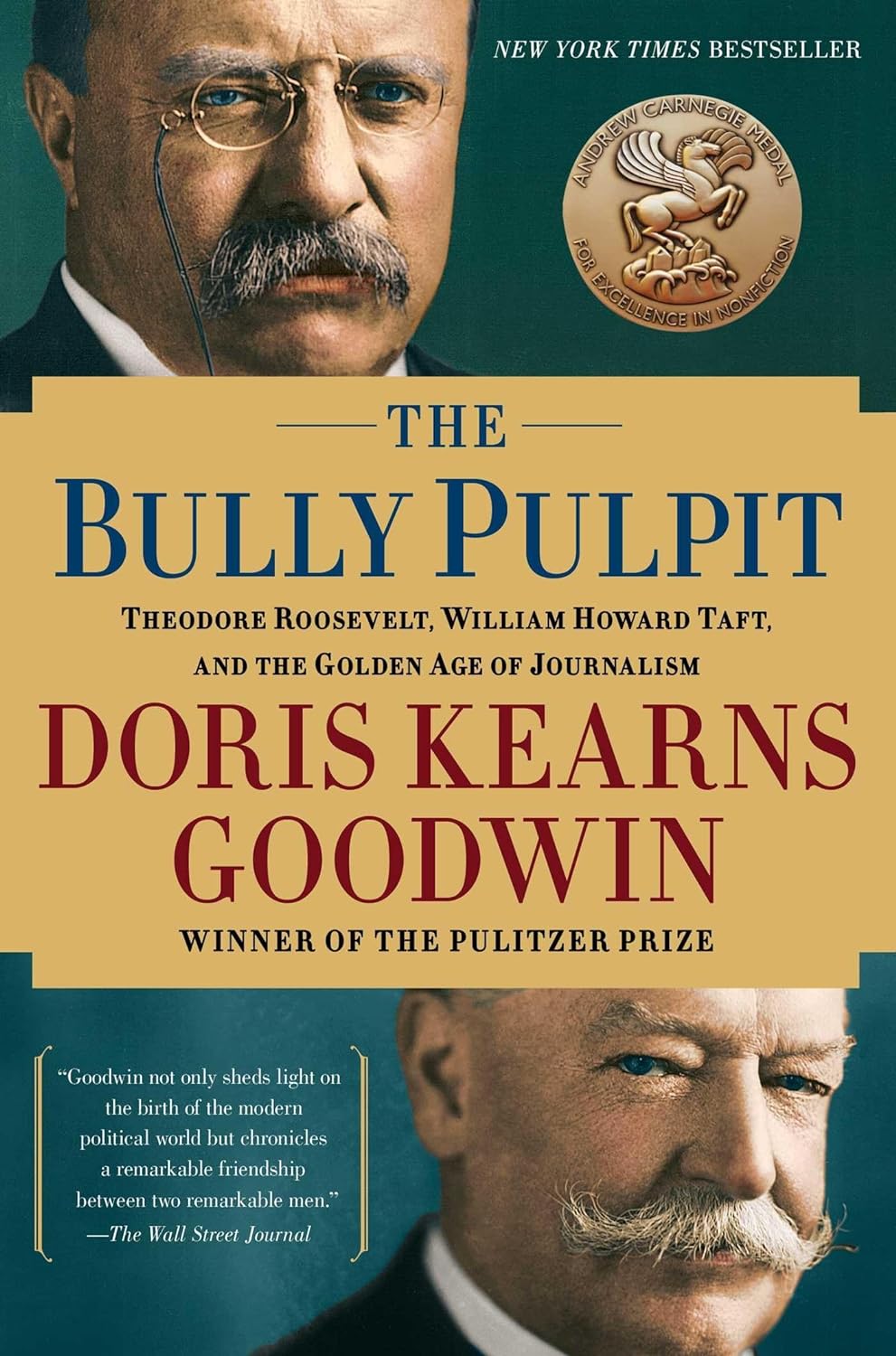
Teddy Roosevelt has long been a personal hero of mine. However, after reading Doris Kearns Goodwin’s 2013 bestseller, “The Bully Pulpit: Theodore Roosevelt, William Howard Taft, and the Golden Age of Journalism,” I now may be an even bigger fan of the jovial but largely misunderstood and now generally forgotten William Taft.
As sometimes happens, even with great authors, which Goodwin undoubtedly is, the title of this book is somewhat misleading. Sam McClure and his all-star cast of investigative reporters at his innovative and highly influential McClure’s Magazine play only a secondary role in Goodwin’s extended and detailed narrative. Her primary focus is on the long and deeply affectionate personal and political relationship between Roosevelt and Taft that eventually turned turbulent and then bitterly acrimonious during the 1912 presidential election. It is a fascinating story and one perfectly suited for Goodwin’s inimitable skill in capturing American political drama.
Theodore Roosevelt and William Howard Taft had much in common. Born just thirteen months apart in the years immediately before the Civil War, they were raised in prosperous homes, the sons of successful fathers who played prominent roles in their local Republican Party. They were well educated at Harvard and Yale, respectively, and made an immediate splash in life, Roosevelt serving three tumultuous terms in the New York state assembly while Taft was appointed to the Superior Court of Cincinnati, all before they were thirty. They married strong, intelligent, and independent women who enthusiastically supported and encouraged their careers. (When he was president, Taft said of his headstrong wife, Nellie: “If she had only let me alone, I guess I should now be dozing on the Circuit Court bench.”) In 1890, the two power couples were veritable next door neighbors in the Dupont Circle section of Washington DC when Roosevelt was appointed to the Civil Service Commission and Taft was named Solicitor General of the United States in the Harrison administration. Goodwin writes that the two men would remain close political confidantes for the next two decades. Their wives would not. (“I don’t like Mrs. Roosevelt at all,” Nellie Taft once remarked to a friend. “I never did.”)
For all of their superficial similarities, much distinguished the two men, Goodwin writes. Roosevelt was a born politician who “thrived in the cauldron” of electoral politics. Taft, meanwhile, “detested political gamesmanship, found no pleasure in giving speeches, and chafed at public criticism.” Roosevelt’s abiding ambition in life was the presidency; Taft’s was the Supreme Court. Their horses were eventually hitched together in 1901 when Roosevelt became president after William McKinley’s assassination and Taft was serving on the commission to organize a civilian government in the Philippines, a position that Taft had resigned his seat on the federal bench to take under the agreement that he would be appointed to the Supreme Court when a vacancy next became available. Taft would go on to decline appointment to the Supreme Court three times over the next seven years in order to complete his mission in the Philippines, first as Governor-General and then as secretary of war.
Another of their major differences was how they viewed and engaged with the press. “No public figure of the time understood better than Roosevelt the importance of cultivating reporters,” Goodwin writes, and he was excellent at it. From his days in Albany to his time as Police Commissioner in New York City and eventually during his time in the White House, Roosevelt let reporters into his confidence at every turn. He aggressively leveraged his personal relationship with journalists, particularly those at McClure’s, to promote and forward his political agenda. It was, in Goodwin’s words, “a mutually productive alliance.” Sam McClure’s talented staff, which included Ida Tarbell, Lincoln Steffens, Ray Baker, and William Allen White, would embark on a “novel, vivid, and fearless explorations of the American condition [that] would sound a summons and quicken the Progressive movement.” First drafts of the state of the union and McClure’s forthcoming political exposes were literally shipped back and forth between the Oval Office and the McClure’s office in Manhattan as both sides offered edits and amendments to each other’s work. Goodwin makes much of this informal partnership between Roosevelt and the writers at McClure’s, as demonstrated in the subtitle to this book, but the storyline actually fades early in the narrative and never really returns. In 1906, owing mainly to McClure’s erratic, absentee management of the magazine (Goodwin never says so, but Sam McClure obviously suffered from a serious case of bipolar disorder), several of the star writers left to found their own high brow publication, The American Magazine, which never achieved the critical or commercial success of McClure’s.
“More than any president since Abraham Lincoln,” Goodwin writes, “Theodore Roosevelt was able to shrewdly calculate popular sentiment.” He was also an expert at manipulating it. Roosevelt intuitively grasped the unique power the presidency held in shaping public sentiment and mobilizing action. (When reviewing a draft of an upcoming state of the union with his advisors, Roosevelt reportedly quipped, “I suppose my critics will call that preaching, but I have got such a bully pulpit.”) Taft lacked the same skill and dexterity in managing the press and his administration would ultimately suffer because of it.
Taft would emerge as Roosevelt’s closest and most trusted advisor in his cabinet. “To strength and courage, clear insight, and practical common sense,” the president wrote to a friend during his second administration, “[Taft] adds a very noble and disinterested character.” When Roosevelt went away on one his many extended trips out west, he let it be known that it was his affable and modest secretary of war who was in charge in his absence, not the vice president or secretary of state.
Roosevelt pledged not to seek a third term in the immediate aftermath of his smashing election in 1904. He promoted a progressive agenda of economic and political reform, much of it facilitated by the active cooperation of leading muckraking journalists. As the 1908 presidential election approached, Roosevelt aggressively promoted Taft – his veritable political soul mate – as his successor. “For the last ten years,” Roosevelt quipped in 1908, “I have been thrown into the closest intimacy with [Taft], and he and I have on every essential point stood in heartiest agreement, shoulder to shoulder.” In off-the-record conversations with journalist friends, Roosevelt swore that “he would crawl on his hands and knees from the White House to the Capitol” to secure Taft’s election. Indeed, Goodwin says, “the ferocity of Roosevelt’s desire for a Taft presidency far exceeded the candidate’s own.”
Many Americans admired Taft for his high intelligence, cool administrative competence, and good-natured congeniality. To Ida Tarbell, “one of the most influential journalists of all time,” according to Goodwin, Taft was a breath of fresh air, “one of the most kindly, modest, humorous, philosophical of human beings.” Henry Adams, perhaps the most acute political observer of his generation, believed that Taft was “the best equipped man for the Presidency who has been suggested by either party during [my] lifetime.” Roosevelt himself said after Taft’s election, “I predict a brilliant administration for him. I felt he was the one man for the presidency, and any failure in it would be as keenly felt by me as by himself or his family.” Indeed, the former judge from Ohio was a candidate everyone knew to be “reliable, hardworking, and loyal.” Much like Herbert Hoover in 1928, Taft appeared to be exactly “the right man, at the right place, at the right time.”
The split between Roosevelt and Taft came quickly and unexpectedly in 1909. So far as I can tell after reading “The Bully Pulpit,” there were really only two primary events that account for the split that ripped the Republican Party asunder. First, immediately after taking office, Taft vigorously pursued tariff reform. “Protectionism had become a central tenet of conservative Republican ideology,” Goodwin writes. Progressives in both parties argued that the tariff was unfair and mainly benefitted wealthy eastern industrial enterprises at the expense of the American consumer. The Roosevelt administration had not been able to make any progress in lowering the tariff over seven years. Yet, in his first year in office, Taft effectively corralled enough votes on Capitol Hill, including the lions of conservative reaction, Senator Nelson Aldrich of Rhode Island and Speaker of the House Joseph Cannon of Illinois, to pass a significant revision to the tariff schedule, including a free trade agreement with the Philippines (a tremendous personal triumph for the celebrated former Governor-General). The resulting compromise Payne-Aldrich Tariff Act, however, was a disappointment to progressive, who wanted to see far deeper and wider cuts in the tariff schedule. They were incensed that the president signed and then publicly trumpeted an act they viewed as a shameful sell-out.
Second, and perhaps even more curious, was a 1910 scandal at the Department of the Interior. After vowing to keep Roosevelt’s cabinet more-or-less in tact, Taft replaced progressive conservationist secretary of the interior James Garfield with Seattle mayor Richard Ballinger, ostensibly in order to bring better sectional balance to his cabinet. Ballinger would soon be accused of improperly steering valuable public lands in Alaska to some cronies back in Seattle. Ballinger denied any wrongdoing and, with the benefit of a century’s worth of perspective and research, Goodwin essentially corroborates his innocence. But progressives at the time believed the accusations against him and embarked on an increasingly mean-spirited and underhanded campaign to get him fired. The president, a former federal judge who believed deeply in fairness and upholding the law, simply refused to summarily abandon a falsely accused subordinate in order to win political points with the progressives. To make matters worse for Taft, he terminated (understandably and correctly, in Goodwin’s opinion) a number of people at the interior department for insubordination and illegally leaking confidential documents to the press, including Gifford Pinchot, head of the Division of Forestry and one of Theodore Roosevelt’s closest political allies in the conservation movement. Goodwin writes that Taft never politically recovered from the unnecessary and unfortunate Ballinger-Pinchot scandal.
By late 1910, the Republican Party was in crisis, split between the conservative eastern Old Guard and a growing insurgency of western progressives, and the discord was manifesting itself at the polls. “[The 1910 mid-term election] was not only a landslide,” Taft acknowledged, “but a tidal wave and holocaust all rolled into one general cataclysm.” The wounded Taft administration limped toward 1912. Theodore Roosevelt, who had almost single-handedly made Taft president in 1908, began to lead the effort to undermine his re-nomination in 1912. The former president decided to run only when “convinced that Mr. Taft had definitely and completely abandoned the cause of the people and surrendered himself wholly to the biddings of professional political bosses and the great privileged interests standing behind them.” For her part, Goodwin adds, “While [Taft] had been an exemplary lieutenant, serving the public well as governor general of the Philippines and as secretary of war, he appeared oblivious to the monumental changes taking place in his own country.” It must be noted that neither Roosevelt nor Goodwin add much in the way of corroborating evidence to support their claims.
Goodwin paints a truly tragic picture of the embattled president. “In many ways, [Taft] is the best man I have ever known,” wrote Archie Butt, military assistant to both Roosevelt and Taft and an unsung hero in Goodwin’s narrative, “too honest for the Presidency, possibly, and possibly too good-natured or too trusting or too something.” The ensuing battle for the 1912 Republican nomination was brutally competitive and politically nasty. Taft did his best to stay above the fray, mostly avoiding personal insults against his erstwhile friend and benefactor (although at one point he labeled Roosevelt, “a real menace to our institutions”), an act of political generosity that was not reciprocated by Roosevelt, who relished mocking his former subordinate. (As the fight for the nomination escalated and became increasingly personal between his two bosses and closest friends, a distressed Archie Butt cut short a European vacation to return home, securing a last minute ticket on the Titanic. He was last seen heroically assisting the crew in loading women and children onto lifeboats.)
A major political reform initiative at the time was the introduction of primary elections for the nomination of presidential candidates, a move that circumvented the power of traditional political bosses in selecting candidates at the national conventions. Roosevelt came out swinging and won 9 of the 13 states holding primary elections, many of them in dramatic fashion. But the Old Guard, never fans of the popular former president, still held the reigns at the national nominating convention and easily handed the re-nomination to Taft, a man they found more politically stable and reliable. Roosevelt responded impetuously by launching a third-party bid for the presidency under the new Progressive (Bull Moose) Party. Roosevelt’s efforts essentially split the Republican vote down the middle and handed the election to progressive New Jersey governor Woodrow Wilson, who won with just 42% of the popular vote, but achieved a landslide in the electoral college. Poor Taft won just 8 electoral votes (Utah and Vermont) and captured only 23% of the popular vote, by far the worst political performance of any incumbent president in American history. Even worse, he garnered 600,000 less votes than his former friend and rival. Roosevelt, for his part, won six states and captured 27% of the vote, a result the former president considered dismally disappointing, but nevertheless still stands as the greatest electoral performance by any third party candidate.
In closing, I loved “Bully Pulpit,” perhaps even more than “Team of Rivals,” which is really saying something. William Howard Taft emerges as such an unlikely hero; an honest, noble, but ultimately tragic figure. It is sad and unfortunate, I think, that men like Taft – thoughtful, self-effacing and politically moderate – are generally doomed by the harsh realities of American electoral politics that often favors wild-eyed radicals over sober-minded professionals. Taft’s story thankfully ends on a high note. He reconciled with Roosevelt in the years before the Rough Rider’s early death in 1919 and eventually achieved his life’s ambition when President Warren G. Harding named him chief justice of the Supreme Court in 1921, as position he held until his retirement in 1930. Viewed in full, Taft’s fifty-year career – from Cincinnati to Manila to Washington – represents perhaps one of the richest, most varied, and most selfless records of public service in history.
 What's Tim Reading Now?
Leave a comment