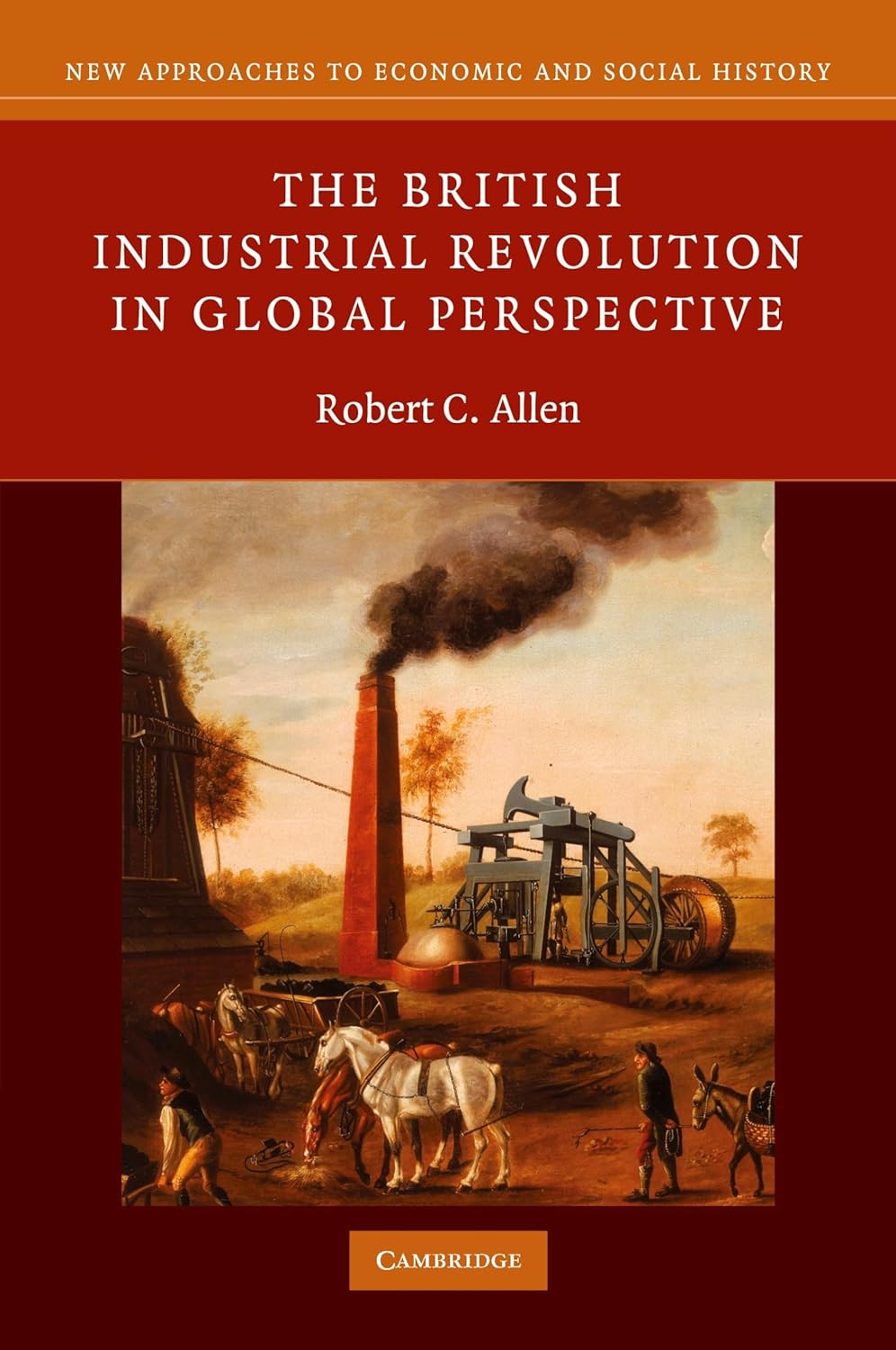
Two significant pieces of scholarship about the Industrial Revolution appeared almost simultaneously in 2009: Joel Mokyr’s “The Enlightened Economy” and Robert Allen’s “The British Industrial Revolution in Global Perspective.” They offer completely different perspectives as to why the Industrial Revolution occurred when and where it did. Both agree that technological innovation played the critical role in generating sustained economic growth, but they differ as to what promoted that innovation. Allen’s book focuses on the demand for inventions, and what kind of cost conditions made that demand so acute that it triggered the Industrial Revolution. In his view, the answer as to why the British led the Industrial Revolution can be boiled down to one simple statement: “The British were simply luckier in their geology.” That is, they were blessed with a virtually inexhaustible supply of cheap, high quality, and conveniently located coal.
Allen’s core thesis is based on two basic facts about eighteenth century Britain. First, compared to continental Europe, wages in Britain were remarkably high. Second, energy costs were remarkably cheap. The author argues that the Industrial Revolution was invented in Britain in the eighteenth century because “it paid to invent it there, while it would not have been profitable at other times and places.” In short, “The cotton mill and the coke blast furnace were invented in Britain because they saved inputs that were scarce in Britain [i.e. labor] and increased the use of inputs that were abundant and cheap [i.e. coal].” These innovations, Allen says, were tailor-made to Britain’s unique circumstances and virtually useless elsewhere until the technical innovations became so efficient in the early nineteenth century that they finally made economic sense in the prevailing conditions on the Continent and in the fledgling United States.
“The British Industrial Revolution in Global Perspective” is broken into two equal parts. Part one is devoted to explaining the pre-industrial economy. There are endless explanations for why the Industrial Revolution got going. Allen says three are more compelling than the others. First is urbanization. Beginning in the sixteenth century, British cities, particularly London, began to grow. This was driven by the enclosure of farmland and the associated agricultural revolution in the countryside. Better farming and urban growth were mutually reinforcing – “bigger cities led to more efficient farms,” Allen writes, “and better farming led to bigger cities – and were also the immediate causes of high wages in Britain. One critical result of this urbanization was a dramatic increase in literacy and numeracy. Second, there was the emergence of consumerism as a motive for work (the so-called “industrious revolution”). Finally, there was the postponement or deferral of economically inconvenient marriages (the so-called “European marriage pattern”) that slowed population growth and made wages in London the highest in the world by the eighteenth century. Allen says that this modern culture (bigger cities, smaller families, more education) was necessary for creating the Industrial Revolution, but not sufficient to bring it about. “The Industrial Revolution was the result of a long process of social and economic evolution running back to the Middle Ages,” Allen writes, but it was Britain’s unique wage and price structure in the eighteenth century that served as the pivot around which the Industrial Revolution turned.
London’s growth before the Industrial Revolution was staggering. With a population of barely 50,000 in 1500 (albeit larger than what New York City would be in 1800), London grew at 1.5 percent a year for three centuries and topped one million by 1800. Urban growth had a substantial impact on domestic timber supplies and prices because of the almost insatiable demand for wood for building and fuel. One direct outcome of this energy crisis was the slow and collective perfection of the coal burning home. British coal was “the cheapest energy in the world,” according to Allen, and the British desperately needed cheap energy. Already by 1700 over half of British homes received their thermal energy from coal. By 1800 virtually all British thermal energy was provided by coal.
Part Two focuses on explaining the Industrial Revolution. Allen says that it was technological innovation that drove the Industrial Revolution and it was the unique combination of high wages and low energy prices in Britain that drove technological innovation. In other words, British businesses demanded new technology that would substitute cheap energy for expensive labor. He hastens to add that the British possessed no genius for invention; it was their unique factor price imbalance that required it. Some have argued against this thesis by showing that very few eighteenth century British patent applications cited labor savings as a motive. Allen says that is because to do so would have courted political and social trouble, so they instead focused on product quality improvements in their official documentation.
The author then provides three excellent and extensive case studies of technological innovation that served as the engine of the Industrial Revolution: the steam engine, cotton textile manufacturing, and coke smelting. Interestingly, of the three only steam power demonstrates a direct link between the science of the Enlightenment and the key innovations of the Industrial Revolution. Thomas Savery invented and patented a steam pump in 1698. Thomas Newcomen further refined the original design into a true atmospheric steam engine in 1712. When the Savery-Newcomen patent ran out in 1733 there were one hundred steam engines at work across Britain, almost all of them pumping water from coal mines, the only use case for which they were economically viable. By the end of the century, after innumerable improvements to fuel efficiency, some small, others quite significant, there would be 2,500 steam engines working in all manner of industry. Yet, even then France would have only seventy. Steam engines would only be economical in France (and elsewhere around the world) once fuel efficiency improved enough to make them profitable in areas with high costs of energy. Between 1720 and 1840 the real coal cost per horsepower-hour dropped by 90 percent, and even then water and wind still remained the dominant sources of power across Europe and the United States.
Cotton was the wonder industry of the Industrial Revolution. In 1700 the British cotton industry didn’t exist. By 1830 it employed almost half a million people and accounted for nearly ten percent of British GDP. It was driven by a series of technological inventions that mechanized the carding, spinning, and weaving of cotton. Allen says that these innovations all “relentlessly save labor, the scarce and expensive factor of production.” But the labor costs were so different between Britain and France that some inventions, such as the spinning jenny, would prove irresistible in one place (Britain had over 20,000 jennies by 1790) and unattractive in the other (France had less than 1,000). By 1775, Richard Arkwright, inventor of the water frame and carding machine (and also likely the richest entrepreneur of the Industrial Revolution), opened his state-of-the-art water-powered cotton textile factory, Cromford Mill Number 2 in Lancashire, also the home to Britain’s world-leading watch and clock-making industry, critical for manufacturing the precise gears required in the factory. Cromford Mill Number 2 would eventually become the prototype model the world over. According to Allen it delivered a profit margin of forty percent per year, but was still barely profitable in France.
Steam engines and textile factories are the two classic case studies on technological innovation during the Industrial Revolution. Next, Allen turns to a less popular, but possibly more strategically influential example: coke smelting. Simply put, coke smelting was essential for the production of cheap iron, and cheap iron was essential for building the core components of the industrialized economy, namely railroads, steamships, and mechanized manufacturing equipment.
Abraham Darby is widely credited with developing the coke smelting process, although Allen says it was simple and “required almost thought at all” and Darby never attempted to patent the process. Moreover, Darby probably learned it from Shadrach Fox, from whom he purchased the Coalbrookdale furnace in 1708. Allen says that the growth of coke smelting went through three phases. The first phase (1708 to 1720) was the perfection of Darby’s coke furnace. “Darby’s achievement depended on copying and combining several recent developments in the iron, copper, and brewing industries,” Allen says, “a process of borrowing and amalgamation quite common across the Industrial Revolution.
The second phase (1720 to 1755) witnessed a range of improvements that made coke iron more competitive. At the end of this period it was cheaper to build a coke furnace than to make pig iron with an existing charcoal furnace.
The final phase (1755 to 1850) is when coke smelting achieved true economies of scale. The first coke smelting furnace at Coalbrookdale made 81 tons of iron in 1709. By 1850 the average blast furnace smelted over 4,600 tons a year, a 5,600 percent increase in output. Allen says this resulted in almost a 50 percent reduction in the real cost of production, which seems rather modest considering the explosion in production. Between 1750 and 1800, the percentage of British iron smelted with coke went from just three furnaces to nearly one hundred percent of the market. However, over on the continent, charcoal iron still predominated in France and Germany even as late as 1850. Over the course of the eighteenth century, Britain and France produced almost exactly the same amount of iron and grew at virtually the same pace (Britain produced 125,000 tons by century’s end, while France produced 140,000), only one did so with coke and the other with charcoal. “With French prices,” Allen writes, “coke iron was probably more expensive than charcoal iron even when everything worked right.” In the 1780s a state-of-the-art coke smelting operation based on British best practices was established at Le Creusot outside of Dijon, France. It quickly went bankrupt.
Finally, if Britain’s unique structure of wages and prices led to a demand for techniques that substituted energy and capital for labor, how and why did British inventors come forward to successfully meet the challenge? The most common explanation is some combination of culture and human capital that came together to form what Joel Mokyr has called the Industrial Enlightenment, “the part of the Enlightenment that believed that material progress and economic growth could be achieved through increasing human knowledge of natural phenomena and making this knowledge accessible to those who could make use of it in production.”
To determine if this theory has any merit, Allen takes a close look at the leading British inventors of the age, especially the “Vital Few” – the most consequential ten entrepreneurs of the eighteenth century: Josiah Wedgwood (pottery), John Smeaton (cast iron and experimentation), Thomas Newcomen (steam engine), James Watt (steam engine), Abraham Darby (coke smelting), Henry Cort (puddling process for making wrought iron), James Hargreaves (spinning jenny), Richard Arkwright (water frame), Samuel Crompton (mule), and Edmund Cartwright (power loom). Allen specifically looked to see if these men hailed from an upper class background, maintained any meaningful connections with Enlightenment science and society, and if they had demonstrated a thoughtful commitment to experimentation. The findings, he says, are industry-dependent. For instance, those that operated with steam engines maintained the closest relationships with science and the Enlightenment; those in textiles the least. In sum, “Only about half of the important inventors had a link to scientists or Enlightenment institutions; however, virtually all of them performed experiments to perfect their inventions.” Therefore, if the Scientific Revolution or Industrial Enlightenment played any role in promoting the inventions of the Industrial Revolution, it was likely by changing the culture at large and not just a handful of critical entrepreneurs.
In closing, this is a fantastic book. Allen makes a compelling argument that “The cheap energy economy was a foundation of Britain’s economic success” in the eighteenth and nineteenth centuries. In many cases, I found the counter-examples of France’s excruciatingly slow adoption of steam, coke, and machinery to be the most decisive evidence of all.
 What's Tim Reading Now?
Leave a comment