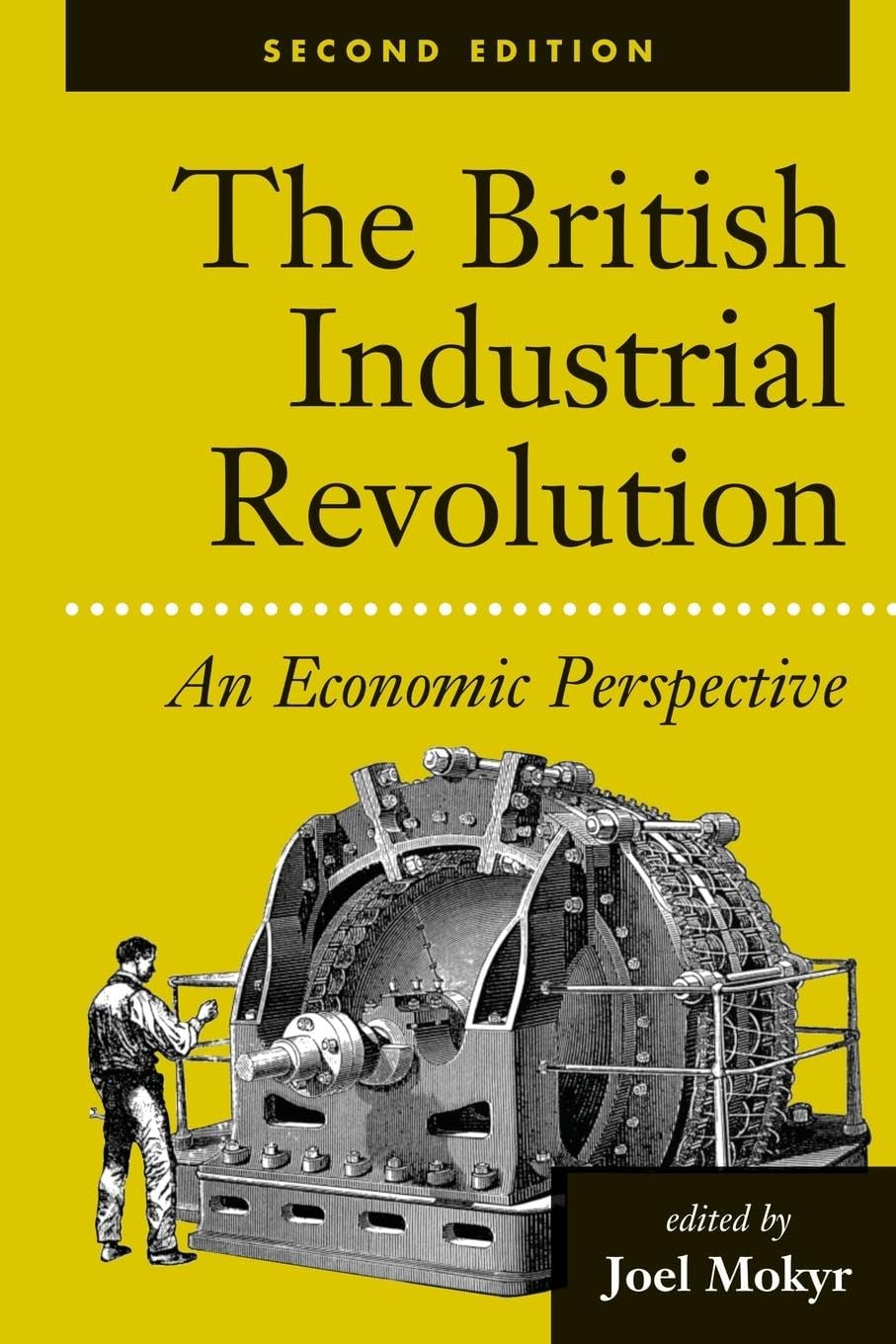
Industrial Revolution Studies isn’t a formal program at any major university, so far as I know, but there ought to be. Over the past half century a veritable library of books and scholarly articles have been published on all facets of the subject. Scholars can’t seem to agree on anything. “The British Industrial Revolution: An Economic Perspective,” edited by Northwestern University’s Joel Mokyr, appeared in 1993 and sought to highlight the current status of research on a range of related questions. Believe it or not, a lot has changed about our understanding of the Industrial Revolution since then.
“The British Industrial Revolution” is not a book, but rather a collection of five extended monographs (i.e. Mokyr’s “chapter” is a whopping 132 pages) from a couple of legends in the field (Landes and Mokyr) and a few scholars you’ve probably never heard of (Harley, Clark, and Mitch). What makes this book special is that it closely considers all the previous research on the topic going all the way back to the eighteenth century. The reader certainly feels that each scholar was exhaustive in their research and analysis.
Gregory Clark of UC Davis asks “was the Industrial Revolution accompanied by an Agricultural Revolution?” Between 1700 and 1850 it appeared as though British agricultural output per worker tripled. Since at least the time of Arnold Toynbee (1884) this was considered settled science. It has long been argued that without this agricultural revolution the urban, industrial, and densely populated modern world that emerged in the mid-nineteenth century would have been impossible. “The gains in output per worker allowed about 5 million people to be engaged in industrial rather than agricultural production in 1850, feeding the urbanization that is characteristic of this period,” Clark says. Amazingly, there is no direct connection between these dramatic gains in agricultural productivity and the technological innovations of the Industrial Revolution. They evidently emerged at the same time for different reasons.
Over the past two decades, Mokyr has struggled to tie the leading technological innovators of the Industrial Revolution back to the Baconian program of useful knowledge associated with the Enlightenment, but Clark shows rather convincingly that the British experienced something of an Agricultural Enlightenment. By 1850 there were over 600 societies in Britain dedicated to agricultural improvement, up from just 35 in 1800. Less than one periodical a year on agriculture was published in Britain in the early eighteenth century; a century later the number had grown to over 20. Yet, the unambiguous source of British agricultural productivity gains is maddeningly unclear. Clark says that the tripling of British agricultural productivity cannot be explained by any combination of yield increases on specific crops, a shift in favor of crops with higher yields, more land under cultivation, or enclosures. Even under the most positive assumptions of all four drivers combined, British agricultural productivity should not have increased by any more than 85 percent. There is no direct evidence of any major gains per worker nor did land enclosures make any tangible difference. “There was no agricultural revolution during the industrial revolution,” Clark writes, yet somehow there clearly was.
On several occasions after closely examining the available data, Clark asks “where is the missing food?” He’s unable to answer the question and often ends his sentences with exasperated exclamation points. He notes glumly, “Our failure to observe an agricultural revolution anytime from 1700 to 1850 threatens to unravel the whole Industrial Revolution.”
David Mitch of the University of Maryland (Baltimore County) examines and rejects another sacred cow of Industrial Revolution Studies: improvements in British human capital through literacy and advanced education ultimately drove British industrialism. Here, Mitch says, the answer is evidently pretty straightforward: “mediocre, stagnant, and decadent” eighteenth century British higher education and slowly improving literacy rates mattered hardly at all. “The universities were relatively inactive in spreading scientific and technical knowledge during the Industrial Revolution,” Mitch writes, although informal intellectual institutions emerged to do that. Even as late as 1840, census information shows that only 5 percent of jobs in the industrial sector strictly required literacy (and only 2 percent for women’s jobs), although literacy may have been useful in roughly half of the total jobs. In short, Mitch concludes, “there is little evidence to suggest that education played a central role in England’s Industrial Revolution,” although informal education served as alternatives to formal education, which played a positive, but by no means indispensable role.
David Landes is the doyen of modern Industrial Revolution Studies. His book “The Unbound Prometheus: Technological Change and Industrial Development in Western Europe from 1750 to the Present” (1969) was a watershed publication in the field. In a chapter in “The British Industrial Revolution” titled “The Fable of the Dead Horse,” Landes provides an overview of how Industrial Revolution Studies scholarship developed over the past 150 years. It all began with the stridently negative interpretation of events found in Toynbee’s “Lectures on the Industrial Revolution” (1884) and other social-activist scholars of the socialist Fabian Society. Their views remained the dominant interpretation until the 1920s. Then, beginning with the writings of John Clapham of King’s College and T.S. Ashton of the London School of Economics, there emerged the viewpoint of the Industrial Revolution as more gradual, circumscribed, less “cataclysmic” in nature, and on balance a net positive to society. Thus emerged a long standing academic rivalry in the field pitting two competing perspectives against each other, where academic conclusions were strongly shaped by contemporary political opinions. On one side, industrial capitalism was viewed as enslaving, alienating, and immiserating. On the other side, it was seen as the only reliable salvation from widespread and grinding poverty.
Everyone disagrees about the data, of course, but the most widely accepted research shows stagnant living standards between 1760 and 1820, and then a dramatic takeoff with 100 percent real wage growth from 1820 to 1850, although even relative Industrial Revolution optimists like Joel Mokyr consider this evidence weak and unconvincing. By the mid-twentieth century the growth economists had taken over, led by Walt Rostow, Simon Kuznets, and H.J. Habakkuk. An entire generation of economists circled back to the conclusion that the growth ushered in by the Industrial Revolution was actually quite modest and slow developing. Some scholars, such as Rondo Cameron, want to cancel the term Industrial Revolution altogether on the grounds that it is “inaccurate, unscholarly, and misleading.” Scholars that refuse to give up the term he labels the “fundamentalist ayatollahs of economic history.” Mokyr himself refers to Britain as “The Holy Land of Industrialism.”
The most recent participants to the debate are the cliometricians, classically trained economists working with huge data sets from census and probate records. Despite the appearance of quantitative precision, Landes says that their impressive-looking cliometric models are actually “brave structures built on shaky foundations.”
One thing is certain: something significant started happening in the mid-eighteenth century and it hasn’t stopped for over two hundred years. Today, Switzerland has a per capita income that outpaces that of Mozambique by 400 to 1, a chasm that Landes says is “a source of resentment, discouragement, humiliation, and hostility.” Yet, Landes remains an unreformed “fundamentalist ayatollah of economic history” who proudly embraces and capitalizes the term Industrial Revolution. “In all the annals of human history,” he says, “no innovation has been so universal in its appeal, so ecumenical in its impact.”
Why is explaining the Industrial Revolution so hard? In his sprawling introductory chapter/monograph, Mokyr concedes that “arguments about what exactly changed, when it started, when it ended, and where to place the emphasis keep raging.” Indeed, I don’t think it will ever stop. Scholars can’t even agree on what the Industrial Revolution was all about. Was it the emergence of a market economy or the factory system or technological innovation or sustained economic growth? Mokyr emphasizes the limited nature of the Industrial Revolution for a long time. It was largely confined to a single industry (textile manufacturing) in a single region (Lancashire). “The new spinning technology (of Arkwright, Hargreaves, and Crompton) practically created an industry de novo,” he says. The gains from technological progress were then accelerated by gains in foreign trade and specialization.
Mokyr stresses that the British had no comparative advantage in invention, but rather excelled at innovation – or what one might call tinkering with other people’s breakthroughs. “British society exhibited a degree of tolerance for deviant and heterodox ideas that was unusual, though not unique,” according to Mokyr. Moreover, this innovation was “consistently and vigorously” supported by the British government, while otherwise leaving private enterprise alone. “It is no exaggeration to say that nowhere in the world was property perceived to be more secure than Britain,”Mokyr writes, and nowhere was the connection between wealth and social status so tight as in the Hanoverian period (1714 to 1901).
I found some of Mokyr’s conclusions unconvincing. For instance, he is quick to reject demand-driven innovation as “quite clearly fallacious,” but then goes on to show that classic Smithian division of labor created specialized workmen who were more inclined to drive technological innovation because breaking up the production process into simple parts made each part more simple to mechanize. He then shows how demand for inexpensive cotton textiles along with productivity gains in weaving could serve as a “focusing device” that funneled more capital and innovation on complementary activities like spinning. Next, he concludes that “Empire and foreign policy seem to have conveyed at best a slight advantage,” but then shows that the cotton textile industry – the industry most influenced by technologically-driven productivity gains – depended on foreign markets for half of its sales.
The technological advances achieved by the British were owed more to a mindset than scientific knowledge, Mokyr says. British mechanics possessed “a rational faith in the orderliness and predictability of natural phenomena – even if the actual laws underlying chemistry and physics were not fully understood.” British engineers were more likely to atomize technical problems, analyzing them individually as part of a whole. Mokyr contends that British science was different from French science, as was the position of British scientists in society. “Bacon’s science was empirical, experimental, and pragmatic whereas French science was theoretical and abstract.” Scientific enterprises in Britain were supported mainly by the private sector, whereas the government subsidized and managed things in France.
In closing, “The British Industrial Revolution” is a dense and somewhat out-dated review of the leading arguments and controversies in the field. If you are looking for a shorter, more straight-forward and more accessible assessment, try “The Industrial Revolution: A Very Short Introduction” by Robert C. Allen (2017).
 What's Tim Reading Now?
Leave a comment