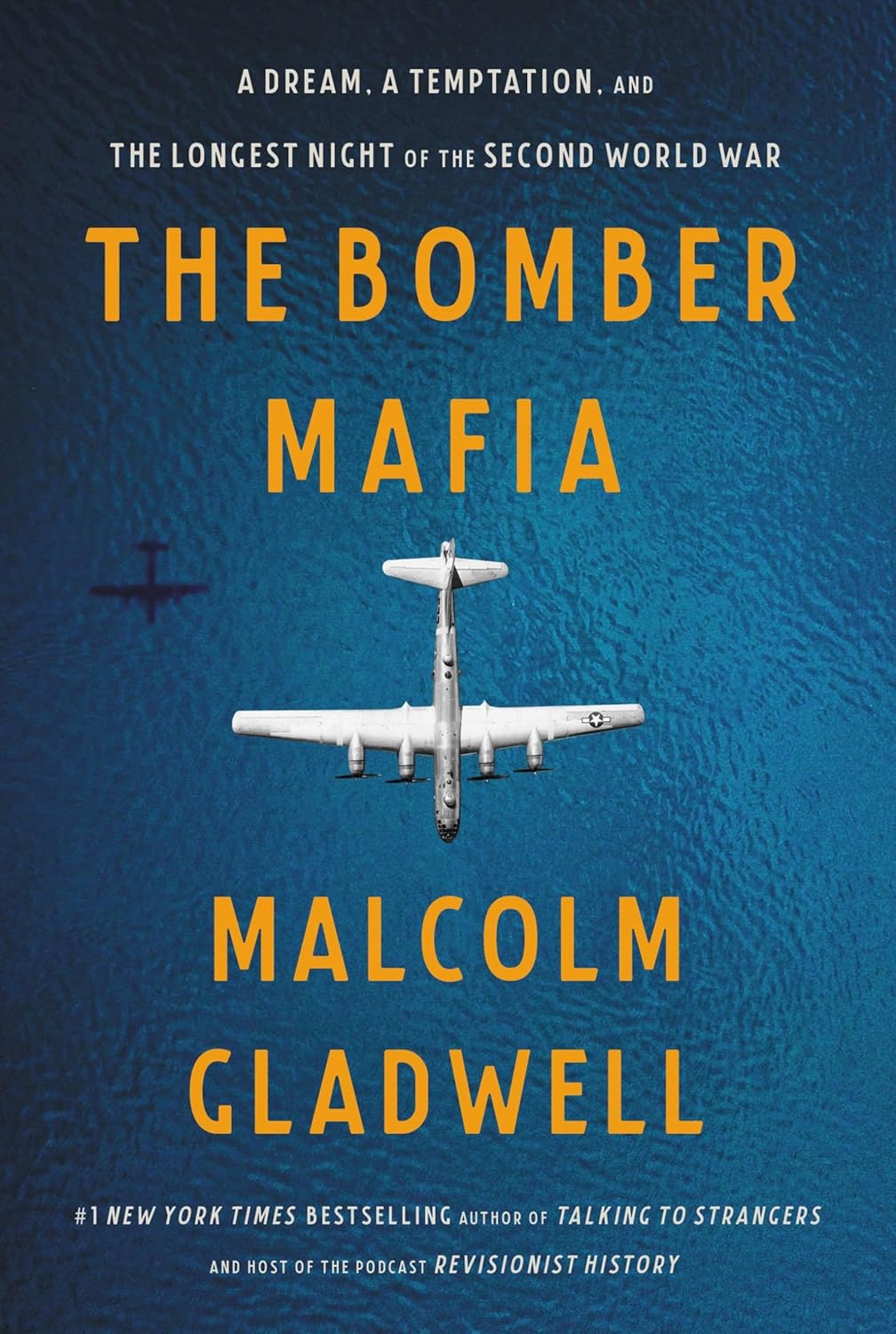
Somebody (but definitely not Mark Twain) once said, “It’s easier to fool people than to convince them that they have been fooled.” It seems to me this is what Malcolm Gladwell’s latest bestseller, “The Bomber Mafia: A Tale of Innovation and Obsession” (2021), is really all about, although the author doesn’t frame it that way.
Most Gladwell books seek to answer a compelling and often vexing question: Why do some things go viral (The Tipping Point)? Why are some people so much more successful than the rest of us (Outliers)? Why do people, even experts, have such a hard time correctly reading people (Talking to Strangers)? Gladwell then cobbles together a bunch of related research and captivating anecdotes to create a brisk narrative that presents a plausible explanation to the question. For some reason he doesn’t do that in “The Bomber Mafia.” Rather, this is a short story about how a small group of renegade airmen in the 1930s got it all disastrously wrong. “The Bomber Mafia,” he says, “is a case study in how dreams go awry.”
The bomber mafia was a group of perhaps a dozen Army Air Force officers teaching at the Air Corps Tactical School at Maxwell Airfield in Montgomery, Alabama in the interwar period. I suspect you’ve never heard of any of the members: Haywood Hansell, Donald Wilson, Ira Eaker, Harold George. Their motto was Proficimus more irretenti: “We make progress unhindered by custom.” They developed a radically new concept of future war that was built upon three critical assumptions, all of which would prove to be catastrophically misguided during the Second World War.
First, they believed that modern warfare left industrialized nations highly vulnerable to crippling attacks on their defense industrial complex. Gladwell says the origin story to this belief came in 1936 when a flood in Pittsburgh inundated a Hamilton Standard plant that manufactured a spring critical to the production of airplane propellers. The entire American aeronautics industry ground to a halt. The bomber mafia were inspired. What if you could identify the choke points in the enemy’s defense industrial base, such as factories that produced essential components like springs and ball bearings? You could theoretically end the war quickly, efficiently and relatively bloodlessly by taking out a short list of manufacturing facilities like the one that was flooded in Pittsburgh. (Curiously, Gladwell seems to suggest that this idea originated with the men at Maxwell Airfield in 1936 and never once mentions the early air power theorists who actually developed this theory, such as the Italian general Giulio Douhet [1869-1930] whose highly influential book on strategic airpower [“The Command of the Air”] and the importance of targeting a country’s industrial base appeared in 1921.) Before the war, the Army Air Force developed Air War Plans Division One (AWPD-1) that identified 148 strategic targets across Germany, such as electrical power plants, synthetic oil refineries, aluminum plants, and aircraft assembly lines, whose loss, it was believed, would utterly cripple Hitler’s war making ability.
The second critical assumption held by the bomber mafia was that “the bomber will always get through”. Modern bombers, they believed, would fly so high, so fast, with such thick armor and such fearsome defensive weapons that they would be virtually invulnerable to enemy anti-aircraft measures and attack planes. The US government would eventually put its money where its mouth was. The most expensive national defense project of the entire Second World War was not the Manhattan Project (that was the second most expensive), which cost $2 billion ($29 billion in current dollars), it was the B-29 Superfortress, which cost $3 billion ($42 billion today).
Finally, the bomber mafia believed that the riddle of accurate high altitude bombing had been solved. The third most expensive defense project of the war was the development of the famed Norden bombsight, also known as the Mark XV, which cost $1.5 billion, almost as much as the atomic bomb, believer it or not. The Norden bombsight, developed by the eccentric Dutch inventor Carl L. Norden, was “the mechanical cornerstone of the Bomber Mafia ideology,” according to Gladwell. It was a 55 pound analog computer that allowed a bombardier to input up to 64 variables (such as airspeed, temperature, altitude, wind speed, bomb type and weight, angle of attack, lateral drift caused by crosswinds, etc.) to compute when to accurately release his payload. It took six months of intense training to operate it. The Norden bombsight, it was said, enabled a modern bomber to “drop a bomb into a pickle barrel from six miles up.” For the strategic airpower theorist at Maxwell Field it was the Holy Grail. It would turn out to be a false idol.
For the bomber mafia all of this added up to an entirely new strategy for airpower: high altitude, daylight precision bombing of critical industrial choke points. On paper it all made sense. The attributes of the modern bomber would keep American airmen safe. The accuracy of the Norden bombsight would ensure that the enemy’s warmaking capacity would be crippled quickly and relatively humanely. The war would be over quickly and with limited loss of life on both sides. It sounded almost too good to be true – because it was.
One by one these assumptions would be proven frighteningly inaccurate. Roughly 38,000 men in American bomber crews would consequently lose their lives because of it. First, Germany and Japan’s defense industrial base proved remarkably resilient against bomber attacks. There would be no repeating of the Pittsburgh propeller spring factory in the Second World War. Perhaps the most famous example of the bomber mafia’s theory in practice was the US raid on the German ball bearing plants at Schweinfurt, which Gladwell calls “a bomber mafia fantasy.” The Army Air Force launched 230 B-17 bombers against the five ball bearing plants at Schweinfurt in August 1943. The crews dropped two thousand bombs but scored only eighty hits, decreasing German ball bearing production by roughly a third. The impact on overall German war production was negligible. After the war, the United States Strategic Bombing Survey concluded “there is no evidence that the attacks on the ball bearing industry had any measurable effect on essential war production.” Sixty planes were lost during this single raid and 552 airmen were killed. This type of performance would be repeated again and again.
By 1943 it was clear that the bomber would most certainly not always get through, the Norden bombsight was both not as accurate as advertised and rendered completely useless when confronted with common obstacles, such as cloud cover or the high winds of the jet stream. Whatever damage was done to defense manufacturing plants was quickly repaired. In the case of the Schweinfurt raid the statistics were sobering: twenty-five percent of the bombers did not get through, only four percent of the bombs dropped hit their target, and the ball bearings plant’s production temporarily degraded by just thirty percent. The Army Air Force was unable to improve much on these metrics for the remainder of the war, according to Gladwell.
Did the bomber mafia give up on their strategy and pivot to something else? No, Gladwell says, they did not. Instead, they doubled down and clung tenaciously to their pre-war beliefs. Why? Gladwell hardly says, which is a shame because this is a classic Gladwellian question. Why do people cling to existing beliefs even after they have been proven undeniably wrong? Gladwell briefly cites one example of a cult in Chicago whose leader convinced them that a spaceship would pick them up in the moments before God destroyed the world again by flood. A researcher accompanied the members of the cult on the night of their anticipated extraterrestrial pickup. When the hour of the pickup came and went, he noted that everyone accepted the disappointment without rancor or incrimination. They just got up and left. I would have loved to learn more about the psychology of all of this. How do people react when their most deeply held convictions are overturned? How did communist true believers react when the shortcomings of their political and economic systems became undeniable?
The bomber mafia may not have been prepared to rethink air power strategy, but one man was: General Curtis LeMay. LeMay is the unlikely hero of Gladwell’s narrative. In American pop culture LeMay is often portrayed as a homicidal, knuckle-dragging neanderthal. He was the inspiration for the character General Jack D. Ripper in Stanley Kubrick’s classic 1964 anti-war film “Doctor Strangelove,” a fact that Gladwell curiously never mentions. LeMay is perhaps best known for saying he wanted to bomb the North Vietnamese “back to the stone age.” Again, curiously, Gladwell only acknowledges this fact in a footnote on the second to last page of the book, where he also notes, “oh, by the way…” LeMay was the 1964 vice presidential running mate of the uber racist segregationist George Wallace. Talking about burying the lede! In the pages of “The Bomber Mafia,” Gladwell refers to British air war advisor and advocate of saturation bombing Frederick Lindemann as a “sadist” and British Air Marshal Arthur Harris as a “psychopath,” but seems to endorse the assessment of military historian Conrad Crane that LeMay is “the greatest airman in history.”
LeMay replaced the bomber mafia’s chief evangelist Haywood Hansell as commander of the Twenty-First Bomber Command in the Mariana Islands in January 1945. Hansell was the “anti-LeMay,” according to the author, and “trueist of the true believers” when it came to strategic airpower theory. But he had not been getting results and his boss, Chief of the Air Staff General Lauris Norstad, wanted results, not excuses. Thousand mile distance, poor weather, the unanticipated jet stream over Japan, and poor intelligence on the distributed Japanese defense industrial base all combined to render Hansell’s daylight, high altitude precision bombing campaigns ineffective. It was time for a change and Hansell was clearly not prepared to change. LeMay was.
The new air commander completely scrapped the bomber mafia’s precision strategic airpower theory and tactics. LeMay would implement a 180 degree change of plans. Instead of daytime raids, they would come at night. Instead of flying at high altitude, they would come in at 5,000 feet. Instead of trying to precision drop bombs on specific defense manufacturing plants, they would indiscriminately dump thousands of tons of napalm across the city, deliberately creating a firestorm that would consume everything in its path. As horrible as it sounds (and was), it worked. The initial firebombing of Tokyo in March 1945 dropped 1,665 tons of napalm on the city and killed an estimated 100,000 people. The Strategic Bombing Survey concluded that more people lost their lives by fire in a six-hour period in Tokyo than at any time in the history of man. LeMay’s Twenty-First Bomber Command would go on to incinerate 67 Japanese cities in less than six months. It is estimated that as many as one million men, women and children lost their lives.
In a matter of months LeMay brough Imperial Japan to its knees. He later said the atomics bombs were “superfluous.” Incredibly enough, in 1964, the Japanese awarded LeMay the First Order of Merit of the Grand Cordon of the Rising Sun, the highest award their country could give a foreigner. Evidently the Japanese also believed the argument that LeMay’s brutal air campaign hastened the end of the war thus preventing a US invasion of the Japanese islands in late 1945 that likely would have killed millions and perhaps avoid the postwar partitioning of the Japanese homelands if the Soviets had joined the assault and eventual occupation.
So, whatever happened to the members of the bomber mafia after the war? Did they ever recant? Come to terms with their mistakes and faulty beliefs? Gladwell, unfortunately, doesn’t say.
 What's Tim Reading Now?
Leave a comment