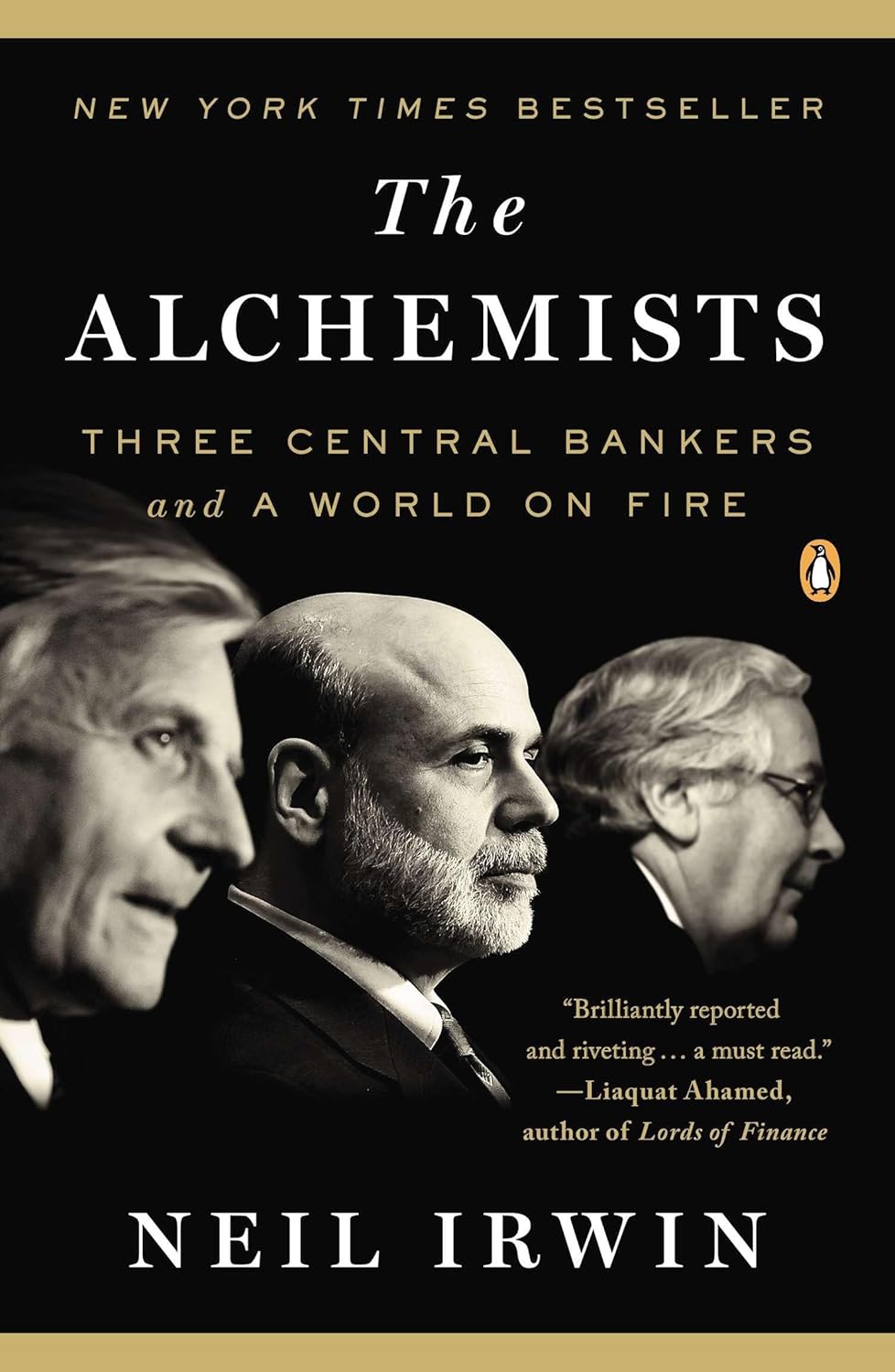
For many years Ben Bernanke was an economics professor at Princeton University with an academic focus on the Great Depression. He was plucked from obscurity by the Bush administration and made chairman of the Federal Reserve in February 2006. A short 18-months later the subprime mortgage crisis hit. Bernanke and his peers at the Bank of England and the European Central Bank (ECB), Mervyn King and Jean-Claude Trichet, had to use every tool at their disposal (while inventing a few new ones along the way) to stave off another Great Depression. Neil Irwin, senior economics correspondent at The New York Times, tells this gripping, fast-paced story in “The Alchemists: Three Central Bankers and a World on Fire” (2013).
Irwin breaks the story into four parts. The first is a hundred page backstory on central banking. He starts at the beginning, with Johan Palmstruch, “history’s first central banker,” according to the author, who led Sweden’s Stockholms Banco in 1656. Palmstruch held large reserves of Sweden’s clumsy and heavy currency, copper plates known as dalers. He began issuing paper certificates against this currency and the world’s first reserve currency was born. Predictably, this was soon followed by overprinting, runaway inflation, panic, and finally collapse. By 1667, history’s first central banker was in jail for fraud. Many contemporary opponents of the Fed probably feel the same should happen to Bernanke & Company.
Irwin shows that central banking has been a centuries long experiment of trial and error. However, one of the rock solid principles is that the central bank should be the so-called lender of last resort. Walter Bagehot, nineteenth century editor of The Economist, famously counseled that to avert a panic, central banks should lend early and freely (i.e. without limit) to solvent firms, against good collateral and at high rates. Bagehot’s Dictum still applies today.
The United States came to modern central banking slowly and late. The Bank of England was founded in 1694. The US Federal Reserve System was established over two centuries later in 1913. The so-called Free Banking Era (1836 to 1863) was marked by severe panics and accompanying recessions (1837, 1839, 1857). The National Banking Act of 1863 tied the supply of dollars to chartered banks’ holding of government bonds. It was an improvement, but the money supply remained inelastic and thus prone to exogenous shocks, such as the failure of the bank Jay Cooke & Company in 1873. Further panics occurred in 1884, 1890, and 1893. Instead of a single central bank, the National Reserve Association created a network of twelve banks around the country as a way to balance power among regional institutions and a central authority. Some districts covered large swaths of the population, such as San Francisco (20% of the population), while others covered a tiny sliver, such as Minneapolis (3%). Irwin calls the whole things “an unwieldy and complex organization.”
By the early twentieth century, central bankers still had a lot to learn about their craft. Rudolf von Havenstein led the German Reichsbank in the aftermath of the First World War and is responsible for the infamous hyperinflation of the post-war years. We’ve all seen the images of some poor Berliner using a wheelbarrow full of inflated deutche marks to pay for a loaf of bread. I always thought the Germans did this deliberately to wipe out their reparations. Evidently not. By 1923, Havenstein might increase Germany’s money supply by two-thirds in a single afternoon. Irwin says he was convinced that this was a good thing. I’m not sure how.
By the late twentieth century central bankers still found controlling inflation a vexing issue. The United States abandoned the Bretton Woods system of fixed exchange rates in April 1971. Inflation climbed relentlessly until it was over 13% when Paul Volcker took over the Fed in 1979. Volcker embarked on a novel strategy for getting inflation under control. Rather than control the price of money (interest rates), the Fed would target the supply of money itself. Irwin likens it to a business that sets out to sell 100 hamburgers and adjusts the price as necessary to sell the inventory, rather than listing the price as $10 per hamburger and seeing how many they can sell. The upshot is that Volcker committed to raising interest rates as high as necessary to get inflation down (that is, he would do whatever it took to sell the 100 hamburgers). By 1982 inflation was under 4%. Irwin says that Volcker’s policies were painful, but the Fed had earned its reputation as an uncompromising inflation fighter. Moving forward, both Wall Street and Main Street would remain confident the Fed would prevent prices from spiraling out of control.
By 2005, Irwin writes, it appeared that the industrial world’s economic problems had more or less been solved. In fact, the world was then at the tail end of what would become known as The Great Moderation, a period of decreased macroeconomic volatility from the mid-1980s to the financial crisis of 2007. This smooth sailing was directly attributable to the professional competency of the world’s leading central banks. Or so the central bankers thought. They called it the “Jackson Hole Consensus,” after the location of the Kansas City Fed’s annual conference for economic scholars. It emphasized the importance of politically-insulated monetary policy focused on price stability as the best means of economic stabilization. It also held that financial crises were history.
By 2005, the global economy faced a unique problem – a “global savings glut.” There was more money than there was reasonably safe investment opportunities. Irwin writes, “Capitalism is a powerful force for creating that which is in demand – even something as intangible and elusive as a safe investment.” The financial services industry cooked up the mortgage-backed security. They had first been introduced in the mid-1990s. In 1995, $36 billion were issued. By 2005 almost $1 trillion dollars in mortgage-backed securities were issued and the market screamed for more. Interest rates around the world were at near zero and financial institutions were issuing trillions of dollars in a relatively new instrument that even a high school sophomore could see were inherently precarious.
The second and third parts of “The Alchemists” are a blow-by-blow account of the extended global financial crises of 2007 to 2010. It started in August 2007 when BNP Paribas announced it was unable to value some of its mortgage-related assets. A month later the Bank of England had to intervene to rescue mortgage provider Northern Rock. In March 2008 the Fed used its 13(3) authority to lend money in “unusual and exigent” circumstances to rescue investment bank Bear Sterns by allowing for an acquisition by JP Morgan. Five months later, however, the Fed would stand aside as Lehman Brothers went under. The morning after Lehman Brothers failed the Fed rescued insurer AIG with an emergency $85 billion loan. Bernanke later said: “The failure of AIG, in our estimation, would have been basically the end.” In October, in an unprecedented move, the United States, Britain and the Eurozone announced a coordinated interest rate cut. By March 2009, the S&P 500 had fallen 57% from its 2007 peak. It looked as if the economy were headed for another Great Depression. Indeed, a chart of stock market performance from 2007 to 2009 tracks very closely with the period 1929 to 1931.
What made this financial crisis so frightening and catastrophic, according to Irwin, is that the investments cratering, such as money market mutual funds, had been viewed as absolutely safe. Much of the financial world is based on trust and some degree of illusion – for instance, fiat currency and fractional reserve banking. In 2008 and 2009 the financial services industry was confronting the possibility that the entire architecture was a fraud. The Fed’s response was a gargantuan $1.75 trillion quantitative easing and an interest rate of near zero, while simultaneously serving as the lender of last resort to much of world, lending roughly a quarter of its total assets ($580 billion) to foreign central banks.
By the summer of 2009, the Fed, a largely secretive and undemocratic institution that had battled mightily over the past eighteen months to keep the US and global economy from descending into cataclysm, had an approval rating of 30% in a new Gallup poll. Anger at the Fed came from both directions politically, the Occupy Wall Street movement on the Left and the Tea Party movement on the Right. Bernanke was barely reconfirmed (70-30) for a second four-year term as chairman of the Fed in January 2010. Meanwhile, the Fed just barely preserved its vital independence in a wave of reform legislation focused on transparency and accountability, culminating in the Dodd-Frank Act of July 2010, which included new oversight organizations such as the Consumer Financial Protection Bureau and the so-called Volker Rule that limits how banks can invest and trade.
Just as the major central banks seemed to have the global financial subprime mortgages crisis under control, the long-term financial instability began toppling the weaker members of the Eurozone, the so-called GIPSIs (Greece, Ireland, Portugal, Spain, Italy). In May 2010, European leaders agree on a €110 billion Greek aid package that was met by widespread popular protests against associated austerity measures. What was never made clear to me was how and why Greece’s extreme budget deficit – which in 2009 amounted to 15.7% of its economy, the highest in the world – somehow imperiled the entire seventeen-nation Eurozone of 330 million people. How can country of eleven million people with a GDP of only $300 billion and accounting for just 2% of economic output threaten the entire superstructure of the euro? Obviously it can, it’s just that Neil Irwin never really explains how. Or if he did, I missed it.
Meanwhile, in November 2010 the Fed announces another $600 billion round of market intervention known as “Quantitative Easing Two” (QE2). A skeptical Congress and weary Main Street greeted the news with “activism fatigue,” but Bernanke and the Fed argued it was necessary to achieve their “dual mandate” of ensuring stable prices and maximum employment. The Fed certainly had its fair share of critics, but evidently Irwin isn’t one of them as he never suggests what Bernanke & Company could have done differently or better. In fact, Irwin sums up the controversial Fed Chairman’s achievements this way: “Ben Bernanke had steered the US and world economies away from the financial abyss in 2008, preserved the Fed’s political independence in 2009, and undertaken QD2 in 2010, quite possibly averting a deflationary spiral and a new recession.” Wow! Give this guy a medal already! Bernanke’s only mistake, according to Irwin, was allowing Lehman Brothers to collapse.
The fourth and final part of “The Alchemists” focuses on the painful restructuring undertaken by the GIPSI countries in 2010-2011. In the summer of 2011, as countries like Spain and Ireland struggled to maintain solvency, the European Central Bank announced a quarter-percent rate hike to stanch an inflation rate that had inched up to nearly 3%. Irwin says that those rate hikes might be “among the biggest monetary policy mistakes of the modern age.” From the perspective of 2023, that feels like a silly exaggeration. In an effort to save the GIPSI economies – and in violation of its own rules – the ECB began buying billions of euros in Greek and Spanish bonds. Something had to be done. By 2012, unemployment in Spain was nearly 25%!
The United States slowly emerged from the financial crisis. After four years of near zero interest rates and $2 trillion dollars in bonds purchased in multiple rounds of quantitative easing, Bernanke still wasn’t finished. The Fed began experimenting with alternative ways to leverage monetary policy to promote long term economic growth, such as shifting the Fed’s portfolio from short-term to long-term treasury bills (aka Operation Twist) and the explicit targeting of GDP goals to guide policy actions much the same way Volcker once targeted the money supply to reign in inflation in the early 1980s. In an effort to get unemployment below 6.5% and inflation under 2.5%, further rounds of open-ended quantitative easing have been speculated. Known as QE3 – or jokingly as QE Infinity – the Fed would signal to the market that aggressive market intervention will continue indefinitely until those goals are achieved.
“The Alchemists” is a great read for the layman looking to better understand the turbulent economic times of what has become known as “The Great Recession.” “The Big Short” is more entertaining and does a better job explaining the roots of the subprime mortgage crisis, but “The Alchemists” provides a much broader scope.
 What's Tim Reading Now?
Leave a comment