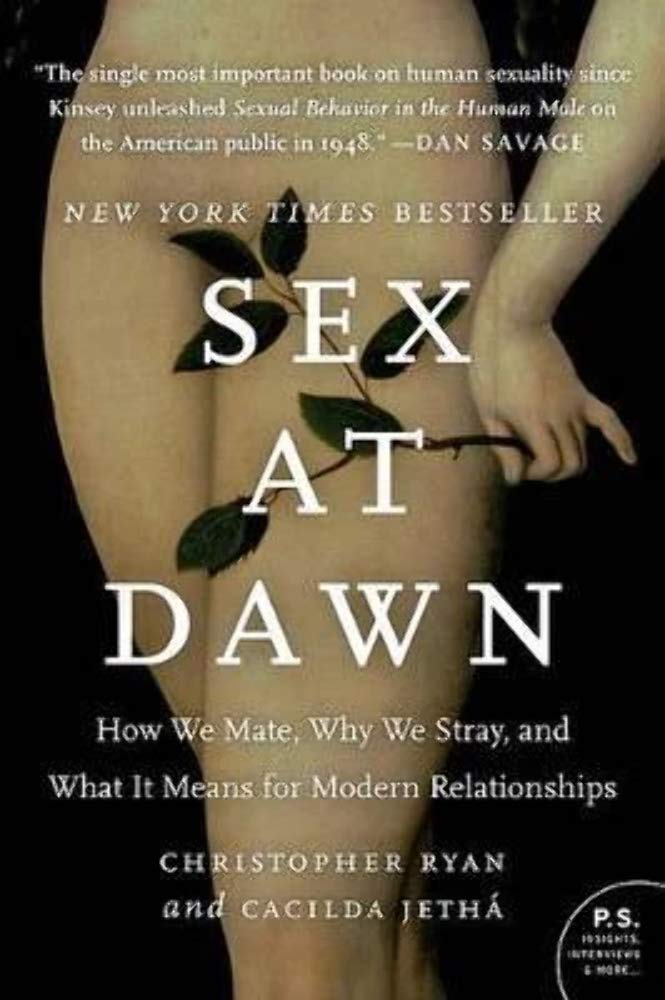
Anthropologists have long noted that marriage is virtually universally present in all cultures across time and place. From that observation it has been extrapolated that monogamous pair bonding is the natural mating arrangement for Homo sapiens. In “Sex at Dawn: How We Mate, Why We Stray, and What It Means for Modern Relationships,” Christopher Ryan and Cacilda Jetha challenge these basic and long held presumptions. “Despite centuries of religious and scientific propaganda,” they say, “the basic illusions underpinning the supposed ‘naturalness’ of the conventional nuclear family is clearly exhausted.”
The authors begin by describing and then rejecting the standard narrative of human sexual evolution. That narrative goes something like this: Men, with nearly inexhaustible sperm, are driven to mate widely and frequently; women, with an extremely limited supply of eggs, are choosier in selecting mates and trade sexual access in return for access to resources and physical protection; men gain certainty of paternity in this arrangement and thus ensure that their genes are passed on to the next generation. The authors argue that this narrative cannot be explained by evolutionary biology but rather is a cultural phenomenon shaped by the agricultural revolution that began some 10,000 years ago.
Our true sexual instincts, they claim, were honed over hundreds of thousands of years during human prehistory when our ancestors were hunter-gatherers and our social arrangements were very different. Contrary to popular conception, often characterized by Thomas Hobbes’ assertion that prehistoric human existence was “solitary, nasty, brutish, and short,” the authors argue that our hunter-gatherer ancestors led an almost idyllic life. “A dispassionate review of the relevant science clearly demonstrates that the tens of thousands of years before the advent of agriculture,” they write, “while certainly not a time of uninterrupted utopian bliss, was for the most part characterized by robust health, peace between individuals and groups, low levels of chronic stress and high levels of overall satisfaction for most of our ancestors.”
Low human population density ensured an abundant and varied diet. The upshot, the archaeological record shows, was that prehistoric humans were as tall as their modern descendants and, if they survived early childhood, could expect to live a full life of 70 years or older. Moreover, their lives were far from solitary. In all likelihood, they lived in close-knit communities of 100-150 individuals. And they propagated by having indiscriminate sexual relations and raising their offspring cooperatively and communally. Wait….what?!
Yes, that is the big “gotcha” in “Sex at Dawn.” “What if – thanks to the combined effects of very low population density, a highly omnivorous digestive system, our uniquely elevated social intelligence, institutionalized sharing of food, casually promiscuous sexuality leading to generalized child care, and group defense – human prehistory was in fact a time of relative peace and prosperity.”
Basically, they argue that female human sexuality has been warped and constrained over that past few thousand years, much to the detriment, presumably, of female human sexuality. “Institutionalized sharing of resources and sexuality spreads and minimizes risk,” the authors write, “assures food won’t be wasted in a world without refrigeration, eliminates the effects of male infertility, promotes the genetic health of individuals, and assures a more secure social environment for children and adults alike.”
The authors present a few points to defend their thesis. First, they say, consider the famously libidinous behavior of the bonobo, our closest genetic relative besides the chimpanzee. (One of the many interesting things I learned in reading “Sex at Dawn” is that there is only 1.6% genetic difference between humans and chimps and bonobos; that’s less than that between dogs and foxes or African elephants and Indian elephants.) If you squint hard enough, bonobos may actually represent our distant hunter-gatherer past, demonstrating close knit, largely peaceful, and wildly promiscuous behavior. Fun fact: humans and bonobos are the only female mammals to have hidden ovulation and copulate throughout their menstrual cycle.
Second, the authors claim that human anatomical biology also supports their claims. In short, both the male and female genetalia show signs that humans evolved where mating competition occurred at the microscopic level. Rather than having the strongest males fighting it out for exclusive sexual access to the female herd (e.g. polygamous), human sexual competition developed to occur inside the vagina. For instance, the authors argue, the enlarged head of the human penis and the back-and-forth thrusting of mating was specifically designed as a plunger to suck out the semen of the last male. Furthermore, they write about the chemical properties in the first and last ejaculatory thrust to show that the real competition occurs after sex is over. “The evidence that sperm competition played a role in human evolution is simply overwhelming,” they claim.
So what do Ryan and Jetta really tell us about human sexuality? Frankly, I’m not sure. I love their playful writing style and applaud their disruptive arguments. But did they convince me? No. They didn’t. They ask serious and compelling questions, such as: “Might the contemporary pandemics of fracturing families, parental exhaustion, and confused, resentful children be predictable consequences of what is, in truth, a distorted and distorting family structure inappropriate for our species?” But the alternative narrative they supply provides precious few answers. For instance, the authors argue, “If human sexuality developed primarily as a bonding mechanism in interdependent bands where paternity certainty was a nonissue, then the standard narrative of human evolution is toast.” If the standard narrative of human evolution is, in fact, “toast,” how does their competing worldview better help explain contemporary human sexual relations?
Toward the end of the book the authors cite some social science research showing that sex is, for women, a primarily emotional connection. In a world where women regularly had sex with every eligible male in the social group, why would emotional connection matter? The authors never seek to reconcile this fact (?) with their thesis. “One of the most important hopes we have for this book,” they write, “is to provoke the sorts of conversations that make it a bit easier for couples to make their way across this difficult emotional terrain together, with a deeper, less judgmental understanding of the ancient roots of these inconvenient feelings and a more informed, mature approach to dealing with them.” They completely ignore the fact that most Western women feel no strong urge to procreate indiscriminately. There appear to be deeply ingrained differences between male and female sexual preferences and the standard narrative best explains these differences that the authors explicitly reject.
 What's Tim Reading Now?
Leave a comment