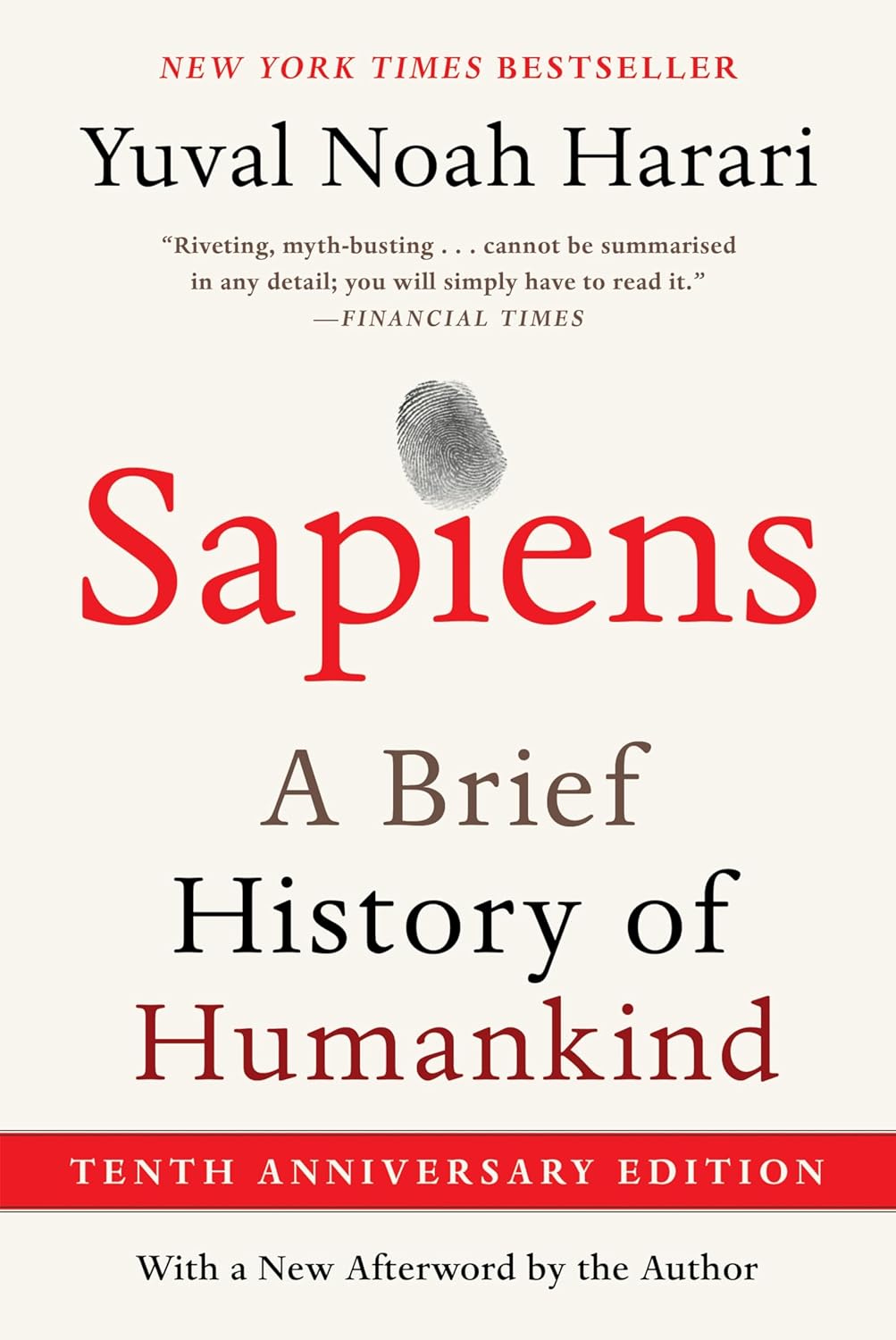
Yuval Noah Harari’s “Sapiens: A Brief History of Humankind” may be the most popular non-fiction title of the past decade. It has sold more than 10 million copies and appears in dozens of languages. What surprised me most after finally getting around to reading it is how relatively unoriginal it all is.
Harari divides his narrative into four parts. The first, the Cognitive Revolution, explores human pre-history. The Cognitive Revolution occurred between 70,000 to 30,000 years ago. It allowed Homo sapiens – one of half a dozen distinct human species (e.g. Neanderthals, homo erectus) – to communicate at a level never seen before in language. As far as we know, only Homo sapiens can talk about things we have never seen, touched, or smelled, which allowed us to create unifying institutions like religions, myths, legends, and fantasies These revolutions have empowered humans to do something no other form of life has done, which is to create and connect around ideas that do not physically exist (think religion, capitalism, and politics). Harari’s primary and most striking insight of the entire book is that it is these shared “myths” that have enabled humans to take over the globe and have ultimately put humankind on the verge of overcoming the forces of natural selection, but that is jumping ahead in the story.
Part Two reviews the Agricultural Revolution, which occurred some 10,000 years ago. Harari is no fan of this epoch making event. In fact, he calls it one of the greatest frauds in human history. Contrary to what many believe, the establishment of permanent agricultural communities did not make human life any better. It did help support larger population growth, but at a great cost in standard of living. Harari says that our hunter-gatherer ancestors had a better and more diverse diet, a more disease free life, and an overall healthier lifestyle. Once Homo sapiens began to farm wheat in a systematic way, days became long and dull with backbreaking labor, while the close quarters of village living led to an explosion of communicable diseases. “This discrepancy between evolutionary success and individual suffering is perhaps the most important lesson we can draw from the Agricultural Revolution,” he says.
Part Three looks at the Unification of Mankind. So what made Homo sapiens so unique, so powerful, so disruptive? It wasn’t our intelligence, per se, according to Harari. For much of our existence, despite our enormous brains, Home sapiens have lived somewhere in the middle of the food chain. Moreover, if brain size alone dictated success, it would be Neanderthals dominating the earth today, not Homo sapiens. Rather, Harari argues again that it was our ability to communicate and, most important of all, our ability to create myths. Without myths, such as money, empires, and religion, we would likely never be able to cooperate in groups larger than 100 or so individuals. As Harari concludes, “Commerce, empires and universal religion eventually brought virtually every Sapiens on every continent into the global world we live in today.”
The fourth and final part tackles the Scientific Revolution, which began around 1500 and continues to today. Harari’s main point here is that the power of modern science has supercharged the fundamental myths that have united mankind. Indeed, he claims, “The feedback loop between science, empire and capital has arguably been history’s chief engine for the past 500 years.” He explains that feedback loop this way: “Over the last 500 years the idea of progress convinced people to put more and more trust in the future. This trust created credit; credit brought real economic growth; and growth strengthened the trust in the future and opened the way for even more credit … This was the magic circle of imperial capitalism: credit financed new discoveries; discoveries led to colonies; colonies provided profits; profits built trust; and trust translated into more credit.” Harari’s arguments are neat and compelling.
The author ends his long exploration on the history of human development on a rather curious note. He asks if all of our recently begotten affluence, peace and security have made us any happier as a species? In other words, is a banker in twenty-first century New York any happier than a hunter-gather living 20,000 years ago? The gut response might be “of course,” but Harari says that it isn’t that simple. Whether you explain happiness as a biochemical phenomenon, the pursuit of a life worth living, or the absence of craving for more the answer is unclear. In fact, he concludes, “This is the biggest lacuna in our understanding of history.”
Harari concludes “Sapiens” with a brief peak into the future. He asks how the fields of biological, cyborg and inorganic engineering might one day soon replace natural selection with intelligent design, thus creating a singularity event in natural history, a point at which all the concepts that give meaning to our world will become irrelevant. Homo sapiens will have broken free from the constraints of nature to achieve eternal youth, as well as the divine abilities of creation and destruction.
 What's Tim Reading Now?
Leave a comment