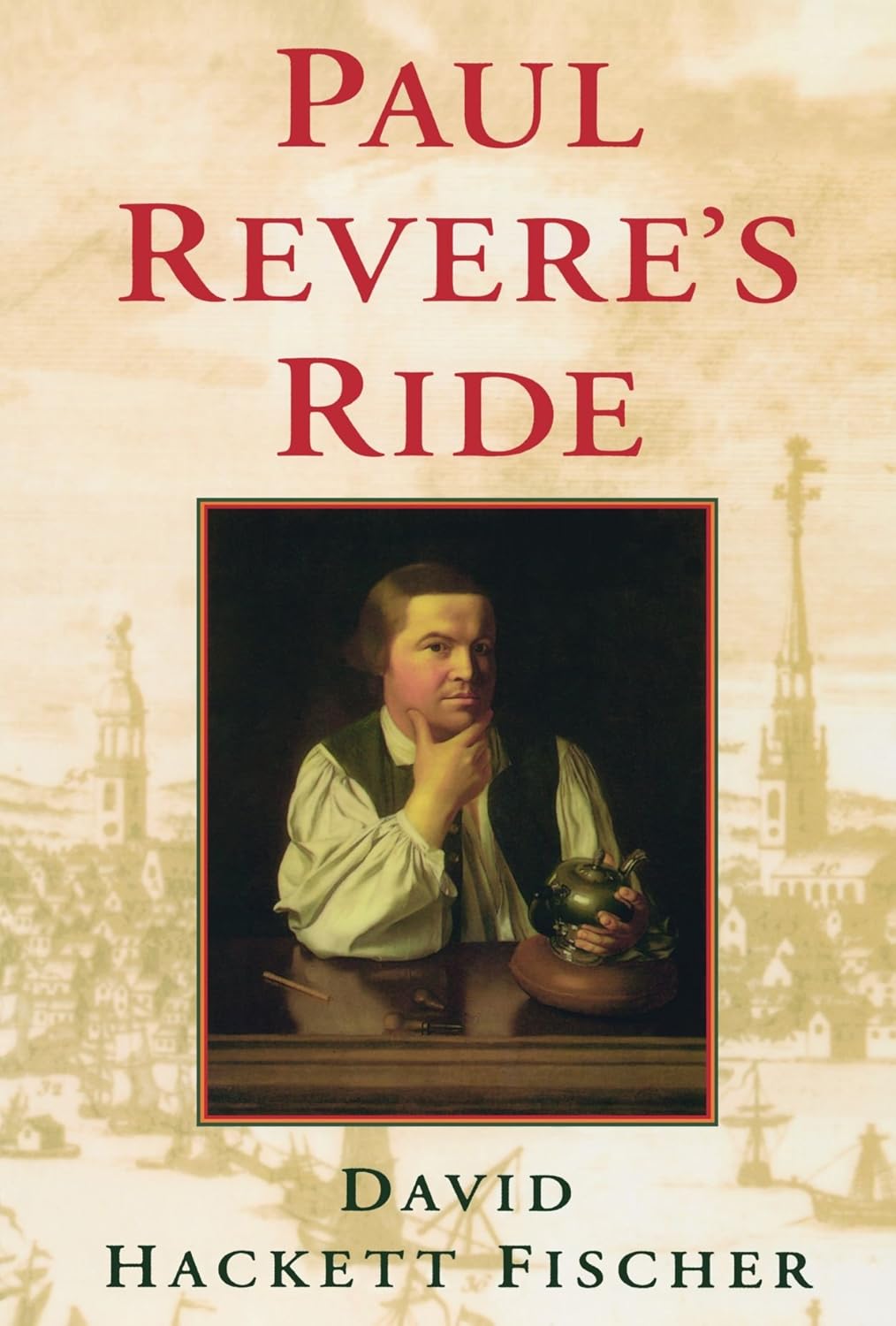
David Hackett Fischer writes delightful books. He expertly combines the breezy readability of a master popular historian with the professional craftsmanship and deep primary research of a top rate academic. The end result is a narrative that is at once a dazzling adventure tale and a groundbreaking piece of historiography.
The adventure tale aspect of “Paul Revere’s Ride” is phenomenal. Fischer’s narrative relies heavily on fascinating eye witness accounts: mostly depositions and personal writings from the British and American troops who marched and mustered and fought that long, bloody day, along with the diary observations from many citizens who happened to witness the remarkable events of April 19, 1775. These accounts are all fresh and personal, overwhelmingly human and familiar, offering a certain vitality and immediacy rarely found in other histories of the American Revolution.
Fischer also highlights some fascinating and long forgotten characters and events from that memorable day, such as Margaret Kemble Gage, the American-born wife of the British commander, who Fischer claims in all probability was the rebel spy who informed the American revolutionary leaders of the impending march on Lexington and Concord, which was one of the most tightly guarded secrets in Boston. Other examples include the women of Pepperell, Massachusetts, who, completely of their own accord and under their own leadership, established a women’s militia to patrol and secure the village after their husbands had marched to Lexington, during which time they successfully intercepted, arrested and held a loyalist messenger. Or the story of Samuel Whittemore, a 76-year-old farmer who grabbed his musket and engaged the Redcoats at close range along the Battle Road back to Boston, despite his exemption from active service because of his advanced age, who suffered 14 bayonet wounds and was shot in the face and left for dead in the process, only to survive and live to age 96. Or the town nut at Concord who cheerfully served drinks to both sides before the fighting and then later on casually walked – oblivious and unscathed – between the engaged lines of British and American troops, musket balls whizzing fast and hot all around him.
The groundbreaking piece of historiography side of this book is equally remarkable. The casual reader may find many of the insights surprising (this reader certainly did). Here are a few notable examples: 1) Revere’s April midnight ride was not his first: he galloped through the night of December 13, 1774 to warn the citizens of Portsmouth, New Hampshire of a British expedition to capture rebel gunpowder and arms; 2) the main focus of Revere’s Lexington ride was not to alarm the countryside of the British incursion but rather to quickly alarm two senior American leaders – John Hancock and Sam Adams – who it was believed were the main targets of the British expedition; 3) and he never shouted “The British are coming!” but rather “The Regulars are Coming Out!” – as the colonists thought of themselves as very much “British” in 1775; 4) many of the American minutemen, far from being the bunch of country bumpkins the British soldiers believed, were often more combat experienced, from service in the French and Indian War, than the vaunted British regulars, the vast majority of the whom had never heard a shot fired in anger before that day; and 5) the Americans were also even more disciplined than the British, who at several critical times that day – the initial engagement at Lexington Green, the confrontation at Concord’s North Bridge, and along the Bloody Road back to Boston – willfully bucked the authority of their officers and lost all unit cohesion, in the process either committing shameful atrocities against the local population or shamefully running from the fight.
Fischer also consistently stresses the importance of individual actors, arguing that the fate of an empire may have hinged on the actions of just a few people, most of them peripheral and obscure actors, such as British Lieutenant Jesse Adair, who deliberately steered the British column directly into the mustering militia at Lexington Green, thus provoking the stand-off and first shots of the war, or Ammi White, a Concord ne’er-do-well, who bashed in the skull of an injured British soldier on Concord’s North Bridge, leading to rumors of widespread atrocities by the Americans, and resulting in the escalation of barbarous behavior on both sides, especially by the British along the Bloody Road back to Boston.
But no single actor and their actions loom as large or as critical in Fischer’s narrative as those of the title character, Paul Revere. Far from the sidebar character history has long remembered him as, Revere was, according to the author and based on his exhaustive research, the central, indispensable actor in the drama that unfolded on April 19th, altering history in a fundamental way. Revere knew everyone and was everywhere, showing an uncanny knack for landing himself in the middle of historical events. In his 2000 best seller “The Tipping Point,” celebrity author Malcolm Gladwell used Paul Revere (and entirely based on his reading of this book) as the archetypical “connector,” the singular type of individual capable of spurring on mass movements. The “Lexington Alarm” may have been, in truth, a group effort – and one that relied on a generations old organizational communication – but, without Paul Revere and the unique position he held in 1775 Boston events would have turned out far differently.
Whether you are a history buff or just like a great story, “Paul Revere’s Ride” is not to be missed.
 What's Tim Reading Now?
Leave a comment