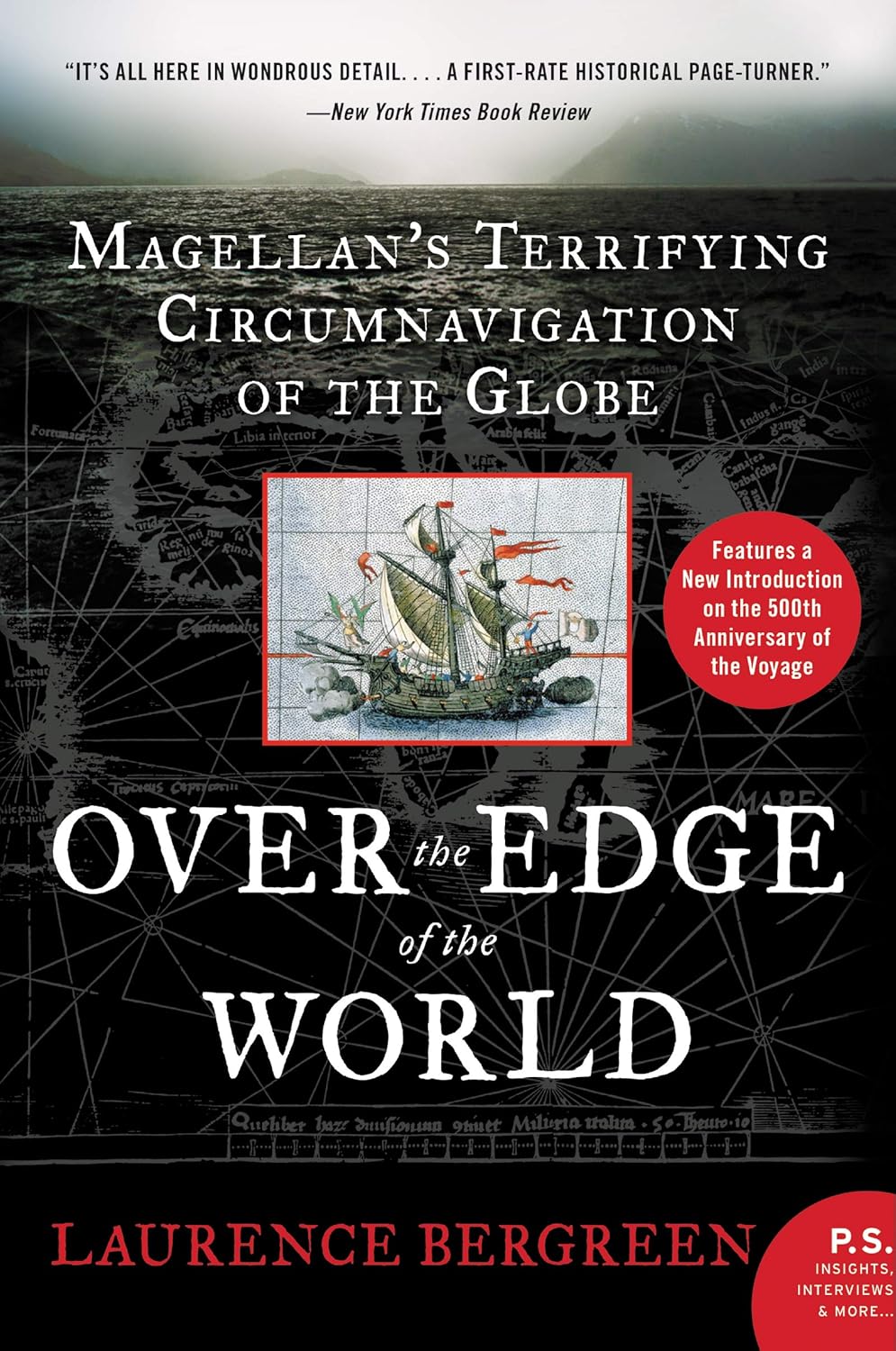
This book blew my mind. I don’t think “Over the Edge of the World: Magellan’s Terrifying Circumnavigation of the Globe” by Laurence Bergreen won any major awards or made any notable bestseller lists, and that’s a shame because it’s fantastic. I found my copy in a box at a flea market in eastern North Carolina. I read lots of popular history, but had never heard about “Over the Edge” before. My expectations were pretty low. It turned out to be one of the most fascinating narrative histories I’ve ever come across.
In the early sixteenth century the nascent Spanish and Portuguese empires were locked in a titanic struggle for global domination. In 1494, Pope Alexander VI sought to mediate the conflict between the two competing Catholic powers by dividing the world neatly in half among them. The resulting Treaty of Tordesillas allocated most of the western hemisphere as the exclusive domain of Spain. Portugal got the eastern abutment of South America (Brazil) and everything else to the east. The two zones met again somewhere in the vicinity of the recently discovered Spice Islands in modern day Indonesia. The details were hazy. “The Treaty of Tordesillas was not even a line drawn in the sand,” Bergreen writes, “it was written in water.” The Spanish and Portuguese quickly got to work extracting as much resources as possible from their respective zones.
Ferdinand Magellan, born in 1480, was a young, ambitious courtier at the court of Portuguese King Manuel. Magellan served his sovereign with gusto, receiving numerous wounds in battle over the years. However, Manuel disliked and mistrusted him. Three times Magellan proposed an expedition to find a water route to the Spice Islands. Three times he was refused. Manuel was, according to the author, “a deeply suspicious, unhappy, and conflicted man – a man determined to keep others from attaining fame and power.” In 1517, Magellan did the unthinkable: he took his proposal to the teenaged Spanish King Charles.
The Spanish were intrigued, but wary. “The prospect of a Portuguese leading a Spanish expedition through Portuguese waters made nearly everyone at the Casa de Contratacion [an organization responsible for everything from collecting taxes and duties to administering all aspects of exploration] uneasy; if the Portuguese became aware of the expedition, relations between the two countries might be strained to the breaking point.” The irresistible lure of fabulous riches from the Spice Islands eventually overcame their initial reservations. Magellan was given five ships and 260 men. It would be called the Armada de Molucca. It had three objectives: 1) definitively locate the strait across the South American continent; 2) reach the Spice Islands and demonstrate that they laid within the Spanish zone according to the Treaty of Tordesillas; and 3) return home with hulls full of valuable spices. Magellan formally renounced his allegiance to King Manuel and gave his loyalty to King Charles. It was somewhat akin to defected to the Soviet Union during the height of the Cold War.
The Armada de Molucca got underway on September 20, 1519. The crew was traveling into the unknown. Their knowledge of the far reaches of the world was shaped by the travelogues of Marco Polo and John Mandeville. They fully expected to encounter mermaids, boiling oceans, and one-eyed monsters. What they found were giants elephant seals, penguins in the millions, and elaborately tattooed natives, which more or less confirmed at least some of their wild expectations.
Magellan was the Portuguese Captain General now loyal to the Spanish king. The other ship captains and crew was mostly Spanish, with an odd assortment of English, German, and Greek sailors adding to the mix. It would prove to be a highly volatile and combustible mix. The Spanish trusted neither Magellan’s political loyalty nor his navigation skills. On Easter 1520, while wintering at Port Saint Julian on the east coast of modern day Argentina, the Spanish captains of the Armada de Molucca led a mutiny against the Portuguese Captain General. “Magellan’s conduct during the mutiny and its aftermath was worthy of Machiavelli,” Bergreen says: subtle and calculating when possible, but brutal when necessary. He would execute several of the ringleaders and would abandon Juan de Cartegena, the most senior and politically well-connected mutineer, on a remote island.
Magellan sailed on with four ships (the Santiago wrecked south of Port Saint Julian while on a solo reconnaissance mission searching for the strait; all hands miraculously survived) in search of the fabled strait. Bergreen notes that maps and charts were the most tightly guarded state secrets of the Age of Discovery, but most of them were at best only directionally accurate. “The were calls to adventure rather than a set of directions,” he says, “hypotheses rather than conclusions, provocative geographical cartoons that fed the fantasy of empire.” In October 1520 they at last discovered the strait. For some, they had come far enough. Despite their oath to their king, they felt it was time to turn back. Magellan refused. He viewed their expedition as more divine than secular. “This was discovery as revelation,” Bergreen writes, “as prophecy, as a high-risk collaboration between God and His favored nation, Spain.” The crew of the San Antonio, the largest ship in the Armada de Molucca, had other ideas and silently slipped away while on a scouting mission in the straits and fled back to Spain. Magellan pressed on with three ships and 200 men and reached the Pacific after 38 days in the strait. According to the author, “Magellan’s skill in negotiating the entire length of the strait is acknowledged as the single greatest feat in the history of maritime exploration.”
With the first of three objectives completed, Magellan sailed into the vast Pacific Ocean. “Magellan anticipated a short cruise to the Spice Islands,” Bergreen says, “followed by a longer but untroubled voyage home through familiar waters.” The Armada de Molucca’s voyage across the Pacific took 98 days and covered 7,000 miles. The crew was almost completely debilitated by scurvy. Magellan was spared because of his private stash of apple quince, but he attributed his remarkable immunity to divine intervention. By the time they stumbled upon the island of Guam in March 1521 the Captain General was already showing signs of delusion.. The native population, completely unaware of human existence outside of their island home, was surprisingly hospitable. They possessed no concept of private property and generously nursed the sickly crew back to health. The next stop in their incredible voyage would turn out quite differently.
Unlike those on Guam, the natives of the Philippines knew of the outside world. In 1405, the Chinese Treasure Fleet of Cheng Ho departed from Nanking to establish trade and diplomatic relations around the South China Sea, not conquer or claim distant lands. Cheng Ho made seven voyages in total, probably reaching as far as northern Australia. By 1500, the Chinese emperor mothballed the Treasure Fleet and imposed an imperial decree making it a capital offense for a ship with more than two masts to put to sea. “Portuguese and Spanish explorers sailed into the vacuum of power left by China,” Bergreen writes.
The story of Magellan on the Philippine island of Cebu is incredible. By this point in the journey, the Captain General was delusional. He now believed that he and his mission were divinely inspired and protected. At no point back in Seville did anyone suggest that Magellan undertake any sort of evangelical mission during his expedition. Yet on Cebu he began to aggressively proselytize to the natives and began to win converts. “In contrast to his pragmatic crew members, who considered themselves travelers through an alien landscape,” Bergreen writes, “Magellan conducted himself as if he were an instrument of the Lord.” When one of the local chieftains, sick on his deathbed, refused to be converted, Magellan promised that he would recover if he accepted baptism and promised the natives that they could chop his head off if he didn’t. The chieftain was soon baptized and then miraculously recovered just as Magellan had promised. The entire population of Cebu, some 2,200 souls in all, embraced Christianity.
To the natives, Bergreen writes, Magellan appeared to be “a powerful and beneficent god.” And then he took things one-step too far: Magellan foolishly inserted himself in local politics. The chief on Cebu, Humabon, had a rival on the neighboring island of Mactan named Lapu Lapu. Magellan offered to take care of Lapu Lapu for him, confident that a few dozen Europeans wearing armor, carrying crossbows and arabesques, and supported by naval artillery from the fleet could easily overcome anything the natives threw at them. Magellan would pay for his hubris with his life. On April 27, 1521 Magellan waded ashore on the island of Mactan with about 50 other heavily armed crewmembers. Humabon and his warriors were told to stay on the ships and “watch the Spanish lions hunt their prey.” Lapu Lapu emerged from the jungle with some 1,500 spear-carrying warriors. After hours of hand-to-hand combat on the beach, outnumbered 30-to-1, and too distant to receive artillery support from the fleet, Magellan and his men slowly succumbed to the natives. The Captain General was hacked to pieces and left bobbing in the surf. “In the end,” Bergreen writes, “the only peril he could not survive was the greatest of all: himself.” Lapu Lapu, a relatively minor chief on a relatively minor island whose name would have been lost to history had it not been for Magellan’s impetuousness, is today a national hero in the Philippines.
The immediate repercussions of Magellan’s graphic and shocking death were severe. His loyal slave, Enrique, expected manumission upon his master’s death. The remaining leadership of the Armada de Molucca thought otherwise, insisting that Enrique remained the property of Magellan’s widow back in Seville. In revenge, Enrique set in motion a grave conspiracy, informing Humabon that the Europeans secretly planned to betray him and his people. In response, Humabon plotted a preemptive ambush and killed a quarter of the remaining crew, which included all of the most senior and experienced men remaining, during a farewell feast on Cebu. The Armada de Molucca sailed off in three ships with only 115 remaining crewmembers. Their last sight of Cebu was of enraged islanders tearing down the cross they had erected and smashing it to bits.
Now hopelessly shorthanded, the Armada de Molucca was forced to abandon one of their ships, the Concepcion, in order to consolidate their crews. Never again would they erect crosses or insist on mass conversions. “The expedition’s sense of moral imperative melted away amid the luxuriant Indonesian heat,” Bergreen says. All they wanted to do now was find the Spice Islands, fill their hulls with clove, nutmeg, cinnamon, and mace, and then sail for home. Finally, on November 8, 1521, 27 months after departing from Seville, the Armada de Molucca entered the harbor of Tidore, one of the five Spice Islands, located in the eastern archipelago of modern day Indonesia.
Bergreen calls the natives of these islands “murderous and slippery.” Almanzor, chief of Tidore, was the “gatekeeper of the cloves.” He was well schooled in international trade and already knew the Portuguese and Spaniards well. He was in a power struggle with the leader on the neighboring island of Ternate. Cebu and Mactan served as a cautionary tale to resist the temptation to fight anyone else’s battles. However, the simple presence of the Armada de Molucca was highly destabilizing and fraught with danger for both parties. “There were hazards for the Europeans (the islanders might massacre them), and there were hazards for the islanders themselves (the Europeans might take their women or disturb the local balance of power).”
The two remaining ships were loaded with 1,400 pounds of cloves and prepared to head for home. At the last minute, one ship, the Trinidad, sprung a leak that would take months to repair. The remaining ship, the Victoria, would set out on her own on December 21, 1521with a crew of 60. According to Bergreen, her solo voyage across the expanse of Portuguese controlled waters and around the Cape of Good Hope, “the most fearsome place in the entire world,” had little chance for success. Meanwhile, the Trinidad, once repaired, planned to return home by re-crossing the Pacific. After sailing as far north as Japan, she headed back south and was ultimately captured and destroyed by the Portuguese, who had never stopped hunting Magellan and his Armada de Molucca.
The Victoria entered the bay of San Lucar on September 6, 1522. She had only 18 crewmembers remaining, and they could barely stand up. They had traveled fifteen times longer than that covered by Columbus on his first voyage. They carried 381 sacks of cloves worth nearly 8 million maravedis, more than enough for the entire expedition to turn a profit. “The achievement was the Renaissance equivalent of winning the space race,” Bergreen says. “In a sudden reversal of the balance of power, Spain was poised to control the spice trade and, by extension, global commerce.” Future attempts to clarify the eastern dividing line of the Treaty of Tordesillas ended in failure; both sides claimed possession of the Spice Islands.
Most miraculous of all, one of the final surviving crewmembers was Antonio Pigafetta, the expedition’s official historian. Bergreen calls his chronicle “the most important account of distant lands to appear since The Travels of Marco Polo.” The circumnavigation of the globe would not be repeated for another 58 years when Sir Francis Drake did so in 1580. Indeed, Bergreen says “Magellan’s expedition stands as the greatest sea voyage in the Age of Discovery.”
In closing, the tale of the Armada de Molucca is incredible. I can’t believe it hasn’t been made into a Netflix Original Series yet. I hadn’t known that Pigafetta had meticulously recorded all the details of the amazing three-year journey. He left to posterity one of the greatest adventure stories of all time.
 What's Tim Reading Now?
Leave a comment