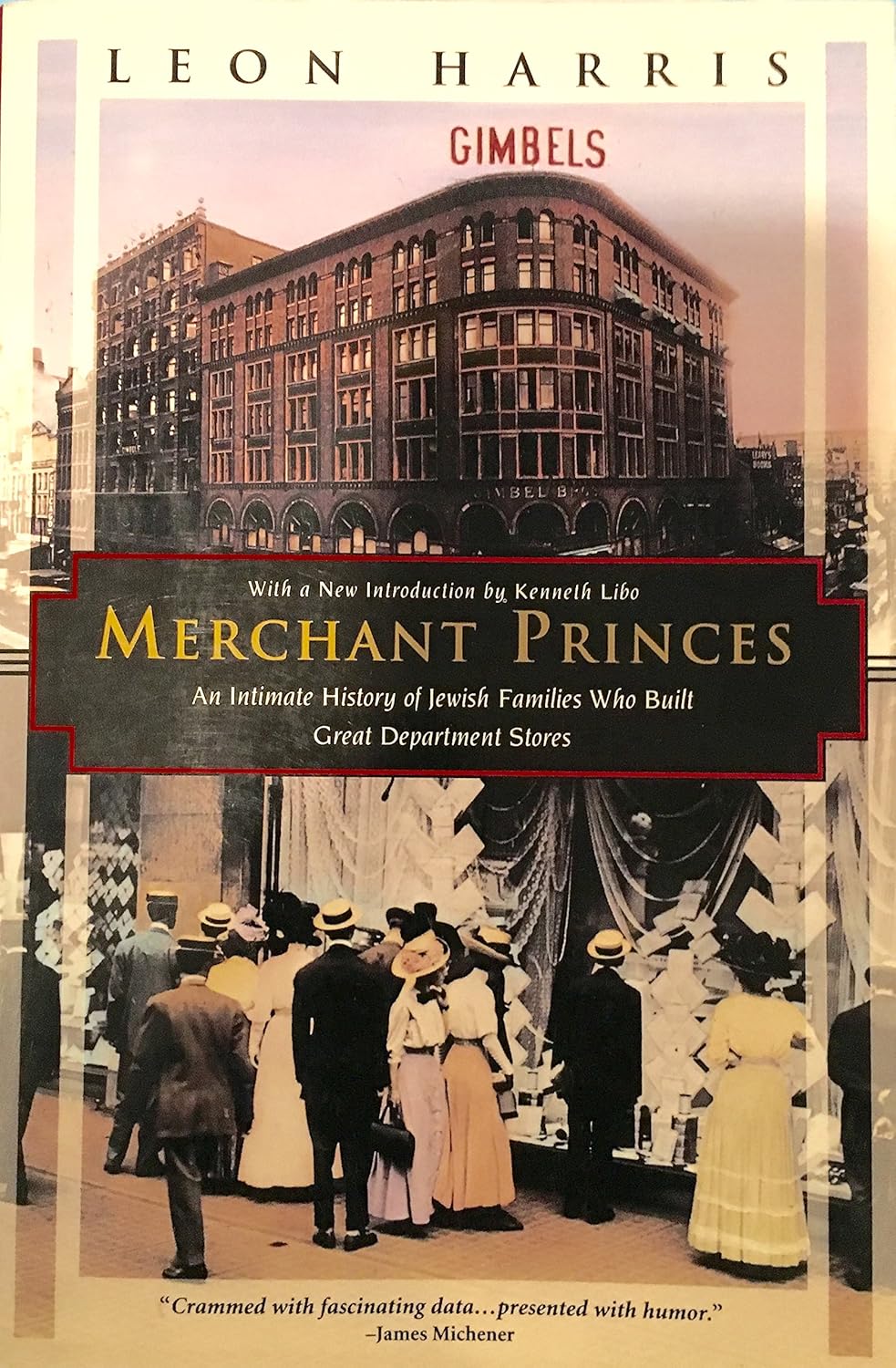
“Merchant Princes” is one of Malcolm Gladwell’s all-time favorite books. During an appearance on the Tim Ferriss podcast, Gladwell noted that he loves this 1977 bestseller so much he often gives away copies to people he meets, especially if they’re Jewish. That is pretty high praise coming from one of my favorite non-fiction authors. I immediately ordered a copy for myself.
Overall, I must confess, I was a bit disappointed with “Merchant Princes,” although it is certainly a fun and easy read. The central story is this: beginning in the mid-nineteenth century, tens of thousands of German Jews emigrated to the United States, fanned out all across the country, and established themselves as successful merchants in their adopted cities. “Excluded from owning land or practicing a profession,” author Leon Harris writes, “most European Jews were limited to money-lending, peddling, and shopkeeping, and so became expert at commerce.” I love economic history and learning, for example, how the railroads or the automobile or the shipping container dramatically reshaped the country economically, politically, and socially. I was hoping that “Merchant Princes” would do this for the consumer retail industry, but it does not. Rather, it is mostly a social history – a collection of stories about the Jewish families that built regionally significant department stores.
According to Harris, himself a third generation descendant of a Jewish merchant family in Dallas, there were only perhaps 5,000 Jews living in the United States in 1820, but over 250,000 by the time of the Civil War. This flood of German-Jewish immigrants mostly started out as simple peddlers until they raised enough capital to open a small merchant establishment. Once they did, the hardest working and most innovative among them thrived. The pattern is remarkable. Virtually every city in the country would eventually be home to one of these immigrant German-Jewish merchant princes: Atlanta (Rich), Memphis (Goldsmith), Boston (Filene), Philadelphia (Gimbel), Pittsburgh (Kaufman), Dallas (Sanger, Neiman, Marcus), New York (Straus, Bloomingdale, Bergdorf, Goodman), San Francisco (Strauss, Gump), Phoenix (Goldwater), Portland (Meier, Frank), Chicago (Rosenwald), the list goes on. In fact, Harris claims that Detroit and Minneapolis were the only American cities where the dominant department store wasn’t German-Jewish-owned. Also, I learned that my own childhood was touched by one of these Jewish merchant princes. Growing up outside of Hartford, Connecticut our local department store was G. Fox, established by one Gerson Fox (formerly Gershon Fuchs) in 1830.
Sadly, “Merchant Princes” doesn’t tell you much about how or why the American department store developed the way that it did or what its macroeconomic impacts were. A few things were clearly important, I think. First, American clothing manufacturers learned how to mass produce clothes in varying sizes in order to meet the enormous demands of the Union Army during the Civil War. Suddenly, low cost “off-the-rack” shirts and pants became an option for cost-conscience consumers. Second, retail stores adopted a “one price” policy and ended the tradition of haggling over every purchase. Third, merchants embraced a variety of customer-centric policies, such as liberal credit and unlimited returns. Finally, storeowners invested heavily in creating an enjoyable, sometimes magical, shopping experience featuring ornate architecture and elaborate merchandising displays. I should note that Harris doesn’t lay it out this explicitly; rather, these are my personal observations and interpretations after reading “Merchant Princes.” And they’re probably not 100% right. As H.L. Mencken once famously quipped: “For every complex problem there is an answer that is clear, simple, and wrong.” Indeed, Harris doesn’t offer much in the way of strategic themes or critical insights explaining the remarkable development of retail shopping in the hundred years after the Civil War. Rather, in his estimation, “The building of the great American department stores was not, as is sometimes the winning of great battles, the result of a single brilliant or courageous stroke; it was a success that accumulated only from endless concern with countless tiny and often tiresome details.” That may be true, but it doesn’t make for great reading.
The bulk of “Merchant Princes” is dedicated mainly to telling the stories of the wealthy families who built the most successful department stores in America. Frankly, I found that if you’ve heard one story of an immigrant German-Jewish peddler who builds a successful department store in some late nineteenth century American city, you’ve heard them all. They arrive with nothing but the clothes on their back. They peddle wares until they can afford to open a store. They eventually send for their brothers back in the old country. They all sleep on the floor. They demonstrate a deep commitment to the community they serve (e.g. liberal credit, sponsor parades, annual tree lightings, generous donations to local museums and symphonies). They send their sons to the finest schools back East. The sons return home only to drink and carouse. Finally, they are wealthy and build fabulous homes in the most exclusive neighborhoods of the city, but are still denied membership at the local country club because of their religion. This pattern is repeated in “Merchant Princes” for one city after another until the reader is tempted to skip to the end. The denouement of the story of American department stores, at least from the perspective of the late 1970s, is their consolidation into Federated Department Stores, a sort of department store trust led by “a little barbarian from the Midwest,” Fred Lazarus, a German-Jewish merchant who got his start in Columbus, Ohio. Harris suggests that each regional store gobbled up by Federated ultimately lost its soul.
“Merchant Princes” may not have been the book I was hoping it would be, but it nevertheless tells a remarkable American story that is absolutely worth reading. You’ll probably never look at a department store the same way again and you’ll likely learn a lot of interesting tidbits along the way. For instance, I learned that the longtime Macy’s chief, Isidor Straus, was a passenger on the Titanic. When his wife of over forty years, Ida, was offered a seat on a lifeboat with other women and children, she refused in order to stay and die with her husband. When I told my wife of over twenty years the touching story, she informed me that in the event we ever find ourselves in a similar unfortunate situation, she doesn’t want me to be surprised when she takes the seat on the lifeboat.
 What's Tim Reading Now?
Leave a comment