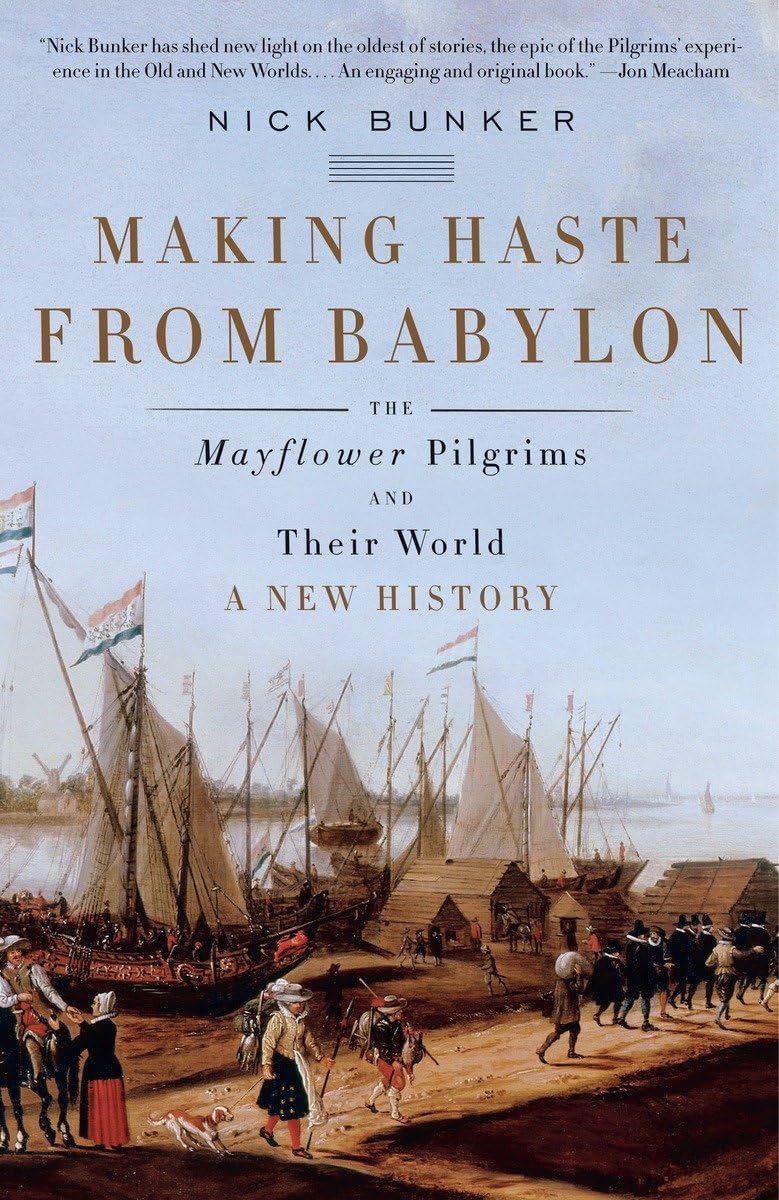
I picked up this book at a local library book sale. Last year I read “An Empire on the Edge” by the same author and thought I would give “Making Haste from Babylon” a try. There is much one might comment upon in Nick Bunker’s narrative of the Pilgrim experience, but I’ll limit mine to just one: the role of the beaver.
Prior to reading this book my understanding of Plymouth Colony adhered closely to the standard interpretation as taught in American elementary schools and expanded upon in such contemporary accounts as Nathaniel Philbrick’s “Mayflower: A Story of Courage, Community, and War” (2006). What none of these accounts highlighted was the pivotal role played by the beaver in the establishment of the Pilgrim community in the New World.
In short, beaver hats were all the rage in Jacobean England, not to mention Paris and the other major cities of mainland Europe. However, the supply of beaver pelts was tenuous and expensive. Only one market supplied beaver skins in the early seventeenth century: Russia. Access to the skins came almost exclusively via the Arctic Russian port of Archangel, which was located thousands of miles away from London and iced in nearly ten months of the year. Moreover, Russian traders accepted only scarce hard currency in exchange for the pelts and prices kept rising as Russian hunters trapped the beaver to near extinction and were forced to venture into the most remote parts of Siberia to find new supplies. On top of all of this, one man in London, the beaver king Ralph Freeman, virtually monopolized the beaver skin trade.
Thus, you had sky-high demand and shrinking supply, the type of situation that makes any investor’s eyes sparkle. Bunker estimates that a new beaver skin hat in 1620 cost roughly eight times the cost of a raw beaver pelt on the wholesale market, a cost that was only likely to increase in light of the supply chain issues coming out of Russia. What if investors could secure an entirely new and reliable source of beaver skins on the other side of the Atlantic in the New World? An immense source of wealth could surely be tapped if only a hearty and committed group of colonizers could be found to establish a year round outpost and develop a trading relationship with the natives in the beaver-rich territory that is today called New England. Enter the Puritans of Leiden, a relatively small group of Separatists from the Church of England who had fled the country for the Netherlands in 1617. Things hadn’t worked out exactly as planned in Leiden for reasons both political and economic and they were looking for a place to relocate. A diverse group of risk tolerant investors in London led by Thomas Weston agreed to finance their voyage in the hopes of securing a tidy profit in the form of North American beaver skins once they were established.
There is much more to “Making Haste From Babylon” than beaver skins, but that is the part of the story that most surprised and fascinated me. For as much as Bunker wrote about it, I wish that he had written and explained more. For instance, how much total capital was invested in the enterprise? There was the initial voyage on the Mayflower in 1620, but there were at least annual replenishment voyages that brought new settlers and critical supplies, which included everything from heads of cattle and other livestock to shirts and shoes and items to trade with the native population. How much did investors ultimately pour into Plymouth? The Plymouth colony didn’t send back a meaningful shipment of beaver skins until 1627. Why did it take them so long to establish the trading outpost on the Kennebec River in modern day Maine? Once the beaver skins started flowing back to London by the thousands did the Plymouth colony eventually turn a profit? If so, when? Did the initial investors ever get their money back? Bunker really doesn’t say.
In closing, I liked “Making Haste From Babylon” quite a bit and I learned a lot from reading it. If you’re looking to read just one book on the Pilgrims this is likely your best option, although Philbrick’s “Mayflower” is certainly more readable.
 What's Tim Reading Now?
Leave a comment