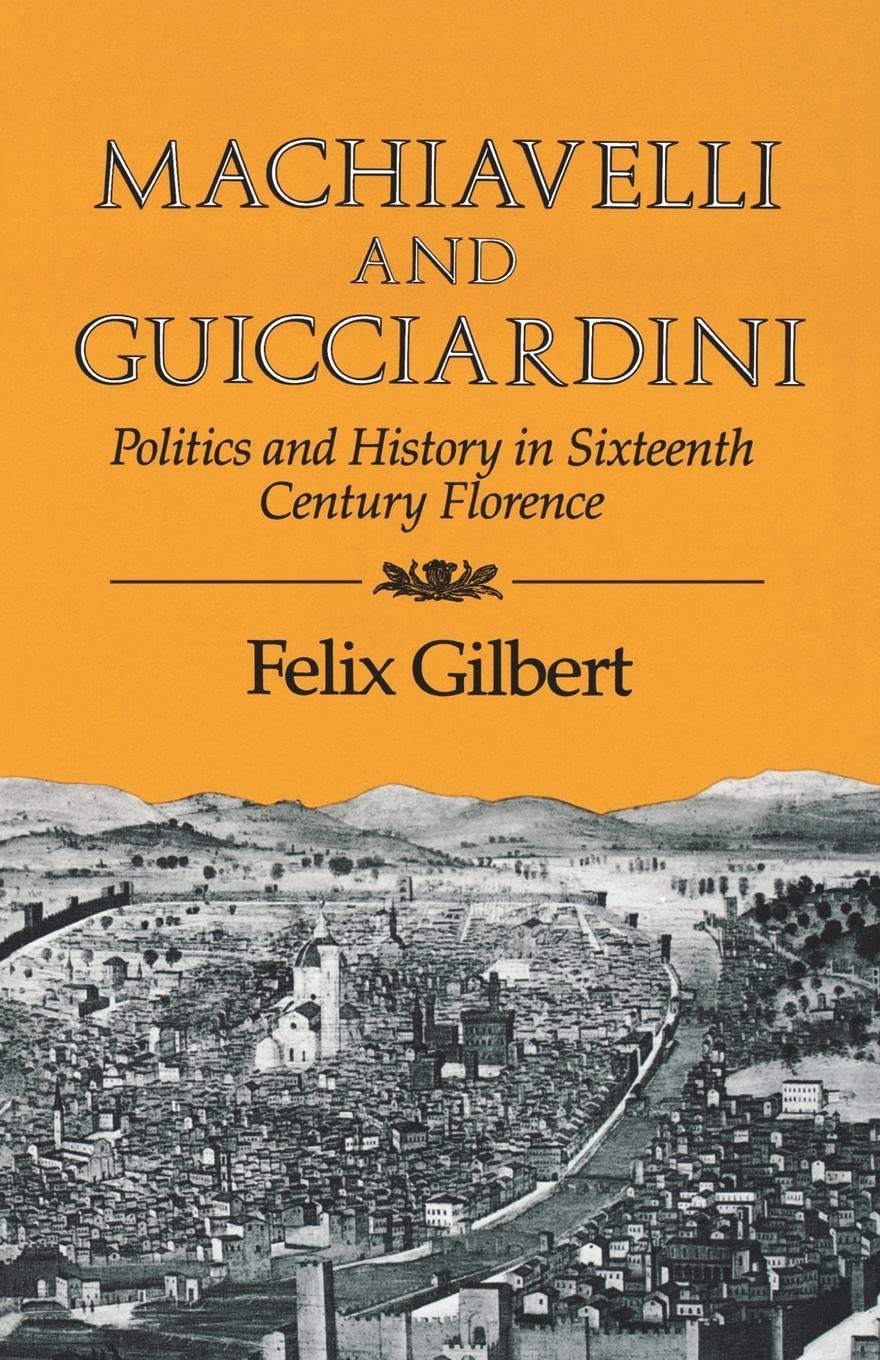
“Machiavelli and Guicciardini: Politics and History in Sixteenth Century Florence” (1965) by Felix Gilbert examines the contrasting political philosophies and historical methodologies of two prominent Renaissance thinkers: Niccolò Machiavelli (1469-1527) and Francesco Guicciardini (1483-1540). Gilbert places both figures within the intellectual and political turmoil of Renaissance Italy in the first decades of the sixteenth century, highlighting their responses to the challenges of fragmented states and shifting power dynamics.
There are three main topics to this book. The first and most extensive is a detailed examination of the political reforms undertaken in Florence after the overthrow of the Medici in 1494. In their wake, reformers sought to re-establish the idealized republic from the time of the city’s founding based on the presumption that Florence was or could be a harmoniously integrated society. At the center of the new city government – “the soul of the city,” it was called – was the Great Council (officially the Council of the People and of the Commune), a concept borrowed from the well-governed and stable republic of Venice and strongly supported by the wild-eyed Dominican monk and would-be prophet Savonarola. The Great Council would be the dramatic but short-lived embodiment of Florentine republicanism that brought the middle class into government. It would be under almost constant attack from the Florentine aristocracy, the well-educated and wealthy men from ancient and honorable families who were the cultural elite of the city, and whose number included Machiavelli and Guicciardini. Gilbert says that conflict in the Great Council between the aristocracy and the middle class was essentially unavoidable. The aristocrats were reluctant to relinquish their stranglehold on political office and the middle class were reluctant to contribute taxes sufficient enough to conduct a muscular foreign policy.
The Great Council was to meet in the new hall where Leonardo and Michelangelo were supposed to paint their famous battles of Anghiari and Cascina on opposing walls. Membership was limited to men over the age of 29 whose male lineage two generations back were eligible for the Signoria. The Great Council ended up having a little over 3,000 members in a city of roughly 70,000 in 1500. Thus, over 20 percent of adult males in Florence were members of the main governing body. Gilbert says that no one envisaged the membership of the Great Council being so large and that the aristocracy almost certainly would have resisted the reform had they known. Great Council members alone possessed full citizen rights and could hold office. It was not a deliberative body; no speeches were made nor was debate allowed. Its principal function was to vote on Florentine laws and taxes, which required a two-thirds majority to pass, and elect eligible men to sit on executive boards, which collectively made executive policy decisions. Special officials, known as the Accoppiatori, were responsible for determining a Florentine citizen’s eligibility for holding a political office, a powerful position that could – and was during the Medici years– seriously abused. A nine member chief executive board called the Signoria made the final decision on all questions of policy, but tenure of office was only two months. The Signoria received advice principally from two boards – the boards of the Twelve Good Men and the Sixteen Gonfaloniere. The presiding head of the Signoria, known as the Gonfaloniere, served as the official head of the Florentine Republic. A political reform of 1502 made the position of Gonfaloniere a life-time appointment, just like the doge of Venice. The position would be held by only one man, Piero Soderini, an aristocrat seen by many as a traitor to his class.
The Florentine Republic of the Great Council lasted eighteen years. It was built on internal contradictions and was riven with dissension and hostility from beginning to end. Gilbert says that the unrest was the result of animosity between social groups within the Great Council, further exacerbated by the animosity of those excluded from government. The Florentine economy was highly unequal. For instance, in one district of the city 30 individual taxpayers out of a total of 660 (that is, less than 5 percent of the taxpayer population) paid more than 50 percent of the district’s taxes. After 1494, these rich and socially prominent Florentine merchants had to share government power with a middle class that they viewed as relatively indigent, ignorant, and inferior, and who, in their opinion, didn’t “pay their fair share” in city taxes. Thus, Florentine society was divided into the rich and the middle class, both of whom served in the Great Council, and the great unwashed masses, better known as the plebs or the mob, who did not. Gilbert says that these significant economic differences created irreconcilable differences of interest that could not be settled through normal democratic discourse.
Gilbert writes that the Florentines shared a common world view about the nature of politics in the fifteenth century. On the one hand, there was something called “ragione,” which held that man’s reason could be effective within a narrow realm. On the other hand, there was “fortuna,” which held that non-rational and unpredictable forces held sway over politics and war, such as Milanese ruler Giangaleazzo Visconti’s sudden death in 1401. This worldview directly affected the work of both Machiavelli and Guicciardini.
With the return of the Medici in 1512, a new political institution, the Senate, was formed. Made up of roughly 120 men elected by the Great Council and the Senate itself, the Senate was the new “soul of the city,” empowered with the authority to approve all fiscal legislation with a two-thirds majority and the power to appoint the members of all the executive boards. Gilbert writes that, “there could be no doubt that it was meant to be the institution for the formulation of Florentine policy.” By this time, many Florentines, including many non-aristocrats, looked back upon the rule of Lorenzo the Magnificent fondly; a peaceful, orderly, and prosperous period when art, scholarship, and business flourished. Lorenzo, a man of reason and moderation, the very image of the Platonic philosopher-king, had kept order in Florence and preserved the peace in Italy. After the Medici’s return the Great Council was closed, but the Signoria was retained. A new, 40 member government commission called the Balia was created and invested with extraordinary powers. The Medici ruled behind the scenes (from 1512 to 1521 that included Pope Leo X, second son of Lorenzo the Magnificent) in the manner of his father, whose reign he considered a golden age, and of the more savvy Roman emperors, but the Medici remained unpopular.
The second topic of the book focuses on Francesco Guicciardini and his revolutionary approach to historical writing. The classical model of history, inherited from antiquity, treats history as a didactic tool. It is less concerned with factual precision and more focused on extracting moral lessons or offering political guidance. Historical events are often presented in a way that emphasizes exemplary actions and behaviors, serving as models for contemporary leaders and citizens. Writers in this tradition sought to distill universal truths or principles from historical accounts, often framing them in narratives that highlighted the virtues or vices of individuals or societies.
Guicciardini adopted a more skeptical and empirical approach, reflecting the humanist emphasis on “true history” based on documentary evidence. Renaissance humanists sought to establish a more rigorous, fact-based approach to history. This model emphasized the importance of relying on documentary sources, eyewitness accounts, and careful examination of evidence. Key features of this model included empirical focus, critical analysis, and objective representation. The goal was to reconstruct the past as accurately as possible, without imposing overt moral or political lessons. Humanists held that factual basis was a prerequisite for achieving the moral and instructional aims of history. To that end, Renaissance historians placed heavy emphasis on documentary sources and accounts written by actual participants in events.
Guicciardini’s “History of Italy” (1540) provides a meticulous and critical analysis of contemporary events, avoiding sweeping generalizations or prescriptive lessons. Renaissance humanists characterized truth as the basic requirement for historical writing. Renaissance historians imitated or “quoted” classical authors much as Renaissance artists copied or “quoted” ancient sculptures and buildings. For instance, Sallust wrote about single wars, so Renaissance historians wrote about single wars; Livy wrote a comprehensive history of his city, so Renaissance historians wrote comprehensive histories of their native cities; ancient authors demonstrated an exclusive concern on politics, so Renaissance historians focused their efforts on politics; ancient historians inserted fabricated speeches, often in pairs, into their texts to help interpret the psychological motivations of the main actors in the historical drama, so Renaissance writers did the same. Thus, it was with the highest of praise that Erasmus complimented Bernardo Rucellai for his book “History of the French Invasion” (1511) by saying “it was written by another Sallust or at least in Sallustian times.”
Francesco Guicciardini was a scion of a well-known aristocratic family and godson of Marsilio Ficino, founder of the Florentine Platonic Academy. He served as Florentine ambassador to King Ferdinand of Aragon. Gilbert writes that Guicciardini was “exceptionally suited to be a theoretician of Florentine aristocratic policy,” which Gilbert says was a difficult task because aristocratic government demands a greater degree of rationalization and theoretical justification. Guicciardini took a balanced view of Lorenzo the Magnificent: on the one hand, he was prudent and liberal; on the other, he was cruel, arrogant, vindictive, and suspicious.
Guicciardini’s purpose in writing “Florentine History” (1511) and later “The History of Italy” (1540) was to examine real world implications of various forms of government. For Guiciardini, history was a man-made process; historical writing should be pragmatic and provide concrete guidance in political action. Facts and causal connections between events were thus paramount to his approach. In short, Gilbert writes, “historical investigation was an instrument to disclose the laws of politics.” Explaining “why” certain events occurred took precedence over the narration of “what” happened. Yet, many of his insights and conclusions in “The History of Italy” are chalked up to the inscrutable arbitrariness and unfathomable power of Fortuna; that is, “the helplessness and impotence of man in the face of fate,” Gilbert writes. Man cannot expect his virtu and reason to be rewarded, although the opposite might be true: Guicciardini believed that the French quickly and easily conquered the peninsula because God was punishing the Italians for their sins and weakness. “To Guicciardini,” Gilbert says, “history provided not rules of behavior, but rather led toward a philosophical attitude.” To the humanists, the purpose of history had been to give man moral guidance. But “The History of Italy” gave the impression that history is aimless and without purpose. “The humanists believed that history was taught by example,” Gilbert writes. “In Guicciardini’s ‘History of Italy’ there are hardly any examples which ought to be imitated.”
The third and final topic of the book focuses on Niccolo Machiavelli. Machiavelli and Guicciardini were close friends and shared a common dislike of Medici rule in Florence and a shared objective of breaking the hold Charles V held over Italy, whose military superiority and rapidity of advance astonished the Italians. They were both believers in Republicanism for Florence, but only if the merchant aristocrats had a decisive share of government. In their view, aristocrats had the right to govern because only they possessed the requisite education and training in the art of government. It took intelligent men with knowledge and understanding of the experiences of the past to construct and manage a stable government. They both held deeply pessimistic views of human nature: men were myopic, petty, self-interested, and often vicious. Both believed that self-interest, in particular, was core to man’s nature and its only permanent element.
Gilbert says that Italian helplessness in the face of the French invasion of Italy in 1494 changed everything on the peninsula. By the second decade of the sixteenth century violence and force, once just one among several factors that determined politics, emerged as the primary and decisive factor in Italian politics. “Gold became negligible,” Gilbert writes, “iron alone determined success.” Military strength became the chief criterion for judging the importance of another power. In a letter to Pope Leo X, a young Italian aristocrat wrote: Before 1494 “your forefathers, in maintaining their rule, employed skill rather than force; you must use force rather than skill.” It was a lesson embraced whole-heartedly by Machiavelli, a senior official in the administration of the Florentine Republic and widely seen as “Sederini’s Lackey” (Machiavelli was the only chancellery official whom the Medici dismissed upon their return). The inadequacy of the mercenary system was one of Machiavelli’s most persistent political concerns.
Gilbert says that “The Prince” and “Discourses on Livy” are superficially very different books – one a “handbook for tyrants,” the other an idealization of a free republic – yet both are focused on the same basic issue of political leadership. The author further argues that both books are “permeated with resentment and bitterness … the words of a defeated politician who reflects on the mistakes which brought about the failure of his cause.” They were also written with the express purpose of securing his return to government, even though he deeply disagreed with the new administration. Like the Roman historian Sallust, Machiavelli viewed money and wealth as evil, and denounced aristocratic influence over Florentine policy. He thought that wealth as the chief qualification for senior office in the Florentine Republic was the fateful flaw in the city’s constitution. Talent and ambition should be the common characteristics of the ruling class, he argued, not birth and wealth.
Machiavelli is portrayed as a realist who broke with classical and moral traditions, emphasizing the pragmatic use of power and the role of human agency over fate. His works, including The Prince and The Discourses on Livy, advocate for a dispassionate analysis of history and politics to guide effective governance. Machiavelli’s vision of politics is dynamic, underscoring the importance of virtù and adaptability in navigating fortuna. Machiavelli argues that there is no special human quality that will fundamentally guarantee success in politics. In the end, everyone is at the mercy of circumstances; that is, fortuna. Sometimes fortuna smiled on you (Pope Leo X) and sometimes it frowned (Pope Clement VII). Fortuna emerged as the ruler of world history, the uncontrollable forces determining the course of events. This sixteenth century view of Fortuna undermined earlier beliefs that man had it within his power to influence and even control events. Rather, success requires a coincidence of individual virtu and favorable events. “The theme of the struggle of man’s virtu against Fortuna was one of the traditional topics of history,” Gilbert writes, and it was one of “the most striking and revolutionary feature of Machiavelli’s political thought.” The purpose of Machiavellian politics, Gilbert says, was “to keep society alive in the ever-moving stream of history.” Moreover, politics is kaleidoscopic – every situation is unique, every outcome is driven by some choice or decision, and fate often intervenes with unforeseen events.
Machiavelli held that the rules of politics were amoral. It was virtually impossible to be simultaneously a good Christian and a successful politician. The best rulers were, after all, part lion and part fox. Machiavelli also believed that politics were calculable because all men were equally evil and self-interested such that their future actions could be easily surmised. He uses Cesare Borgia as his primary example. Machiavelli felt that fortune favored the bold, as he clearly demonstrated in this famous (and famously misogynistic) excerpt from “The Prince”: “Fortuna is a woman, and it is necessary, if you wish to master her, to conquer her by force; and it can be seen that she lets herself be overcome by the bold rather than by those who proceed coldly.”
In sum, Machiavelli broke with classical political philosophy. He emphasized realism over idealism, and rejected the universal concept of morality. He saw history as a tool for political analysis and believed in the power of individual human agency. Machiavelli believed that conflict and violence were endemic to the political system and that survival and stability of a state depend on the ruler’s ability to exercise power effectively. Long term success depended on understanding the complex interplay between coercion, consent, and the manipulation of public opinion. While Machiavelli drew heavily from classical sources, such as Livy and Polybius, Gilbert argues that his thought represents a radical departure from Renaissance humanism’s focus on ideal virtue. Instead, Machiavelli embraced a dispassionate and sometimes cynical view of politics.
In closing, Gilbert demonstrates how these thinkers represent divergent yet complementary strands of Renaissance political thought—Machiavelli as a theorist of power and conflict, and Guicciardini as a chronicler of complexity and nuance—while shaping the evolution of modern historiography and political theory. Gilbert’s work highlights the interplay between the two historical approaches during the Renaissance – classical and humanist – and how they shaped the intellectual and political thought of the time. The classical model served as a foundation for moral and political guidance, while the humanist emphasis on factual accuracy and documentary evidence laid the groundwork for modern historiography. Machiavelli’s writings, according to Gilbert, represent both a continuation of and a significant break from the intellectual traditions of his time, making him a pivotal figure in the history of political thought. His work draws on classical ideas of history as a guide for political action; his analysis is grounded in a pragmatic, almost scientific examination of power dynamics and human nature. Unlike Machiavelli, Guicciardini was more restrained in drawing sweeping moral or political lessons, focusing instead on the complexities and contingencies of history.
 What's Tim Reading Now?
Leave a comment