General Electric is one of the most iconic companies in American history. When I was going to college in the 1990s entry level positions at GE were coveted by the best and brightest students. CEO Jack Welch was a bona fide celebrity. Other leading corporations aggressively sought executive GE talent in the hopes of capturing some of the GE magic. By the turn of the century, General Electric was the most valuable company in the world with a market valuation of over $600 billion.
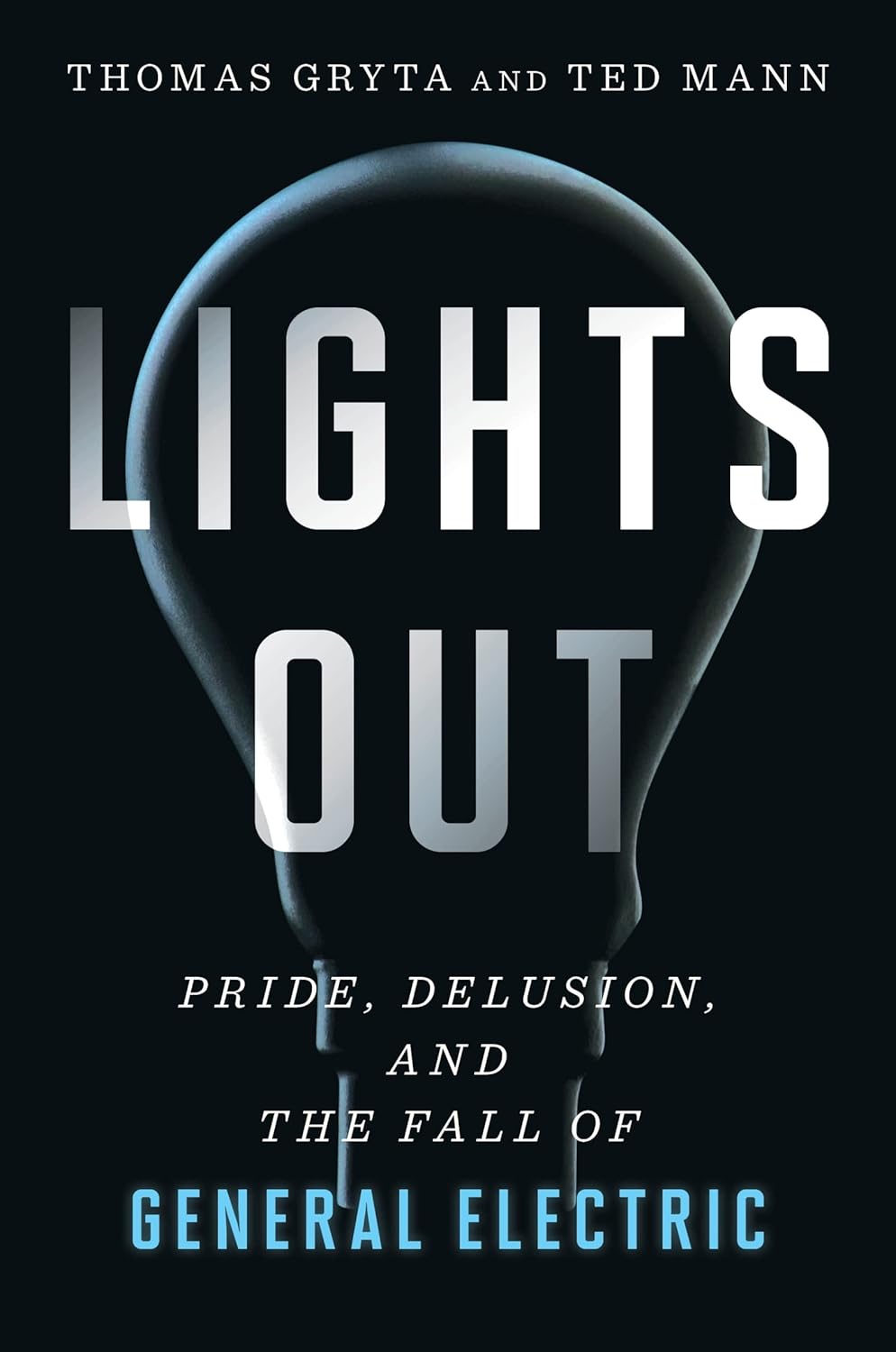
Twenty years later GE is a shell of its former self. Literally hundreds of thousands of employees have been laid off and the company’s market valuation has cratered as low as $50 billion. So what the hell happened? That is a question I had been asking myself as I watched the once invincible corporation struggle for relevance and even survival. Bill Gates had been asking himself the same question, too, and on his fantastic blog, “Gates Notes,” he strongly recommended “Lights Out: Pride, Delusion, and the Fall of General Electric” by Thomas Gryta and Ted Mann.
I enjoyed this book quite a bit and learned a lot. However, it wasn’t exactly what I was expecting, which was an expose on the failures at GE over the past few years. Rather, “Lights Out” is a critical assessment of Jeffery Immelt’s 16-year run as Chief Executive Officer from 2001 to 2017.
To say that Immelt had big shoes to fill in 2001 is a dramatic understatement. The 44-year-old Immelt was taking the reigns from arguably the most celebrated executive in history. His job was simple: Don’t screw it up. Gryta and Mann clearly view Immelt’s tenure as an unmitigated failure. They point out a lot of things Immelt did wrong, but provide little suggestions as to what he might have done better or differently. I actually came away from “Lights Out” with a somewhat sympathetic view of Immelt and the incredibly challenging circumstances of his time at the helm.
Here is how I read the story. Jack Welch benefited from having a strong economic wind at his back for the full 20 years of his reign. He never had to deal with anything like the 9/11 attacks or the 2008 financial crisis. Moreover, he had several tricks at his disposal that would be denied to Immelt. For instance, as Gryta and Mann concede, “Welch cultivated an environment of pressure that incentivized people to [bend the rules].” In order to make quarterly numbers and deliver to Wall Street the smooth and predictable results that Welch demanded, GE executives resorted to all sorts of questionable but legal accounting legerdemain. After the scandals at Enron and Worldcomm, the federal government tightened the screws on corporate accounting practices. According to one GE board member, “The worst thing to happen to Jeff wasn’t 9/11. It was Sarbanes-Oxley.”
Next, Welch benefited from the profit-making machine that was GE Capital. By the time he stepped down in 2001, GE Capital was contributing over 40% of GE’s profits. The operation was so expansive that GE would technically qualify as the seventh largest bank in the country. But Wall Street still valued GE as an industrial manufacturer, applying a more favorable price to earnings ratio to its stock. By the time of the financial crisis, this was no longer true. Wall Street was valuing GE as a financial services firm. Even as Immelt and the leaders at GE worked diligently to shed GE Capital assets while growing the core industrial manufacturing base of its operations, the company stock was saddled with an unfavorable price to earnings ratio.
It seems to me that the authors don’t fully acknowledge the fundamentally different circumstances that Immelt was forced to operate under. Is there any legitimate reason to believe that Welch would have done things better?
So what did Immelt get wrong? Several things, according to Gryta and Mann. First, Immelt had a tendency to overpay for acquisitions. The M&A machine was whirring almost non-stop during Immelt’s tenure and, as the authors tell it, the company lost financial discipline when it came to closing deals, primarily because the Chief Executive Officer refused to let go of a deal once the process started. The massive acquisition of French industrial manufacturer Altsom is a notable case in point, they say. The French government and EU regulators kept layering on concessions that ultimately undermined the strategic rationale for the deal, but Immelt refused to walk away.
Second, Immelt made disastrous forays into oil & gas and information technology. The argument was that Immelt was trying to pivot GE away from Capital and back to its industrial roots, all in the hopes of retaining a better price to earnings ratio. The creation of GE Digital would also theoretically boost the stock by capturing the high multiples associated with information technology companies.
Third, Immelt was a reckless steward of GE’s cash flow. He poured nearly $150 billion in stock buyback programs and stubbornly maintained GE’s pricey dividend in the face of serious challenges.
Finally, Immelt was an eternally optimistic cheerleader who interpreted dissent as disloyalty. The authors claim that GE executives were afraid to question any part of Immelt’s strategy for fear of losing their influence if not their jobs.
The only truly tragic figure in “Lights Out” is John Flannery, who lasted just 14 months as CEO after Immelt’s resignation in 2017. As Gryta and Mann tell it, “Flannery exposed the major problems that went unchecked by his predecessor and put GE on the long, painful road to recovery. For those offenses, he was fired.”
“Lights Out” is a quick and captivating read. I learned a lot about GE during the Immelt years, but ultimately walked away with almost as many questions as I had when I started. One thing is for certain: The GE of the Jack Welch era is dead, and that’s too bad. A powerful and enviable GE was good for America, I think. As the authors note, “[GE] has represented a capitalistic meritocracy, a locus not just of success but of a certain version of virtue – the virtue of targets made, goals surpassed, earnings earned, markets won. And it has stood for a vague but well-marketed notion that, in unapologetic pursuit of a company’s fortunes, and one’s own, there is a certain uprightness – and a lesson for others.”
I’m not very optimistic about GE’s future after reading “Light’s Out.” The latest CEO is former Danaher chief executive and GE board member Larry Culp. Gryta and Mann don’t say much about Culp’s time at the helm, but by the looks of the stock price it hasn’t been great. My main reason for doubting GE’s future is its human capital. The company once attracted the smartest and most ambitious graduates on this country’s leading business schools. That is no longer the case. After all, who would want to work at GE these days? Without a steady funnel of talented men and women to lead and grow GE’s diversified businesses, how can the company hope to survive, let alone thrive?
 What's Tim Reading Now?
Leave a comment