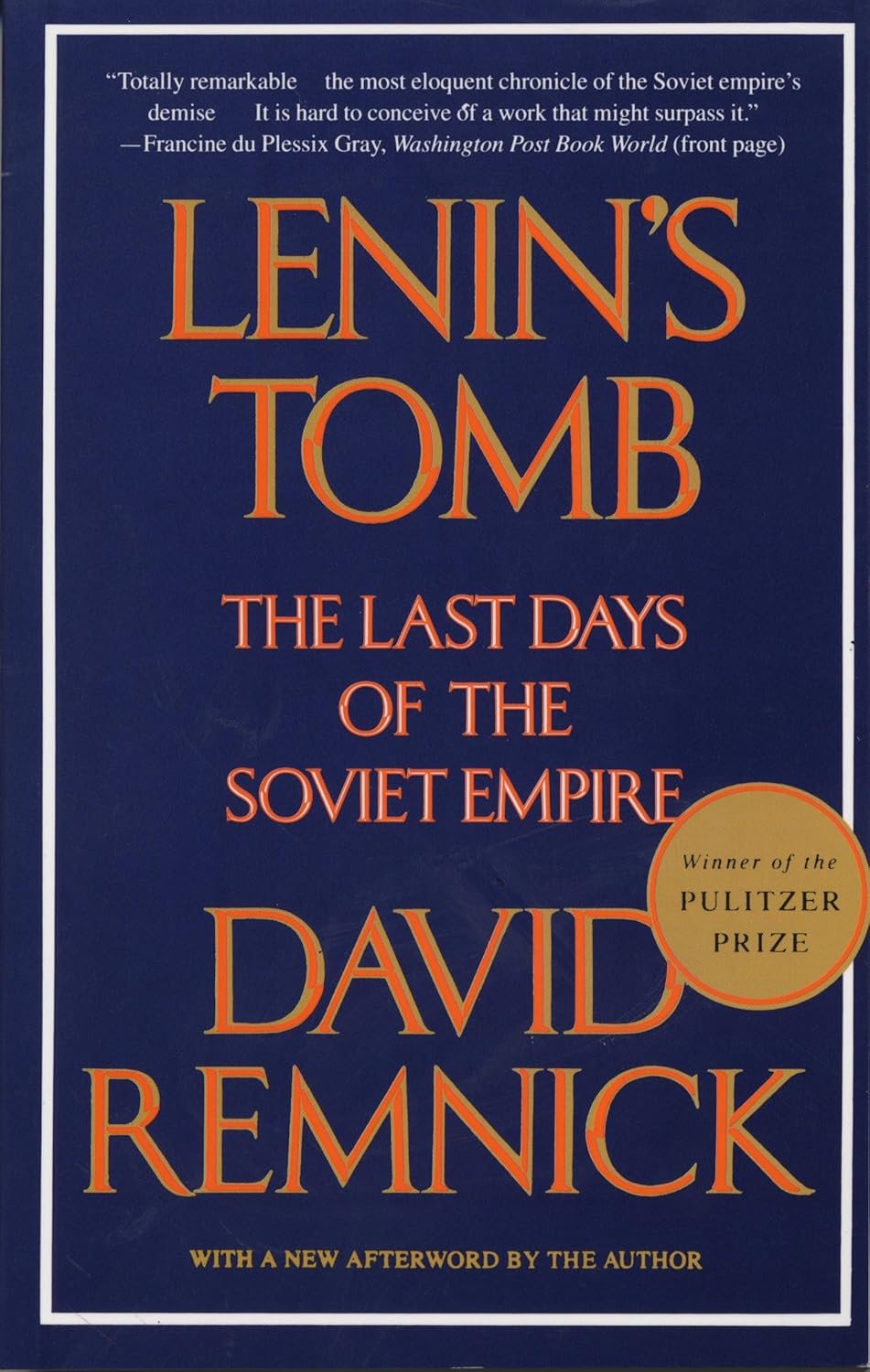
In the summer of 1994 I departed for a semester study abroad program at Moscow State University. It was barely three years after the collapse of the Soviet Union and it would prove to be a wild, often unforgettable experience. A few months before I left, David Remnick’s “Lenin’s Tomb: The Last Days of the Soviet Empire” (1993) was awarded the Pulitzer Prize for General Nonfiction. I didn’t know about it then, but I wish I had, as it provides a fascinating, sobering, and above all accurate account of a failed state with a bankrupt ideology in its final death throes. After living and studying in post-Soviet Russia in 1994, I could have written an epilogue to Remnick’s dazzling journalistic compilation.
Remnick was one of the Washington Post’s lead correspondents in Moscow from 1988 to 1992. He had a front seat – and often a backstage pass – to the implosion of the Soviet Union and its far flung empire. Remnick is a solid and highly professional journalist, but he’s not neutral when it comes to the Soviet Union and its ruling Communist Party. For instance, he refers to the Soviet Union as “one of the cruelest regimes in human history” and “the world’s longest-running and most colossal mistake.” From the fishing villages and mining towns of the Soviet far east to the streets of Vilinius and Riga in the Baltics and village squares in Russian villages on the Black Sea, Remnick bundles together a collection of fascinating human interest stories, all told by a crack journalist with a homicide detective’s eye for detail and a standup comedian’s razor wit.
“Lenin’s Tomb” contains a few central themes. One is the importance of history and the Russian Communist Party’s obsession with it. “The Kremlin took history so seriously,” Remnick says, “that it created a massive bureaucracy to control it.” Ultimately, when the Community Party lost control of Soviet history during perestroika it was doomed to defeat. Remnick says that the Soviet regime was guilty of two crimes on a truly colossal scale: the first was murder (perhaps sixty million people during the course of the regime) and the second was “an unending assault against memory.” The seemingly innocuous effort to build a memorial to all those lost during the Stalinist period would prove to be, in Remnick’s words, “one of the most critical moments in the political and emotional life of the perestroika era.”
Josef Stalin looms large in Soviet history. “Stalinism infected everything and everyone in the Soviet Union,” Remnick says, and it stayed in your system like some parasitic disease, awaiting its opportunity to emerge from its dormancy. The Soviet Union’s Central Committee’s decision to avoid harsh condemnation of Josef Stalin and the horrors of Stalinism was strategic, Remnick says, and it was also arguably rational. The Communist Party valued few things more highly than preserving its own monopoly on power, maintaining domestic political stability, and controlling the Soviet Union’s historical narrative. All three of those things would be gravely undermined if the terrifying depths of the Stalinist era were fully exposed and acknowledged. Moreover, Stalin was practically synonymous with the Soviet victory over Nazi Germany, which Remnick says was a “touchstone, the regime’s lingering reason for being.” By undermining Stalin’s memory, you undermined the greatest victories of the Communist Party, Soviet Union, and the Russian people: World War II, the atomic bomb, and Sputnik.
The return of history first began with Khrushchev’s “secret speech” denouncing Stalin at the Twentieth Party Congress in 1956. In November 1987 Gorbachev seized his moment to pick up what Khrushchev had started. Remnick says that Gorbachev started cautiously, slowly dispensing small doses of the truth. One potential take-away from “Lenin’s Tomb” is that totalitarian regimes really have “the wolf by the ears,” as Thomas Jefferson once remarked about slavery in the American South. Once they ease up enough to permit a full-scale and honest examination of the regime’s past and current behavior, things quickly get out of hand. Gorbachev wanted to fill in the “blank spots” in Soviet history, but that couldn’t be done without tearing down the entire superstructure.
I witnessed the enduring hold Stalin had on the Russian people during my studies in Moscow. I’ll never forget walking in a park not far from the Kremlin and seeing an old, toothless babushka fully clad in Soviet red, pulling a wagon carrying a small dog wearing a hammer and sickle kerchief. She was holding a giant photo of Josef Stalin and shouting support for the long dead tyrant. Perhaps mental illness or dementia alone explains this old woman’s admiration for one of the greatest villains in human history, but I’m afraid that there’s more to the story than that. Russians loved – and continue to love – Josef Stain because Stalin made the Russian people great. According to one Russian citizen interviewed by Remnick: “[Stalin] took Russia, which had a wooden plow in its hands, and he left it with an atomic bomb. Such a man cannot be slandered.” Stalin defeated the Nazis. Stalin brought order to society. Stalin made the Russian nation respected and feared and even occasionally admired. If tens of millions of your fellow citizens had to be murdered along the way to deliver on that success, well it was worth it. It makes the Russian people’s support of Vladimir Putin and his catastrophic invasion of Ukraine all the more comprehensible. Sure, becoming an international pariah, getting frozen out of the world’s financial system, losing all of our western luxury shops, and getting barred from the Olympics and other international events hasn’t been great, but if the rest of the world starts to fear Mother Russia again, it will all be worth it! It really makes you shutter.
Another major theme of “Lenin’s Tomb” is the idea that the Soviet Union was a dysfunctional mafia state mired in grinding poverty. Remnick vividly captures the brutal and often humiliating poverty of the Soviet Union in the late 1980s. The regime had survived since the early 1970s on inflated oil prices. By the mid-1980s the oil boom was over and poverty was pervasive. It has been estimated that perhaps only 2% of the Soviet population of 285 million were relatively well-off, most of whom had achieved that wealth illegally. Another 10% or so were roughly middle class. The rest of Soviet society – over 85% of the population – was poor. Simply put, the vast majority of the Soviet people were “cogs in a system that not only oppressed them,” Remnick says, “but also failed to provide a decent, minimal standard of living.” Indeed, Remnick suggests that laborers in the Soviet Union were veritable slaves: “Miners [whose strike in the late 1980s galvanized the nation] were serfs in a patrimonial system in which the lord was the Communist Party and its instruments were the schools, the trade unions, the mine directors.” This was the result of seventy years of centralized authority, the absence of responsibility or incentive, the triumph of ideology over common sense, and the total dominance of the Party and its sprawling secret police.
“In a state in which property belonged to all – in other words, to no one – the Communist Party owned everything,” Remnick says. The upshot was that the Communist Party apparatus was “the most gigantic mafia the world has ever known.” Everything in the Soviet Union was a racket. No economic transaction was untainted. Remnick tells the story of a woman who needed to bury her mother. At every step along the way she had to pay bribes. The morgue was all full – unless she could pay 200 rubles. There were no coffins in her mother’s size – unless she could pay 80 rubles. The gravediggers were unavailable until the late afternoon – unless she could pay them 25 rubles and a bottle of vodka each. The driver of the funeral bus was unavailable – unless she could pay 30 rubles and a bottle of vodka. On and on it went until the funeral cost over 2,000 rubles or roughly three months pay. “No one could avoid at least at least a certain degree of complicity,” Remnick writes. “That was one of the most degrading facts of Soviet life: it was impossible to be honest.”
A final leitmotif of “Lenin’s Tomb” is the almost farcical incompetence of the Soviet government. (This too is reminiscent of the situation in Ukraine in 2024.) Gorbachev had his work cut out for him, no doubt. When he started upon the path of reform, Gorbachev only had three liberal allies in the Politburo: Boris Yeltsin (head of the Moscow Communist Party), Aleksandr Yakovlev (Secretary of the Central Committee), and Eduard Shevardnadze (the Georgian foreign minister). Gorbachev would later refer to the Politburo and Central Committee as “a lake of gasoline” and conceded that he didn’t fully understand the “monster” he was trying to reform. The Gorbachev years (March 1985 to December 1991) were marked by a remarkable degree of improvisation, both in the conduct of perestroika and the reactionary response leading to the failed coup of August 1991. Once the genie of freedom had been let out of the Soviet lamp, no one it seemed, not even the combined might of the Red Army and the KGB, could control it.
Perestroika was meant to be a return to Leninism, a purer and more honest form of socialism, as well as a purification of the Party from Stalinism and totalitarianism. Gorbachev seemed the ideal person to lead the movement. Gorbachev was relatively young (54) and an outsider, a “Soviet Best Boy,” according to the author – a country bumpkin with a southern accent from the best performing collective farm in the region. “He was the classic small town over-achiever,” Remnick writes, “a class-president type who scored high marks, starred in the school plays, and won the heart of the best-looking girl in the school.” He quickly captivated not only the Soviet Union, but the world. But Gorbachev was simply unable to control the new form of politics he had set free. Others, such as Yeltsin and dissident physicist Andrei Sakharov, advocated for reforms that Gorbachev never dreamed imaginable.
Remnick says that Gorbachev was particularly embarrassed and incensed by Sakharov’s widespread domestic popularity, just as Brezhnev had seen Sakharov’s 1975 Nobel Peace Prize as an humiliating international endorsement of treason. The exiled physicist called for “radical perestroika” and the repeal of Article Six of the Soviet Constitution, which gave the Communist Party a guaranteed monopoly on power. “If God sent Jesus to pay for the sins of humankind,” one contemporary Russian critic quipped, “then a Marxist God somewhere sent Andrei Sakharov to pay for the sins of our system.” For the first time, a disparate coalition of dissenter groups, including Siberian miners, Baltic independence advocates, and Moscow intelligentsia, were being united by the words and example of Sakharov. Remnick, for one, sees Sakharov as undeniably better and purer of the two great men. “If, in the language of the Greek fable, Sakharov was the fox, a man with a singular sense of moral and political ideals,” he writes, “then Gorbachev was the hedgehog, a man capable of deceit and cruelty, a man of shifting values and ideas, but a genius at a nasty game. An irreplaceable man in his moment.”
As the Eastern Bloc began to splinter and collapse, Moscow was determined to hold together the “internal empire,” the sprawling fifteen union republics of the Soviet Union, which Gorbachev believed shared “an ineffable sense of commonality.” Remnick says that Aleksandr Yakovlev, Secretary of the Central Committee of the CPSU, emerged as “Seneca to Gorbachev’s Nero.” More than anyone else, Remnick says, Yakovlev engineered the cultural revolution known as glasnost. He even advocated for the splitting of the Communist Party into permanent conservative and liberal factions, roughly analogous to the Republican and Democratic parties. He also advocated strongly for the daringly ambitious 500 Days Plan.
The 500 Days Plan (officially the Shatalin Plan) was an ambitious – ultimately stillborn – economic reform proposal during the final years of the perestroika era. The plan aimed to transition the Soviet Union from a centrally planned economy to a market economy in less than two years. A central component of the plan was the rapid privatization of state-owned enterprises. Another aspect of the plan was to open the Soviet economy to global markets by reducing trade barriers and encouraging foreign investment. The plan also called for significant decentralization of economic decision-making, giving more power to individual republics and local governments. The 500 Days Plan also included measures for economic stabilization, such as controlling inflation, reducing the budget deficit, and stabilizing the ruble. The Plan faced strong opposition from various factions within the Soviet leadership and ultimately was never fully implemented. According to Yakovlev, Gorbachev’s rejection of the 500 Days Plan “was the last chance for a civilized transition to a new order … it was probably his worst, most dangerous mistake.” Conservative resistance to the 500 Days Plan ultimately coalesced into the attempted coup of August 1991.
According to Remnick, the Communist Party’s reaction to perestroika and the 500 Days Plan was a “strange amalgam of nationalism, neo-Stalinism, and pure resentment.” By 1989 the Soviet people had completely lost faith in Communist ideology and the Party itself. The slang word for Soviet (“sovok”) had come to mean some combination of narrow-minded, weak, officious, lazy, hypocritical, and obsequious. Remnick says that the nuclear accident at Chernobyl dramatically showcased every curse of the entire Soviet system, “the decay and arrogance, the wilful ignorance and self-deception.” In other words, it was a classic “sovok” screw-up. No wonder at the time of the end of the Soviet Union only five percent of the Russian population were members of the Communist Party. Remnick tells a funny story about the time the Moscow Higher Party School (the ideological nerve center of the Soviet Communist Party) hosted a screening of the classic Oliver Stone drama, “Wall Street.” Presumably school officials wanted to show their student body the ugly truth about American capitalism, only to see their ostensibly devoted Marxist-Leninist scholards whoop with delight and approbation when Gordon Gekko unapologetically declares that “Greed is good.” (In fairness, capitalism in Russia would ultimately spawn far more Al Capones than Warren Buffetts.)
By 1989 Soviet ideology had collapsed. The muscular, belligerent international communism of the Brezhnev era had given way to the soppy, almost apologetic communism of perestroika. The banners at the May Day parade – once a showcase of the Red Army’s military might – now read “Peace is for Everyone!” and “We’re Trying to Renew Ourselves!” For the Party faithful it was all quite disorienting, to say the least. “[Soviet citizens] had lived for decades in a world of guarantees (however meager),” Remnick writes, “and absolute truths (however false), and now everything has been denounced, undercut, found out. They felt threatened to the core.”
However, Gorbachev’s most implacable foes were often not die-hard communists, but rather Russian patriots bound together by “a mystical stew of great-power nationalism, the imagery of empire, vast and powerful, unique and holy.” A young KGB agent serving in East Germany named Vladimir Putin was certainly one of them. Viktor Alksnis, an army colonel who Remnick calls “the Darth Vader of the hard-line set,” was humiliated and enraged by the Kremlin’s emasculation. He wanted the Kremlin to be feared again. Instead, “[The Soviet Union] is like Cupid,” he said, “armed, naked, and we impose love on everyone.” It was these types of men who would eventually re-take Russia and turn it back into an autocracy and attempt to reconstruct, at least in part, the glorious Soviet Union of the past. Remnick saw early signs of it coming, too. For instance, on a trip to a Soviet prison camp in the Ural Mountains city of Perm in 1990, Remnick interviewed a prison official. He was unimpressed with the chaos of perestroika and predicted “There will be a dictatorship soon. It won’t be the Communist Party organs, it will be the real organs – the KGB.”
It was largely these types of men who tried to take over the country in 1991. The forces arrayed against Gorbachev and his liberal reforms were significant. The coup leaders included KGB chief Kryuchkov, Defense Minister Yazov, Prime Minister Pavlov, Politburo chief Shenin, Defense Industries chief Baklanov, and Gorbachev’s own chief of staff Boldin. The KGB’s Kryuchkov was the leader; in one form or another, they were all “Gorbachev’s men.”
Remnick says that the plotters had no real plan and no real aim beyond ousting Gorbachev, declaring a state of emergency, and arresting the dangerous liberal drift of perestroika and glasnost. On August 19, 1991 broadcasters went on state television to announce, “The policy of reforms, launched at Mikhail Gorbachev’s initiative and designed as means to ensure the country’s dynamic development and the democratization of social life, have entered for several reasons into a blind alley.” To the plotters’ surprise and delight, news of the coup was initially greeted across the country with calm, even disinterest. Resistance would eventually be isolated to Moscow. Almost as soon as it began, the coup began to crumble. “The combination of confusion, stupidity, drunkenness, lack of will, miscalculation, and happenstance (the blessed rain!) had all conspired against the committee,” Remnick writes. Kryuchkov and his fellow plotters “had Stalinist impulses, but not the core of cruelty” required to succeed. In the words of Jim Hoagland of The Washington Post: the Russian coup “started like Dostoevsky and ended like the Marx Brothers.”
There were few victors in the end, perhaps only Boris Yeltsin, who’s brave stand at the White House during the coup inspired a nation. Gorbachev was crushed by the movement he had started. Many claimed that he fell victim to international acclaim and vanity. Gorbachev’s retirement would prove to be miserable; Remnick says he was “punished, mocked, and ignored.” Remnick says post-Soviet Russians suffered from “unremitting loss and wounded pride.” It would gnaw at them for a decade. Putin successfully tapped into this collective shame and suffering by embracing a mythic nostalgia that is rooted deeply in the Russian people. The Communist nostalgia for order; the military nostalgia for the fear the Soviet arsenal once struck in the heart of the West; the nationalist nostalgia for empire and a higher spiritual purpose. In hindsight, Putin’s rise was all very predictable. “Russia’s economic failure and wounded self-esteem are so profound and combustible,” Remnick wrote in the early 90s, “that the rise of a charismatic authoritarian movement in Russia cannot be ruled out.”
 What's Tim Reading Now?
Leave a comment