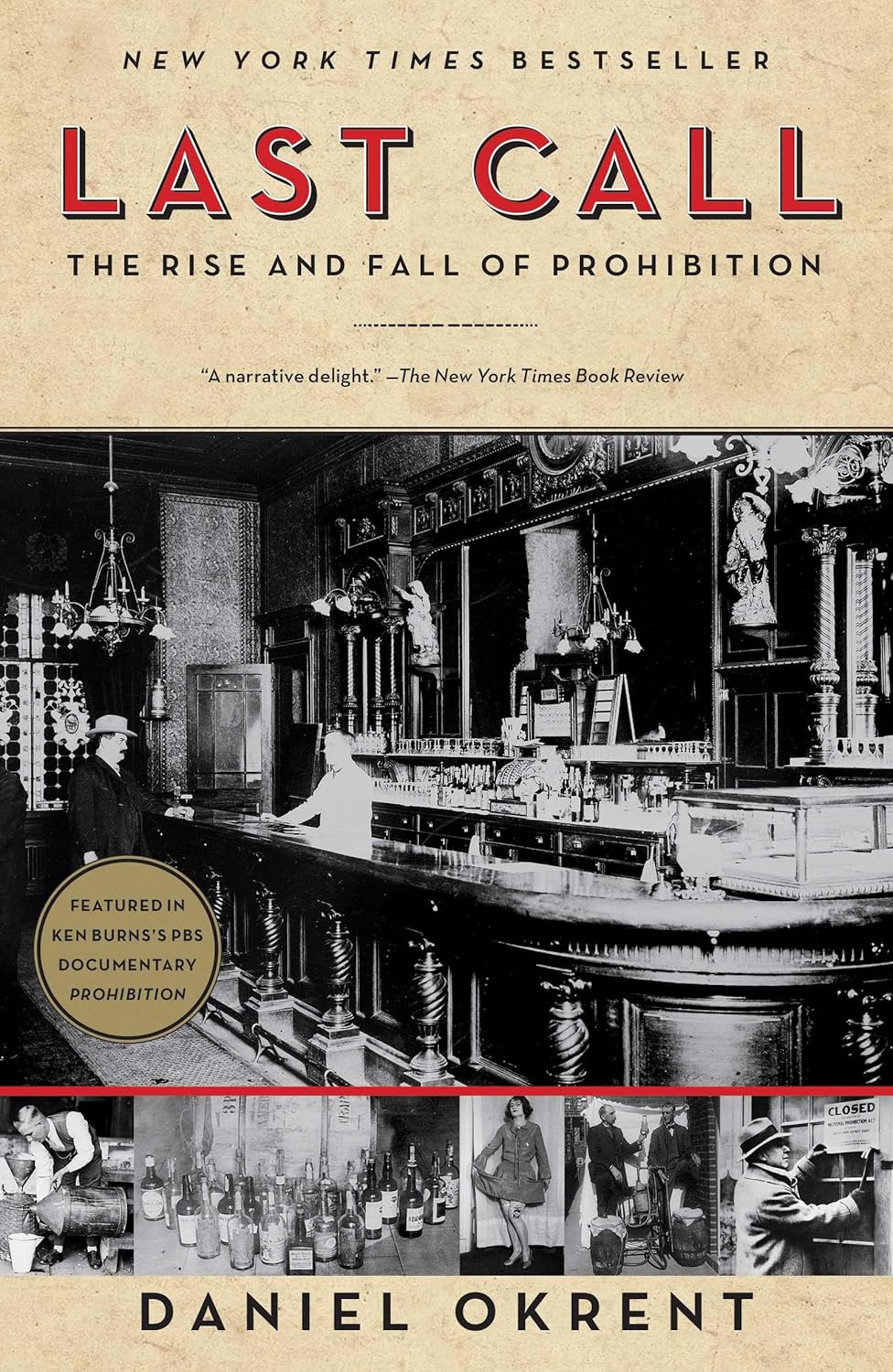
The United States Constitution prohibits the federal government from doing a lot of things. However, over the past 235 years it has only spelled out two things that citizens cannot do: own slaves (13th Amendment) and purchase alcohol (18th Amendment). Author Daniel Okrent tells the fascinating story behind the passage of the 18th Amendment and the struggle to enforce it via the Volstead Act in “Last Call: The Rise and Fall of Prohibition.”
Americans love to drink – and they always have. In fact, Americans in the nineteenth century are estimated to have drank three times more than we do today, which is really saying something. At the dawn of the twentieth century, spirits (i.e. breweries, distilleries, and wineries) represented the fifth largest industry in the country. Yet, on January 16, 1920, after a lengthy and seemingly insurmountable democratic political process, Americans banned the distribution and sale of alcohol. Okrent is almost incredulous: “How did a freedom-loving people decide to give up a private right that had been freely exercised by millions upon millions since the first European colonists arrived in the New World?”
The ill effects of alcohol have troubled Americans for a long time. The first broad-based popular movement against alcohol emerged in the 1840s. Known as the Washingtonian Movement, it involved a series of persuasive public speakers, most notably the former stage actor and reformed hard drinker John Bartholomew Gough (residents of San Francisco will recognize his name), along with a simple and voluntary pledge of abstinence. Abraham Lincoln recognized and appreciated the Washingtonian Movement’s reliance on nothing more than “persuasion, kind, unassuming persuasion.” It is estimated that Gough alone delivered more than 10,000 speeches to audiences of nearly ten million people. All told, more than 500,000 took the pledge of abstinence.
The next important chapter in the war against alcohol opened in 1874 when Frances Willard established the Women’s Christian Temperance Union (WCTU). It marked an important shift in focus. No longer were the advocates praying for the sinner (i.e. alcoholics), but rather for those sinned against (i.e. weeping wife and children). “The moral crusade was now a practical one as well,” Okrent writes. Willard’s WCTU embraced a wide range of progressive causes, everything from prison reform and universal suffrage to public education and the elimination of the electoral college system. Okrent writes that this lack of focus undermined the organization’s strength and effectiveness. Moreover, the WCTU openly embraced a range of questionable facts that eroded the organization’s credibility. For instance, the WCTU successfully lobbied school boards all across the country to include mandatory education on the dangers of alcohol, which included things like “the majority of beer drinkers die of dropsy.”
The final stage in the march to Prohibition came with the founding of the Anti-Saloon League (ASL) in 1893. “The Anti-Saloon League may not have been the first broad-based American pressure group,” Okrent writes, “but it certainly was the first to develop the tactics and the muscle necessary to rewrite the Constitution.” Indeed, the ASL was the 800lbs. gorilla of the Prohibition movement, “the mightiest pressure group in the nation’s history.”
What made the ASL so effective? In Okrent’s estimation it all came down to leadership and focus. The Reverend Howard Hyde Russell may have founded the ASL, but its indispensable leader was Wayne Wheeler, a man once described as “a locomotive in trousers.” (Okrent compares him to Ned Flanders from The Simpsons. H.L. Mencken, a confirmed opponent of Wheeler and the ASL, said of Wheeler at the time of his death in 1927: “In fifty years the United States has seen no more adept political manipulator.”)
A big part of the ASL’s success was owed to focus. Unlike the WCTU, the ASL pursued one political cause to the exclusion of all others: banning alcohol. Wheeler’s organization, large as it was, probably never represented more than 10% of the voting public. But those voters were motivated and responsive. In any close election in any state in the Union, Wheeler and his ASL voters had the power to determine the outcome. Because the ASL freely endorsed members of both parties and refused to meddle in any other issues, it became an extraordinarily powerful political instrument. “No better ally, no worse enemy,” as they say. Over the next twenty-five years, maintaining laser-like focus on a single issue, the ASL cobbled together an unlikely alliance of political bedmates to ultimately pass and ratify the 18th Amendment. It truly is a monument to the successful manipulation of the American political and legal process.
At the macro-level, Okrent says the battle for Prohibition came down to “native-born Protestants against everyone else.” At the core of the movement were evangelical Christians, specifically Methodists and Baptists. Okrent says that the nationwide network of these churches formed the “capillary system” of the ASL. Building on the foundation provided by the evangelical Christian church, Wheeler and the ASL aggressively leveraged the anti-alcohol sentiment found in five distinct groups: progressives, racists, suffragists, populists/socialists, and nativists.
Prohibition as a cause was a “fellow traveler” with other progressive reforms of the era, such as universal suffrage, tariff reduction, income tax, and the direct election of senators, to name just a few. These movements often supported one another. Wheeler was able to co-opt a number of eastern urban progressives, many of who were so-called “wet drys” – those who personally drank but supported efforts to limit or eliminate the consumption of alcohol. Moreover, the path to Prohibition may very well have been paved by the 16th Amendment (federal income tax), which was passed by Congress in 1909 and ratified in 1913. In the early twentieth century, the excise tax on alcohol accounted for 30% of federal revenues. Without the income tax amendment, the prohibition of alcohol would have been fiscally impossible.
More disturbingly, Wheeler actively collaborated with the Ku Klux Klan in an effort to win votes for Prohibition across the Deep South. A familiar trope at the time was that blacks were singularly susceptible to the dangerous effects of alcohol. Most terrifying was the specter of blind drunk black men raping innocent white women. The fact that one Jewish-owned St. Louis distillery actively marketed across the South a brand called “Black Cock Vigor Gin” portraying a nude white woman on the label didn’t help matters. Southern Democrats would prove a reliable voting bloc for Wheeler in the battle for Prohibition.
Wheeler’s most widespread constituency, however, may have been women. Okrent notes, “The rise of the suffrage movement was a direct consequence of the widespread Prohibition sentiment.” Many of the leading suffragists in America, such as Susan B. Anthony, got their political start in the temperance movement. The prohibition-suffrage alliance was “inevitable,” according to Okrent. In fact, the only time the ASL violated its single-issue pledge was its 1916 formal endorsement of woman suffrage. However, Okrent does not explain what role women voters played in the success and then defeat of Prohibition. The 19th Amendment, of course, came after the 18th, but by the time Prohibition was repealed in 1933, millions of new women voters would have influenced the outcome. Presumably, the Prohibition vote grew by millions after the 19th Amendment became law in 1920, but Okrent never explains what role those new votes played.
Finally, Wheeler unabashedly exploited the stereotypical relationship between immigrant groups and alcohol in its various forms. Whether it was Irish and their whiskey or Italians and their wine, the ASL attracted xenophobes of all stripes by promoting Prohibition as a weapon in the war against mass immigration. Wheeler never missed the opportunity to exploit a political advantage, and none proved larger or more consequential than the First World War. Since the late nineteenth century beer drinking had eclipsed all other forms of alcohol consumption in the United States. German-Americans, with names like Pabst, Miller, Coors and Busch, virtually monopolized the brewing industry. Moreover, they owned or directly influenced the vast majority of saloons across the country, which were the prime target of the ASL’s biblical wrath. Widespread anti-German sentiment during the war years delivered the final push that finally got Prohibition over the political mountain.
The Founding Fathers didn’t make it easy to amend the Constitution. A proposed constitutional amendment needs to gain two-thirds of the vote in both houses of Congress, and then be ratified by three-quarters of the state legislatures, which in 1919 was 36 states. Not only did Prohibition pass, it flew through. In 1917, Prohibition passed in the Senate 65 to 20. Interestingly, the vote was almost evenly split between Republicans (29 to 8) and Democrats (36 to 12). The vote in the House was 282 to 128, again almost evenly split between Republicans (141 to 64) and Democrats (137 to 62). It took just 394 days for 36 state legislatures to approve amendment, which is less than half the time it took 11 states to approve the Bill of Rights.
According to Okrent, the failure to effectively enforce the 18th Amendment was a combination of incompetence and willful neglect. To begin with, nobody at the top was a strong proponent of Prohibition. Presidents Harding, Coolidge and Hoover were all tepid supporters at best. Meanwhile, Andrew Mellon, the powerful treasury secretary for all three presidents and the man ultimately responsible for enforcing the Volstead Act, was openly hostile to Prohibition and thought it “extreme, impractical, and essentially unenforceable.” Mellon’s top two lieutenants were Roy Haynes, head of the 1,500 agent Prohibition Department, a political appointee who Okrent describes as comically inept, and Mabel Willebrandt, the young, talented, but woefully overworked top prosecutor of Prohibition cases. Okrent writes “the disconnect between the laws and the means to enforce them approached the surreal.” The Republican administrations of the 1920s were tight-fisted on all government spending. Support for Prohibition proved no exception. Meanwhile, only 18 states bothered to appropriate anything for enforcement. In other words, when it was rolled out in 1920, Prohibition was supported mainly by collective wishful thinking. Needless to say, it didn’t go well.
There were three gaping holes built into the 18th Amendment. First, home brewing for personal consumption was allowed. Those who drafted the bill had in mind small time apple farmers who wanted to keep a barrel after the harvest to make some hard cider. Once enacted, hundreds of thousands of Americans began fermenting their own wine. The grape growers of California, originally and understandably quite nervous about Prohibition, saw demand and prices for their grapes skyrocket. Okrent writes that total US consumption of wine (imported, domestic and homemade) in 1917 totaled 70 million gallons. By 1925 it was 150 million gallons – all of it homemade.
Second, alcoholic beverages for medicinal purposes were exempted. At the time, a wide variety of alcohol-rich quack health remedies were marketed to the American public. Why these were exempted is not clear, but drugstores across America eventually profited even more than California grape growers. “The cash flow from few enterprises gushed with quite the velocity that Prohibition brought to the drugstore business,” Okrent says. In 1916, Chicago-based drugstore owner Charles Walgreen had nine locations. During the 1920s he would open an additional 525.
Finally, there were religious exemptions. The conventional image here involves wine for communion at Catholic churches, and that was certainly the original focus. However, the exemption was abused primarily under the guise of a Jewish congregation, which allowed an individual rabbi to present a list of congregants to legally obtain prescribed quantities of wine and assume responsibility for distributing it. At Congregation Talmud Torah in Los Angeles, membership jumped from 180 to over 1,000 the month after Prohibition went into effect. In another instance, Okrent writes about a new Jewish congregation starting up under a rabbi named Frank Houlihan.
In addition to the three main loopholes in the law, bootlegging grew to almost epic proportions. In the last full year before Prohibition, the US federal government collected nearly $500 million in liquor tax revenues (about $7 billion in today’s dollars). Theoretically, all of that money was available for the taking. By 1926, it was estimated that the annual sales of bootleg liquor had reached $3.6 billion – twice the entire federal budget. Armadas floated just outside the three-mile international waters zone offering a variety of alcohol to boaters from New York and Boston and other coastal cities. Seagram’s owner Sam Bronfman, soon to be the richest man in Canada, organized a sophisticated supply organization that brought liquor overland to Detroit and Chicago. Meanwhile, Al Capone and other gangsters battled over the turf rights to operate thousands of speakeasies and distribute illegal liquor.
The demise of Prohibition was as fast, improbable and unexpected as its rise. Prohibition was clearly not working as intended and people were getting fed up with the situation, but the elections of 1928 delivered “the driest Congress ever,” according to Okrent: 80-16 in the Senate and 329-106 in the House. In the state houses across the country, it was even more lopsided: 43 out of 48 governors were dry. A constitutional amendment had never been repealed before. Despite its obvious shortcomings, Prohibition’s future seemed secure at the beginning of the Great Depression. In 1930, Senator Morris Sheppard of Texas, one of the primary authors of the 18th Amendment, said: “There is as much chance of repealing the 18th Amendment as there is for a hummingbird to fly to the planet Mars with the Washington Monument tied to its tail.” Most people believed him.
If the First World War tipped the balance in favor of Prohibition, the Great Depression may have tipped it back. The first three years of the Depression saw a 60% drop in federal income tax receipts. The people needed jobs and the government needed money. Meanwhile, the ASL, “the most powerful pressure group the nation had ever known,” according to Okrent, had all but collapsed after the sudden death of Wayne Wheeler in 1927. By the early 1930s, the once mighty ASL was on life support. Soon, prominent advocates for Prohibition, such as John D. Rockefeller Jr., Alfred P. Sloan, and Harvey Firestone, began openly defecting to the cause of Repeal. Virtually overnight the entire national mood changed. In 1933, the Senate voted 63-23 in favor of Repeal. Of the 22 members who had voted for the 18th Amendment sixteen years earlier and were still in the Senate, a whooping 17 (77%!) had changed their vote. Two days later the House voted to repeal Prohibition 289-121 after just forty minutes debate. In the first year after Repeal, the government collected $260 million in alcohol taxes – nearly 9% of total federal revenue.
For fourteen years the United States forbid the commercial production, distribution and sale of alcohol. Contrary to popular conception, alcohol consumption did drop significantly during this period. Okrent suggests that alcohol consumption dropped as much as 70% during the first years of Prohibition. By the time of Repeal in 1933, however, consumption rates had climbed back so that they were perhaps 30% lower than they had been in 1920. Even after Repeal, the United States did not return to the pre-Prohibition per capital peak of 2.6 gallons per adult per until 1973. Today, alcohol consumption in the United States has dropped back to 2.2 gallons.
There are lots of lessons in “Last Call.” First, nothing is politically impossible. Both the 18th and 21st Amendments seemed impossible right up until they became law. Second, progressive causes are not always on the right side of history. In a world where leftist school boards are cancelling advanced math classes because they are “racist,” it is important to recognize that their position is not destined to win. Finally, political interests groups with strong leadership and maniacal focus on a single issue possess the ability to literally re-write the Constitution, which I find to be both inspiring and terrifying.
 What's Tim Reading Now?
Leave a comment