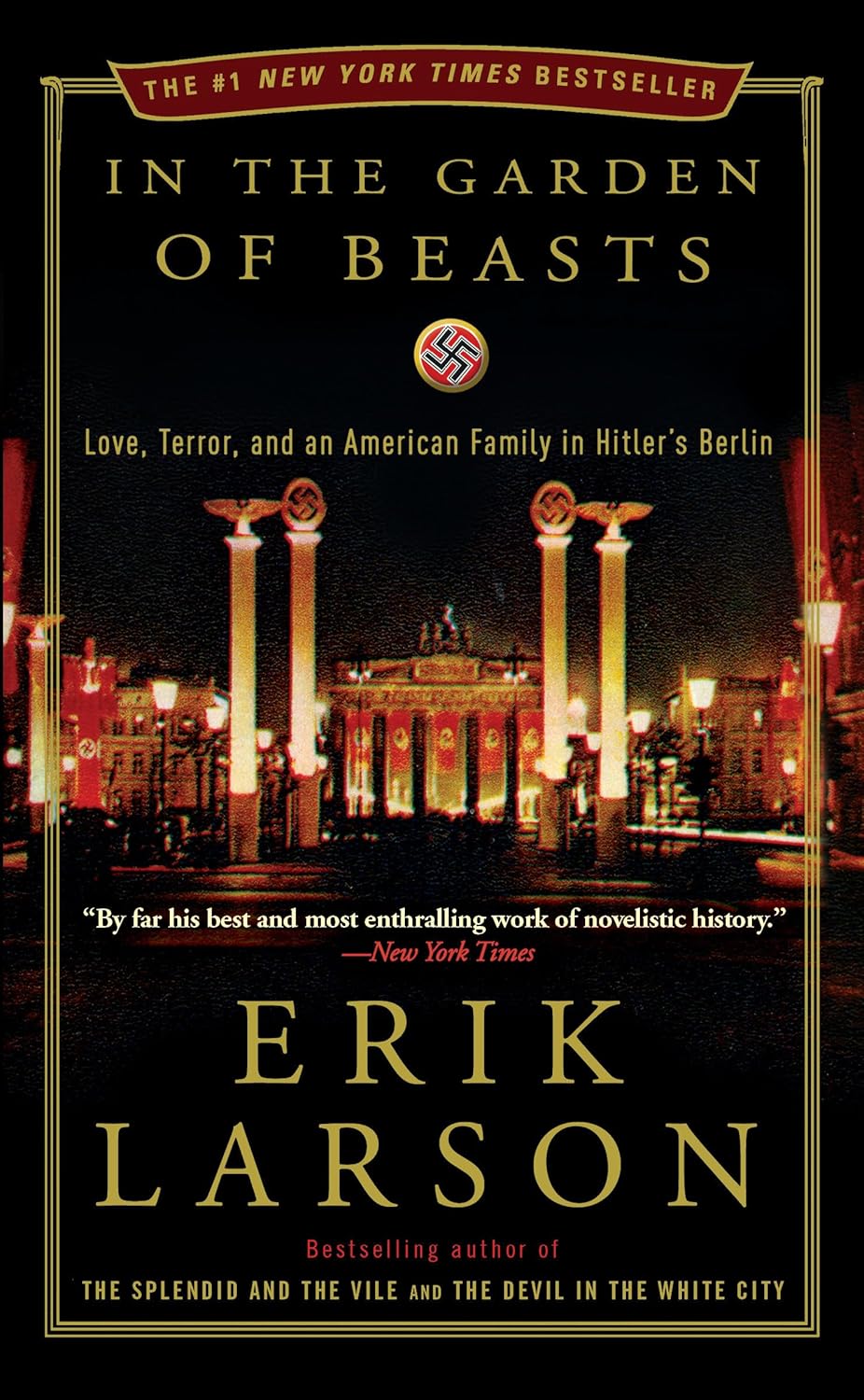
Erik Larson knows how to tell a good story. Perhaps even more importantly, he knows how to find them. Over the years I’ve read my fair share of books on the interwar period and the rise of Nazi Germany, but I don’t recall ever reading about the American ambassador to Berlin in the first few years of Hitler’s reign and his vivacious young daughter. Larson tells this story brilliantly in “In the Garden of Beasts: Love, Terror, and an American Family in Hitler’s Berlin” (2011).
Franklin Roosevelt had a lot on his plate in early 1933. He had just been elected president and was in the midst of implementing his aggressive economic recovery agenda known as “The Hundred Days.” Meanwhile, Adolf Hitler had just been named Chancellor of Germany, the Reichstag had just been set on fire, and the Roosevelt administration urgently needed to appoint a new ambassador. There weren’t many takers. The first half a dozen candidates turned the new president down for one reason or another. Finally, they turned to an obscure history professor at the University of Chicago with an academic speciality in the American South who dabbled a bit in Democratic politics and whose sole qualification for the job was that he received his doctorate from the University of Leipzig over thirty years ago and could speak passable German. His name was William E. Dodd.
Dodd was an amiable 65-year-old North Carolinian who was looking to get out of Chicago so he could focus on finishing his magnum opus, a multi-volume series on the Old South. For some reason he believed that being named the chief American diplomat to Nazi Germany would be something of a relaxing busman’s holiday that would give him plenty of time to write in peace and quiet. Moreover, he wanted to take his two aimless adult children along with him, a 28-year-old son, also named William, who showed a disconcerting lack of direction in life, and his 24-year-old daughter, Martha, a feather-brained trollop whose eventual social and sexual activities in Berlin between 1933 and 1937 are almost beyond belief.
The Dodd family in Berlin included four members, but Larson only writes about two of them: Ambassador Dodd and his daughter Martha. Both got in plenty of hot water during their four-year stay in Hitler’s Germany.
Dodd was unfit for his critical role in American foreign policy and quickly built up enemies at the State Department, both in Berlin and back in Washington. They began to privately refer to him as “Ambassador Dud.” In the early twentieth century the Foreign Service was still something of an Old Boys Club. Most officers were graduates of Harvard or Yale and were independently wealthy, allowing them to live and entertain on a lavish scale, far beyond what their meager government salaries could hope to sustain. Dodd thought such extravagance was shameful and often embarrassing, especially during the Depression. He had been clear with Roosevelt before he accepted the post that he would have to live within his ambassador’s salary. He ended up renting a home from a frightened Jewish banker who hoped that having the American ambassador as his tennant would provide a modicum of protection from the Nazis. Dodd also shipped over his run down Oldsmobile from Chicago to serve as his official transportation around Berlin. His blue blooded deputies at the embassy – all members of the self-proclaimed “Pretty Good Club” – grimaced at the “small town attitude” of their new boss. “They saw his complaints about costs as offensive, tedious, and confounding,” Larson says.
The most shocking thing about Dodd’s performance, as described by Larson, was his general disinterest in his critical position. He was “a diplomat by accident, not demeanor,” Lawson says. In 1933 the United States had two pressing concerns when it came to the new Nazi Government. First, ensure that Hitler continued to pay off the massive government debt held mostly by American creditors. Second, ensure the safety of American expatriates and Jews living in an increasingly hostile environment. Dodd was completely disinterested in the first issue (“Our people will have to lose their bonds,” he laconically observed) and only slowly developed strong feelings about the second. In fact, when he first arrived in Berlin, Dodd was convinced that the stories of Jewish oppression inside Nazi Germany were wildly exaggerated. He would eventually become an implacable opponent of the regime, whose leadership he saw as “inept and dangerous adolescents.”
Ambassador Dodd’s position was challenging enough without the extracurricular activities of his young daughter added to the mix. She arrived in Berlin having been engaged twice, married once and in the midst of getting divorced to a banker husband back in New York. “Outwardly she looked the part of a young American virgin,” Larson says, “but she knew sex and liked it, and especially liked the effect when a man learned the truth.” Over the next four years the daughter of the American ambassador would sleep with Rudolf Diels, the scar faced, married head of the Gestapo; Putzi Hanfstaengl, the towering and married Nazi foreign press chief; the deliciously named Boris Winogradov, a married Soviet NKVD agent; Armand Berard, third secretary of the French embassy; Carl Sandburg, the future two-time Pulitzer Prize-winning historian; and Thomas Wolfe, the famed American novelist; and probably countless others lost to history. In the words of Dodd’s German butler: “[The Dodd residence] was not a house, but a house of ill repute.” It really is incredible and, on a certain level, impressive. To say that Martha’s romantic escapades caused headaches for her father and the staff of the American embassy would be an understatement.
In addition to sleeping with half of official Berlin, Martha entered Germany as a borderline Nazi sympathizer. According to Larson, news reports of mistreatment of Jews and other political opponents left her “unshaken in her view that the revolution unfolding around her was a heroic episode that could yield a new and healthy Germany.” In her memoir, Martha later wrote: “The excitement of the people was contagious and I ‘Heiled’ as vigorously as any Nazi.” She would eventually slingshot politically to the left and spend the rest of her days as a communist sympathizer and purported Soviet spy. One KGB operative was unimpressed: “[Martha Dodd] considers herself a Communist and claims to accept the party’s system. In reality ‘Liza’ [her KGB codename] is a typical representation of American bohemia, a sexually decayed woman ready to sleep with any handsome man.”
One thing “In the Garden of Beasts” makes clear is that almost no one expected Hitler to last long in power. He was just forty-four years old when he was appointed Chancellor and his political base was shaky. Virtually everyone thought he would be thrown out of power by the powerful and influential Paul von Hindenberg or by the Army or by some cobbled together political alliance. At first, “Dodd remained convinced that the government was growing more moderate and the Nazi mistreatment of Jews was on the wane,” according to Larson. It would take Hitler’s response to German Vice Chancellor Fritz von Papan’s politically moderate Marburg Speech of June 17, 1934 and the bloody purge of former ally Ernst Rohm and his stormtroopers (Sturmabteilung) on the “Night of the Long Knives” two weeks later to permanently change his mind.
Jews were a tiny minority in Germany in the 1930s. They made up less than one percent of the total German population of some sixty-five million. (To put that in perspective, in 2023 Muslims made up about 1.3% of the US population.) The German Jewish population was concentrated almost exclusively in urban areas. One third of the Jewish population – about 160,000 – lived in Berlin alone, a city of just over four million in 1933, accounting for about four percent of Berliners. By comparison, almost twenty percent of New York City is Jewish today. In the months when the Dodd’s arrived, “Nazi attacks on the Jews were like summer thunderstorms that came and went quickly, leaving an eerie calm.”
Raymond Geist, Vice Consul of the American embassy in Berlin, complained: “The ambassador is mild mannered and unimpressive whereas the only kind of person who can deal successfully with the Nazi Government is a man of intelligence and force who is willing to assume a dictatorial attitude with the Government and insist upon his demands being met. Mr. Dodd is unable to do this.” To make matters worse, in April 1934 Fortune Magazine published a series of profiles on the American ambassadors in Europe. Dodd was described as a “square academic peg in a round diplomatic hole” and alluded to his relative poverty and lack of diplomatic aplomb. Nevertheless, Larson says that Dodd “became one of the few voices in the US government to warn of the true ambitions of Hitler and the dangers of America’s isolationist stance,” a true diplomatic Cassandra.
Dodd was stunned when he received word that he was being recalled as ambassador to Germany on November 23, 1937. Despite frequent reassurances that Dodd was doing a swell job, Roosevelt ultimately caved to the combined pressure of Dodd’s blue blooded State Department enemies and the uniformly hostile Nazi regime. In the words of William Bullitt, American ambassador to Paris, “We need in Berlin someone who can at least be civil to the Nazis and speaks German perfectly.” Dodd clearly could not. His replacement, Hugh Wilson, was the embodiment of the State Department’s aristocratic “Pretty Good Club,” something the congenial old professor must have found humiliating.
In the end, Larson says that Dodd proved to be everything Roosevelt wanted him to be: “a lone beacon of American freedom and hope in a land of gathering darkness.” Dodd would never learn of the terrifying depths of Nazi depravity; he died peacefully on his Virginia farm in 1940.
 What's Tim Reading Now?
Leave a comment