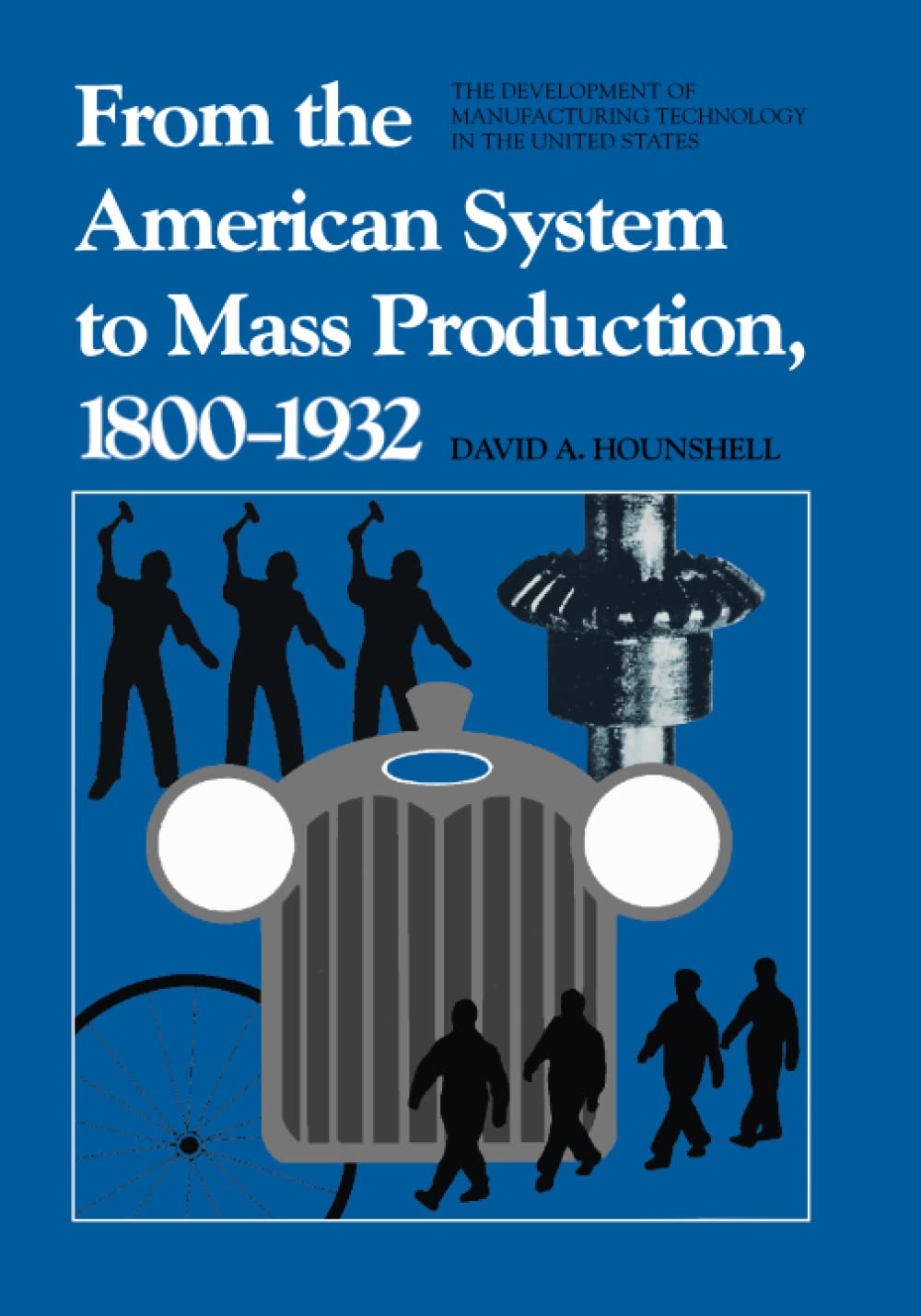
The United States emerged as an industrial colossus in the early twentieth century. An important component of that rise was the development of mass production, which was pioneered in the automotive industry, specifically Henry Ford’s Model T. In his book “From the American System to Mass Production, 1800-1932: The Development of Manufacturing Technology in the United States” (1984), David Hounshell argues that the Model T assembly line was, in fact, the culmination of a century-long precision manufacturing development process first begun in federal armories in the 1790s.
The armories – one in Springfield, Massachusetts (1794), the other in Harpers Ferry, Virginia (1798) – sought the perfect interchangeability of musket parts. The goal was to strip down ten weapons, mix all the parts together, and then re-assemble them from whichever part you happened to pull from the pile. The production of such perfectly interchangeable parts required special purpose-built machines, but also jigs, fixtures, and gauges. This method of special purpose-machinery and uniformity became known as the American system and was purposively unlike the existing “European system,” which stressed individual craftsmanship and meticulous finishing. In the later immortal words of Henry Ford: “in mass production there are no fitters.” It was the difference between “building” something and “manufacturing” it. “This system had come about,” Hounshell writes, “only after a forty- to fifty-year period of relentless effort on the part of the United States government to realize in practice a technical-military ideal that was born in Enlightenment France.”
Beginning in 1765 a French artillery general by the name of Jean-Baptiste de Gribeauval sought to rationalize French armaments by introducing standardized weapons with uniform parts. It would take nearly a century to achieve Gribeauval’s lofty ambition. “French military thought and practice played a paramount role in the United States military during the early national period,” Hounshell says. Almost immediately after independence the War Department began to demand interchangeability and mechanization in small arms production. Between 1794 and 1815, Hounshell says the Springfield armory had transformed armsmaking from “a craft pursuit into an industrial discipline and the weapon from a shop creation into a factory product.”
American efforts at precise uniformity in production did not go unnoticed. In 1853, the British Select Committee on Small Arms toured American armories and were particularly impressed with the workable, mechanized system of uniform firearms manufacturing developed in Springfield. That said, Hounshell notes that true interchangeability remained illusory for a long time. Even the superintendent of the famed Colt factory in Hartford, Connecticut, which drew on long established methods used at Springfield and opened in 1855, once quipped, “I have heard of [interchangeability], but I defy a man to show me a case.”
An entire generation of young mechanics learned this approach to manufacturing at the armories, especially the one in Springfield. They would go on to play critical roles in other burgeoning industries of the nineteenth century that required complex manufacturing, such as sewing machines, farming equipment, and bicycles. Interestingly, for most of the nineteenth century, the American system did not result in large scale production at low cost. In fact, many of the companies that came to dominate their industries, such as Singer sewing machine, McCormick reapers, and Pope bicycles, actually achieved their early growth and dominant market position by a combination of quality and largely handmade production, along with superior marketing and sales operations. Most sold their product at the top end of the industry price range and at a generous profit margin. Singer, for instance, priced their standard sewing machine at five to ten times the cost of production. This was true even in cases where early market entrants, such as Wheeler and Wilson and Willcox & Gibbs, adopted highly refined armory practices in the 1850s, whereas Singer, the overwhelmingly dominant firm (70% market share), did not do so until 1873. In its first year of production in 1853, Singer produced 813 sewing machines. In 1872, using mainly the so-called European method of production – that is, with general machine tools and with much handwork and fitting rather than with special tools, jigs, and fixtures – the company produced almost 220,000 machines. The number more than doubled to 500,000 just seven years later after they adopted the American system at their new manufacturing facility at Elizabethport, New Jersey.
Henry Leland exemplified how the armory system ramified across American manufacturing in the half century after the Civil War. He began his career as a tool builder at the Springfield armory during the Civil War. After that, he moved to the Colt factory in Hartford where he worked in the machine shop that manufactured revolvers. From there he moved to Brown & Sharpe where he ran the screw machine section for the Willcox & Gibbs sewing machine, which remained in production until 1950. Finally, Leland founded the Cadillac Motor Car Company in Detroit in 1902. Thus, Leland is a real world example of the Springfield to Detroit journey.
The McCormick Harvesting Machine Company followed a similar manufacturing trajectory as Singer Sewing Machines. For almost half-a-century the McCormick works in Chicago operated like “a large country blacksmith shop.” Until 1880, Hounshell says, production of the market-leading McCormick reaper depended entirely on “skilled blacksmiths, skilled machinists, and skilled woodworkers.” Moreover, design improvements often required significant model changes year to year making high volume production impossible. It was only after founder Cyrus McCormick fired his younger brother, Leander, as factory superintendent in 1880 that production moved to adopt more sophisticated New England armory techniques. “Leander McCormick in 1880 was still very much the Virginia blacksmith he had been when he first arrived in Chicago in 1848,” Hounshshell says, “the factory’s operations reflected his background.” The new superintendent, Lewis Wilkinson, on the other hand, had learned his craft at the Colt armory in Hartford and the Wilson Sewing Machine Company, both exemplars of the American system. Wilkerson would tutor Cyrus McCormick Jr. on the value of single purpose, machine tools for large-scale manufacturing. In 1882, production jumped over 50 percent in one year to 46,000 units. By 1902, production under the younger McCormick had increased over 500 percent.
The United States experienced a decade-long “bicycle craze” in the late nineteenth century. Several manufacturers of sewing machines and farming equipment that were getting clobbered by the new-and-improved mechanized production at Singer and McCormick tried their hand at making bicycles instead. In 1887, the unstable, large-wheeled “ordinary” bicycle was eclipsed by the two-wheeled, chain-driven “safety” model that we’re all familiar with today – and demand exploded. At its peak a decade later, over 300 American bicycle companies were producing over one million “safety” bicycles a year. Hounshells says that the bicycle industry, while short-lived, was critical and “transitional” for the development of mass production. Innovative bicycle makers, such as Pope Manufacturing Company in Hartford, developed important production techniques involving ball bearings and sheet steel pressing/stamping technology, which Hounshell says ushered in a “revolution in metalworking.” “Taken together,” the author writes, “refined armory practice and well-developed stamping techniques provided the technical basis for automobile manufacturing in the early twentieth century … Both the bicycle and bicycle production technology provided the basis for the age of the automobile in America.” But the automobile industry still needed to solve a production problem that bedeviled scores of bicycle-makers in the 1890s: How to maintain fast, efficient, and effective assembly.
Houshnell says that the Ford production system and its related high cost labor – collectively known at the time as Fordism – literally “changed the world.” Various things led to the creation of the Model T assembly line, including the American system of uniform parts production and Chicago meatpacker’s disassembly lines (although Hounshell says that the popular factory management system called Taylorism had little to do with it), but the final product was the result of relentless experimentation. Hounshell says the assembly line at the Highland Park Factory “somehow suddenly dropped out of the sky” on April 1, 1913. In other words, the assembly line was not invented; it evolved from a variety of existing practices and new techniques. However, just as Lewis Wilkinson’s short tenure at McCormick left a deep and lasting impression on the manufacturing process in Chicago, the same happened with a former Singer machinist named Walter Flanders at Ford Motor Company in the years immediately preceding the introduction of the Model T. Houshnell says that Flanders indoctrinated the Ford Highland Park Factory with a refined version of New England armory practice.
The production figures for the Model T are staggering. In 1908, Ford sold 6,000 at a price of $850. In 1916, three years after the introduction of the assembly line, Ford sold almost 600,000 Model T’s at $360. Simplicity, speed, and especially accuracy were the hallmarks of Fordism. “Accuracy provided the rock upon which the mass production of the Model T was based,” Hounshell says. Eventually, a Model T was rolling off the assembly line every forty seconds. Ford was surprisingly open about their revolutionary production system and the techniques spread quickly throughout the automotive industry and beyond.
Ford eventually became a victim of their own success. Customers came to demand better style and design in their cars and General Motors taught them to expect annual model changes, too. Ford had designed a system to produce just one thing and to produce it very quickly and accurately. When, in 1927, Henry Ford finally conceded that the company needed a new model, the company had to shut down for six months to achieve the changeover. In the process, Henry Ford fired most of the men responsible for the Model T’s phenomenal success. After the introduction of the Model A, Ford’s market share, which had soared as high as 60% in the early 1920s, plummeted to under 15%. Less than five million Model A’s were made, even though Hounshell says it was “a well-designed, well-made, well-priced, ‘thoroughly up to date’ automobile” and the massive River Rouge plant eventually made more Model A’s in one month (180,000) than had ever been made for the Model T.
Hounshell says that the century-long road from Springfield to Detroit was “neither short nor direct.” However, the “uniformity principle” and special-purpose machines played a central role in the journey from beginning to end. The American system and eventually the assembly line were essential to mass production, although clearly they were not required for business success as such leading enterprises as Singer and McCormick came to dominate their industries because of advantages in sales and marketing, not armory-style production.
 What's Tim Reading Now?
Leave a comment