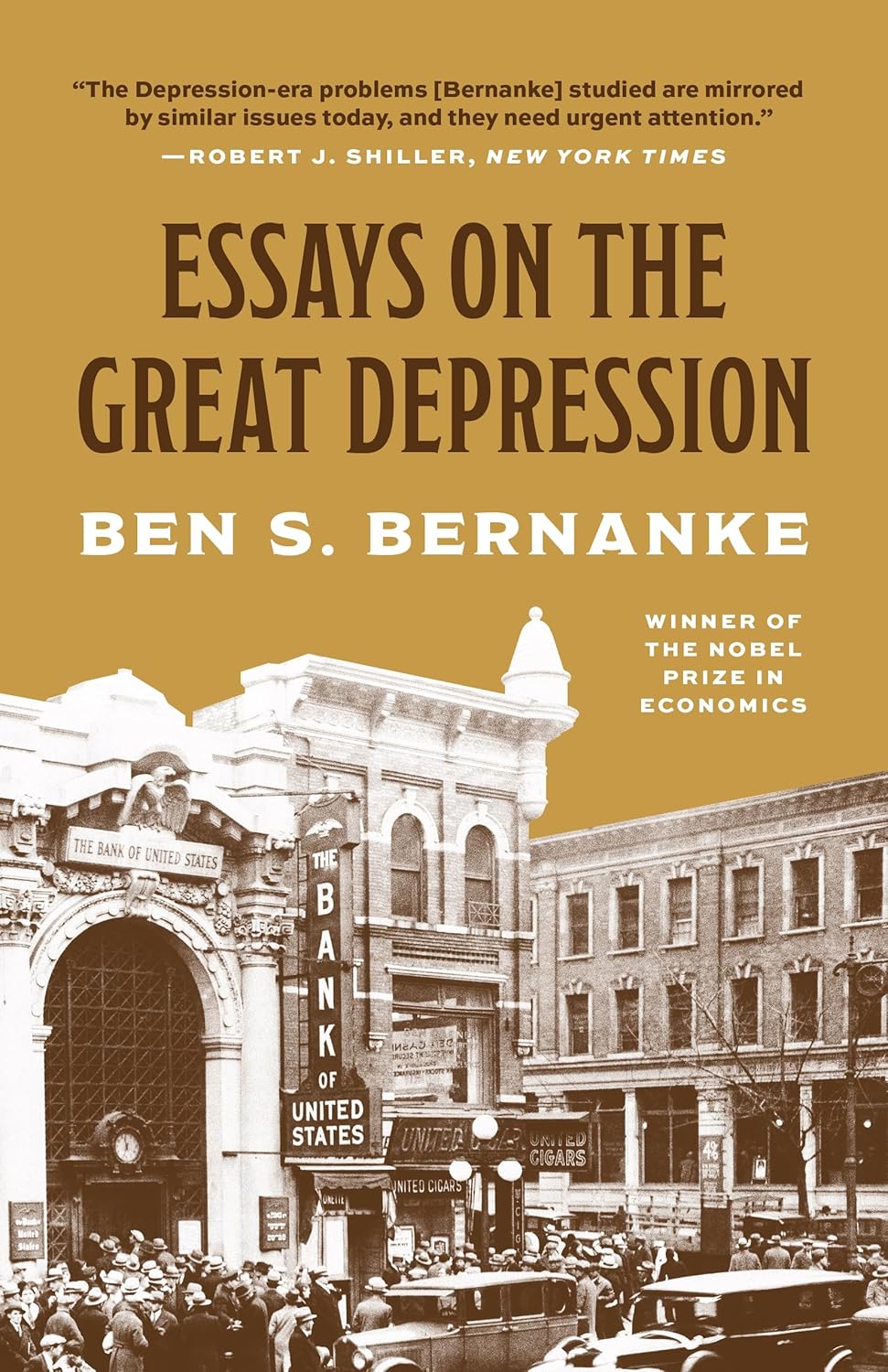
Ben Bernanke has had a remarkable career. For two decades he was a tenured professor of economics at Princeton where he specialized in the study of the Great Depression. And then from 2006 to 2014 he was chairman of the Federal Reserve Bank where he guided the American (and global) economy through the worst financial crises since the Great Depression. This book, “Essays on the Great Depression” (2000), reflect what Bernanke knew and surmised about the nature of severe financial crises and how to control them before he took the reigns of the US central bank.
The book consists of nine independent essays on the performance of international financial and labor markets during the Great Depression published in scholarly economics journals in the 1980s and 1990s. There is no narrative arc to the story. Each chapter is a dense academic study of a specific macroeconomic topic replete with a bewildering array of charts, graphs, data tables, scatterplots, and regression formulas. Needless to say, this book is not for everyone. I have undergraduate and graduate degrees in economics, along with a keen interest in this topic, and “The Great Depression” was almost too much even for me. Trust me, if you’re looking for a layman’s introduction to the causes of the Great Depression, this isn’t it.
For all of the graphs and arcane economic mumbo-jumbo, Bernanke does come away with a few core arguments explaining the unusual depth and length of the Great Depression. First, the dominant factor in the onset of the Great Depression was the precipitous decline in aggregate demand caused by the contraction of world money supplies. The prime culprit in that contraction was the “structurally flawed and poorly managed” international gold standard. Bernanke says the infant US Federal Reserve system proved too insular and too inexperienced to meet the challenge. “Sterilization of gold inflows by surplus countries, substitution of gold for foreign exchange reserves, and runs on commercial banks all led to an increase in the gold backing of money, and, consequently, to sharp, unintended declines in the national money supplies,” he writes. This inadvertent monetary contraction led to a “deflationary vortex” of falling prices, which led to falling output, which led to falling employment. Bernanke is confident that the mismanagement of a structurally flawed gold standard explains this so-called “aggregate demand puzzle” (the nearly simultaneous drop in aggregate demand all around the world in the early 1930s).
Bernanke shows that countries that dropped gold sooner (Great Britain in 1931) rather than later (France in 1936) recovered more quickly. A fatal flaw in the operation of the gold standard was that countries had no incentive to keep their gold balances from accumulating too high. By 1932, France controlled 32% of the world’s gold, the United States 40%. Why these enormous gold inflows did not lead to highly simulative monetary expansions in both countries is not clear to me. Bernanke notes that these gold inflows were “sterilized,” although he never really explains exactly how that happened. Instead, adherence to the gold standard led to deflation (falling prices), which in turn led to all sorts of bad things, including depression (falling output) and the weakening position of borrowers (lay offs, cutting back on capital investments). Bernanke emphasizes that the monetary contraction before 1931 can be thought of as “self inflicted wounds” (i.e. gold sterilization), whereas the further monetary contraction in the two years afterward was due to “forces beyond our control” (i.e. the money multiplier).
Bernanke further argues that the effects of tight money were exacerbated by nonmonetary financial factors, mainly banking panics and business failures that choked off normal flows of credit. In short, the loss of confidence in financial institutions, especially banks, combined with the widespread insolvency of debtors led to financial collapse. The numbers are sobering. In just four years (1930 to 1933) nearly half of US banks (9,000) went under. The banks and other financial service institutions that remained were reluctant to lend. For example, life insurance companies that made $525 million in mortgage loans in 1929 made only $10 million in new loans in 1933. Deflation further exacerbated this dire situation as debtors were reluctant to take on loans today that would have to be paid back in more expensive dollars tomorrow, a phenomenon known as “debt deflation.”
What about the aggregate supply side of the equation, also known as the “aggregate supply puzzle”? Why was the decline in aggregate demand caused by the malfunctioning gold standard associated with such deep and persistent contractions in output and employment? Many have pointed to “sticky” nominal wages as the reason for the protracted real impact of the monetary contraction. Bernanke writes that, “glacially slow wage adjustment” drove the persistent unemployment of the period. The underlying causes for this phenomenon are less clear. I found the section on labor market to be much harder to follow than the one on monetary policy.
In closing, “The Great Depression” is a learned and highly academic consideration of some of the biggest macroeconomic questions concerning the length and depth of the economic calamity that gripped the world in the early 1930s. Some parts of the essays are so technical and dense as to be almost unreadable (at least for me). Others provide cogent insights into the nature and causes of what Bernanke calls “the Holy Grail of macroeconomics.” This book belongs on the shelf of any serious student of the Great Depression, but all others should only venture with care.
 What's Tim Reading Now?
Leave a comment