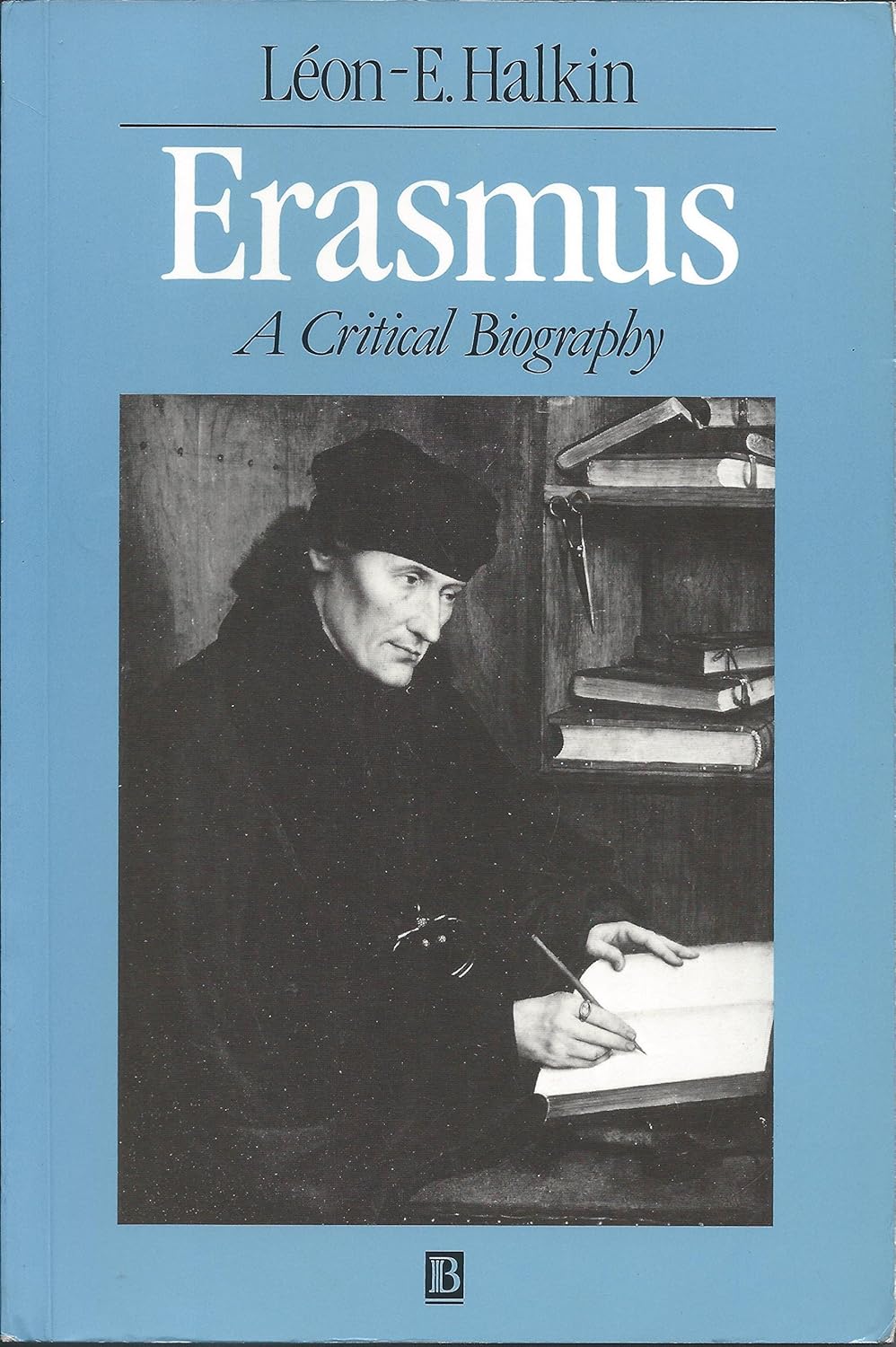
Desiderius Erasmus of Rotterdam (1466-1536) was a Dutch Renaissance humanist, theologian, scholar, and writer. He is perhaps the most important and influential scholar and philosopher of the entire Renaissance period, yet he remains today more written about than read, and that’s because his writing is quite abstruse. “Erasmus: A Critical Biography” (1993) by Leon-E Halkin (translated by John Tonkin) is one of the most highly regarded biographies of Erasmus written in the last half-century. Halkin writes that “[Erasmus’s] thoughts need skilled midwives if they are to be born afresh for a wider public.” I completely agree with him, but found that Halkin is not a highly skilled midwife in the modern translation of Desiderius Erasmus.
Erasmus was, above all else, a humanist, a pacifist, and a defender of pure, apostolic Christianity. He remains today, Halkin says, “more famous than well known.” If there is one thing that truly sets Erasmus apart from his contemporaries it is his astounding productivity for a fifteenth century writer. Indeed, Halkin says, “Erasmus spoke, read, and wrote unceasingly.” He wrote at least fifteen books and unknown numbers of pamphlets and essays, along with over 3,000 letters that have survived. “He published more texts,” Halkin says, “than a philologist of our day reads during an entire lifetime.” Through these writings and classical translations Erasmus made an indelible contribution to Renaissance humanism. His critiques of societal and religious institutions shaped subsequent intellectual and religious movements across Europe.
Erasmus had a rough (but not atypical) start to life for someone born in the fifteenth century Netherlands. Orphaned by the plague at the age of 13, he and his brother were raised and educated by monks in a monastery. He emerged a humanist and was ordained a priest in 1492. Prayer and Mass shaped the daily rhythm of his life, but he was always a Christian humanist scholar like Thomas More or Petrarch, Halkin says. Erasmus lived by the precept, “Live as if you are to die tomorrow, study as if you were to live forever.” Poverty and poor health are leitmotifs in his life story. For many years, especially the long decade he labored away on his doctorate, he was hobbled by illness and lived on the edge of destitution, earning his meager keep by tutoring for wealthy patrons.
For his times, Erasmus was remarkably peripatetic. In an age when most people never ventured more than twenty miles from where they were born, Erasmus traveled, studied, and lived all over Western Europe: the Netherlands, France (Sorbonne), Italy (Bologna), England (Cambridge), Switzerland (Basel and the Trilingual College at Louvain), and Germany (Freiburg). If it was possible to be a cosmopolitan monk, Erasmus was it. He fashioned himself a citizen of the world – and especially of the Republic of Letters. His first published work, “Adages” (1500), brought Erasmus immediate fame, if not prosperity. The book was a collection of proverbs and aphorisms from classical authors with commentary by Erasmus. It helped popularize classical learning and wisdom, and ultimately helped shape Renaissance humanism. “The Adages contributed powerfully to the spreading of the classical spirit,” Halkin writes, “and through this their author reinforced the international character of culture.”
In “Handbook for the Christian Soldier” (1504), Erasmus provided practical advice for living a good Christian life in a complex world. He emphasized daily prayer and the reading of Scripture, along with the emulation of Christ, his mother Mary, and the Saints. He put a heavy emphasis on humility, faith, and especially charity, “the alpha and omega of Christianity,” according to Halkin. He consistently urged the Christian faithful to worship earnestly and to emulate the saints and Mary, not pray to them. Mary, in particular, should only be glorified with respect to Jesus and in relation to Jesus, not on her own. By his early 30s, Erasmus’s path was finally set, Halkin says, “he devoted himself to good letters, to peace, and to the renewal of the Church.” The coming decades would be tumultuous beyond his belief, but his principles held steady.
“The Praise of Folly” (1511) – “without doubt Erasmus’s major work and one of the great books of the Renaissance,” according to Halkin – helped establish his literary reputation and popularized the tradition of satire in European literature. The religious ignorance and childlike credulity of the faithful distressed Erasmus. “Folly” was, according to Halkin, “the manifesto of a critical Christianity, a religion inspired by the philosophy of Christ and the teachings of the Church.” It took aim at “a pharisaical religion made up of routine practices and works drained of their spirit,” Halkin writes. Its witty and biting critique of society, politics, and religion paved the way for subsequent satirical works by authors such as Jonathan Swift, Voltaire, and Mark Twain. Its emphasis on questioning established norms and authorities contributed to the development of modern skepticism and intellectual inquiry. “It spares no one,” Halkin writes, “and denounces the pride of theologians and monks, the bellicosity of popes and princes, the presumptuousness of the learned, the vanity of philosophers and the stupidity of the devout.” Its criticisms of corruption and hypocrisy within the Catholic Church resonated with reformers like Martin Luther, who cited Erasmus’s work as an inspiration. Erasmus had emerged as the world’s preeminent anti-establishment theologian.
The relationship between Erasmus and Luther was long and fraught. At first blush, they looked to be natural allies. Indeed, it has long been said that “Erasmus laid the eggs that Luther hatched.” They certainly took issue with many of the same papal abuses. For instance, Halkin says that Erasmus was, after only Luther, the greatest opponent to indulgences in Renaissance Europe. But their temperaments were completely different and their relationship fell apart before it ever came together. The abuses and weaknesses of the Church – what Halkin calls “a triumphant papacy and an anemic Church” – filled Luther with anger and Erasmus with irony. Luther had no interest in humanism; Erasmus was a humanist to the core and had no interest in oratory. Luther was a born revolutionary; Erasmus was not by nature sectarian. Luther was a grouchy pessimist; Erasmus was a cheerful optimist. Luther wanted to clear out the augean stable of the papacy all at once; Erasmus preached gentle progress with patience. Luther preached a theology of the Cross (salvation through faith alone); Erasmus preached a theology of the Glory (Christ’s teachings and example as a guide to salvation). “Luther was to find that Erasmus lacked godliness,” Haklin writes, “while Erasmus was to remain put off by Luther’s use of a personal experience for prophetic purposes.” Luther perhaps most famously summed up his low opinion of Erasmus this way: “Du bist nicht fromm” (“You are not pius”).
Erasmus would grow disenchanted with the Church, but the author says that he never became a cynic or unbeliever, let alone a full blown Protestant, although many Catholic critics absolutely thought he was. What he lobbied for was a Christian piety that was unflinchingly honest, authentic and genuine. “I prefer a sincere Muslim to a hypocritical Christian,” he once famously quipped, just as he preferred a married priest to a priest with a concubine or a couple of happy divorcees to an indissoluble marriage.
In his own time, Erasmus’s most influential work was his Greek and Latin translations of the New Testament (1516). Dedicated to Pope Leo X, Halkin says the thousand page translations were “a genuine pioneering work.” The Latin text would be republished over 200 times. Erasmus thought it was critical to read ancient texts in their original languages: “Fruit tastes better when you have picked it with your own hands from the mother tree,” he wrote. For Erasmus, these popular publications were successful because they elevated the importance of the Holy Scriptures over familiar forms of popular piety, such as pilgrimages and relics. Surprisingly, the New Testament translations proved more scandalous than even “The Praise of Folly.” Erasmus was accused of heterodoxy and recklessness. It marked the beginning of a long and difficult period in Erasmus’s life as the religion he loved more than anything was violently ripped asunder.
Haklin says that Erasmus “feared schism as much as he abhorred violence.” He strained to navigate a neutral path between Rome and Luther. His temporizing satisfied no one. Referencing the acrimonious twelfth century conflict between the papacy and the Holy Roman Emperor, Erasmus said, “I am a Guelph to the Ghibellines and a Ghibelline to the Guelphs.”
Yet, by the 1520s Erasmus remained perhaps the most famous literary figure in all of Europe and was already recognized as an historical figure. He had three portraits painted of himself by the renowned German artist Hans Hoblein (1497-1543) and one by the immortal Albrecht Durer (1471-1528). He published the first edition of the “Colloquies” in 1518, with five more editions published across the 1520s. Erasmus once again used lively conversation between characters to provide moral and intellectual instruction on a variety of topics, from education and religion to morality and everyday life. Halkin calls them “one of the great literary successes of the sixteenth century” that “worked wonders for Erasmus’s fame and the propagation of his ideas.”
Another dialogue, “The Ciceronian,” appeared in 1528. Erasmus believed that Cicero was the greatest of the masters of Latin style, but shrank from his near canonization by Italian humanists and especially the Franciscans and later the Jesuits, which he thought steered them in the direction of pure paganism. In essence, Erasmus praised antiquity, but without approving of its paganism.
The Reformation crashed down around Erasmus like a tornado, physically and spiritually tearing his life apart. Nevertheless, he clung to the essentials of his religious program, which above all was Christocentric and put primacy on faith over politics, religion, or country. Erasmus, a lifelong pacifist in all situations save defense from the Turkish siege of Vienna, shrank from the use of force in the religious war engulfing Europe. “Let us beseech heaven and earth,” he wrote, “but in no way force anyone into a religion that repeals him.”
In closing Halkins says that Erasmus was an unswerving optimist who wanted to slowly but steadily reform the Church. He was “profoundly religious and ferociously anti-clerical,” according to Halkin. He wanted to recover an enlightened, clear-sighted, and well-informed Christianity, one that was more about love and faith and charity and less about pomp and ceremonies and acts. That author claims that Erasmus wanted to remove the dross accumulated over the centuries and transform the image of the Church into a loving and benevolent caregiver whose face was “beautiful, sweet, and smiling, the face of a mother eternally young.” Erasmus saw himself as a renovator of the Church, not an innovator like Luther. But his literary and theological legacy was largely embraced by the Protestant movement that he ultimately opposed; many of his works, including even his Latin translation of the Bible, were burned by Catholic powers. Over the centuries he would become recognized as the prince of humanists and one of the first truly modern thinkers. “He had the temperament of a pioneer,” Halkin writes, “but not the spirit of a conqueror,” and that may explain why he left a less tangible impact than a Luther or a Calvin or even a Loyola.
 What's Tim Reading Now?
Leave a comment