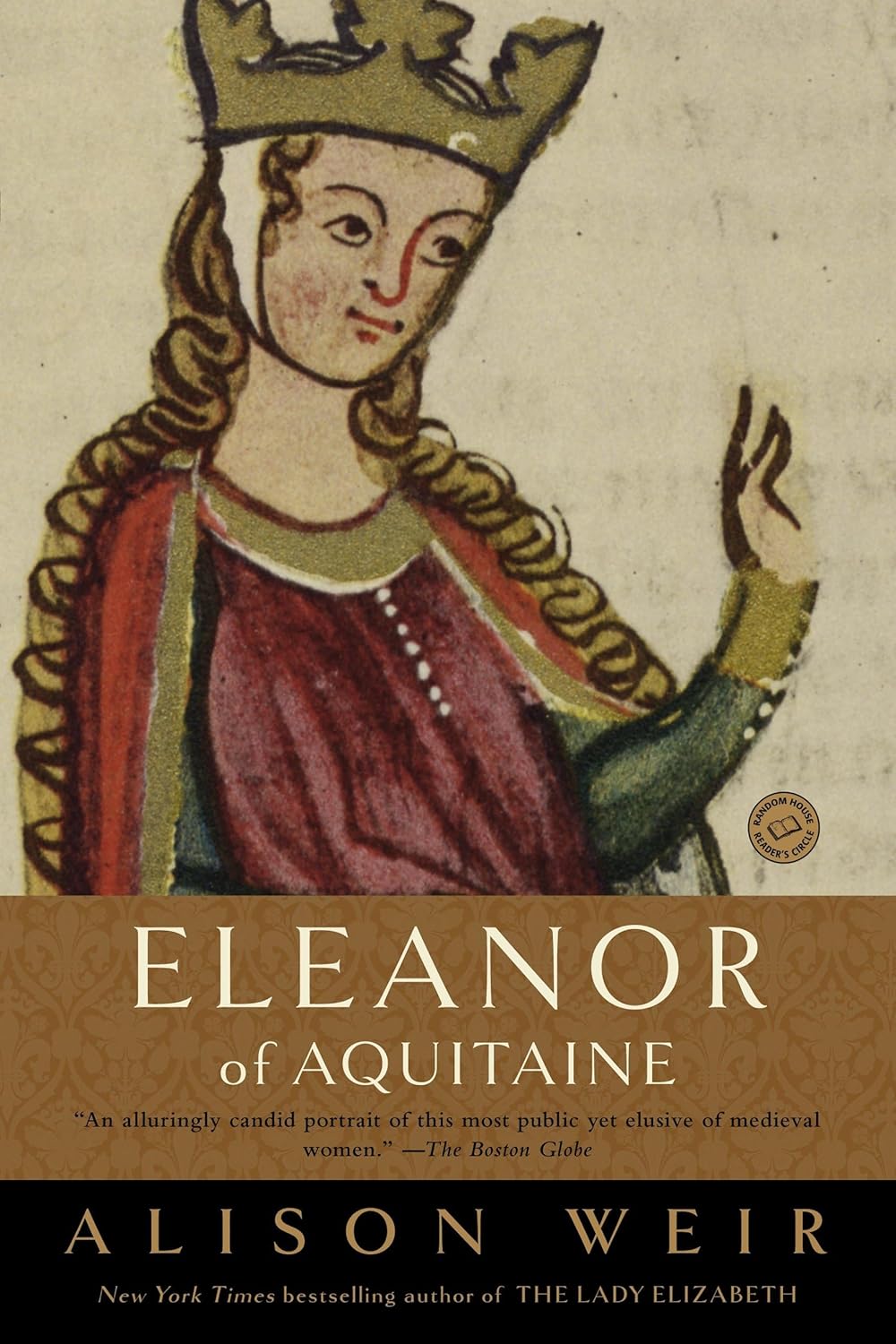
Nobody writes about early English history better than Alison Weir. Her book “The Six Wives of Henry the Eighth” (1991) is one of my all-time favorites. I picked up “Eleanor of Aquitaine” (1999) for the simple reason it was written by Alison Weir. I knew next to nothing about Eleanor before reading this book, not even which century she lived in, let alone what she did. I knew that if anyone could make her 800-year-old story interesting and comprehensible it would be the incomparable Weir.
Life in twelfth century Western Europe was quite different, of course. It seems to me that the best way to think about it is as a giant game of Monopoly. The players are all royals vying for possession of as many lucrative properties as possible. Instead of Broadway and Park Place, they were trying to capture Brittany and Normandy and Aquitaine. You can possess multiple properties at once and, just like in Monopoly, players can steal them from you at any time. No one has any more “right” to own the property as anyone else. It’s a free-for-all. This is the world that Eleanor, Duchess of Aquitaine, was born into in 1122. She would play the game with exquisite skill over the course of her tumultuous 82 years.
There are two things everyone can agree upon when it comes to Eleanor of Aquitaine: she was beautiful and fabulously rich. She married King Louis VII of France in 1137 at age 15. Everyone seemed to agree that Louis got the better of the bargain. The King of France in the mid-twelfth century was really more like the King of Paris. Eleanor brought with her more than a quarter of what is modern France, from the Channel coast to the Pyrenees. Her marriage to Louis would last fifteen years, but would be unfulfilling in multiple ways. The freewheeling young Eleanor was a poor romantic match for the ascetic young French King. His advisors worried that he was under the thumb of “his domineering and somewhat irresponsible wife,” a woman they found to be “young, worldly, and disturbingly beautiful.” Shortly after their ill-fated romp through the Holy Lands on the Second Crusade (1147-1150), which made the Franks a “laughingstock” in the eyes of the Moslems, the King and Queen split up. Eleanor had produced two daughters, but Louis needed sons and he saw Eleanor’s failure to produce them as a sign of divine displeasure of their union. The pope granted an annulment on the grounds of consanguinity in 1152.
Eleanor wasted no time in finding a new husband, her 19-year-old third cousin Henry, Duke of Normandy. Eleanor was “the greatest heiress in the known world,” according to Weir, and the acquisition of such a bride would make Henry “the greatest prince in Europe.” Henry’s new combined domain was ten times as large as the royal demesne of France. Henry and Eleanor became King and Queen of England soon after marrying in 1154. (If there has ever been another woman who was both Queen of France and Queen of England, I’m unaware of it.) Weir writes that King Louis VI’s abandonment of Eleanor was “an act of folly that would lead to a disastrous disturbance of the balance of power in France, and to more than three hundred years of conflict with England.” Henry and Eleanor’s marriage would establish the Plantagenet dynasty that would rule England for the next 331 years and would stand as “one of the most turbulent royal marriages in history,” according to Weir. The couple would have five sons and three daughters.
This fractious royal brood, along with interminable squabbles with Louis and his successors on the throne of France, are what this book is really all about. It’s like a reality TV drama that plays out over half-a-century, with non-stop bickering and backstabbing as each player tries to secure as much of the Monopoly board as possible without getting killed in the process. At first, it’s the sons (Henry, Richard, John) against the old man, with Eleanor supporting her sons against her husband (which landed her in prison from 1173 to 1189), followed by the sons against each other following Henry II’s death in 1189. My problem with all of this is that the story is about as interesting as watching a bunch of strangers play Monopoly. The third time you watch someone take Park Place you just want the game to be over.
Weir claims that Henry II was “one of the most able and gifted rulers to sit one the throne of England.” He centralized the administration of his realm at Westminster and managed it efficiently over the course of his 35-year reign. His relationship with Thomas Becket formed “one of the most famous friendships in history” and had far-reaching consequences for both men. Weir describes Becket as “the perfect courtier” – a highly competent and loyal administrator, often seen as “elegant, witty, generous, vain, and ambitious.” In 1162, Henry forced Becket to assume the role of archbishop of Canterbury. The reluctant and secular Becket quickly embraced his new religious role with gusto, which quickly led to “one of the most famous rifts in history.” Henry wanted to end the judicial exemptions enjoyed by members of the church, who escaped punishment for even the most serious offenses. Becket refused to relinquish any church authority. The king was stunned by the intransigence of his former top lieutenant. The conflict dragged on for years. The pope had to get involved. At one point Becket had to flee England. Eventually, in 1170, Thomas Becket was brutally murdered by four knights loyal to Henry. Weir calls it “the most cataclysmic disaster of the reign” and “an event that shook Christian Europe to its very foundations.” Becket instantly became a martyr, “God’s doughty champion.” Pope Alexander III canonized him in 1173. Meanwhile, the murder turned much of Europe against the King; his “reputation never fully recovered,” Weir writes.
His marriage to Eleanor broke up around this time. Henry began openly cavorting with his young mistress, Rosamund. He began to distribute pieces of his realm to his sons, but refused to relinquish any political control. His heirs would rule in name only. His young sons fought for independence with their mother’s support. Henry ultimately reconciled with his children, but he never forgave his wife. Eleanor would spend over a decade in prison. She was only released upon Henry’s death in 1189. Despite all his trials and tribulations, Weir says, “Henry II is remembered as one of the greatest of England’s medieval kings and one of the most successful rulers of his time.” After reading “Eleanor of Aquitaine,” I’m not exactly sure why he deserves such high praise.
Eleanor went on to play a tangential role in the Third Crusade (1189-1192) as her son and new King of England, Richard the Lionheart, led an initially successful campaign against Saladin, but failed to retake Jerusalem. On his return home, he was captured and held for ransom by Leopold of Austria. In Richard’s absence, his brother John rose in revolt in an attempt to take the throne. Meanwhile, Eleanor helped raise the 150,000 silver marks demanded for his release, a sum equivalent to three times England’s annual revenue. In 1194, Richard was released and reestablished himself on the throne. John would be crowned King of England in 1199 after Richard’s death.
Much of this part of Weir’s narrative devolves into petty squabbles over insignificant prizes. Consider this mind numbing event from 1201: “When John ordered Guarine of Clapion, Seneschal of Normandy, to seize Driencourt, a castle owned by Hugh de Lusignan’s brother, Ralph, Count of Eu, the Lusignans indignantly revoked their oaths of allegiance to John and appealed to King Philip, their ultimate overlord, for justice.” At this point in the book, I found it hard to keep reading. My overwhelming feeling was, “Oh, who cares?!”
Eleanor died in April 1204 at Fontevrault at the ripe old age of 82. Weir says her death went hardly noticed at the time. Eleanor’s legacy would cast a longer shadow. The Plantagenets would rule England till 1485. Her blood would flow in the veins of Elizabeth II. Shakespeare would memorialize Eleanor in “King John” as a “canker’d granddam, a monstrous injurer of Heaven and Earth.” Weir, who strives to present a balanced portrayal, claims in summary that Eleanor “was no shrinking violet, but a tough, capable, and resourceful woman” who “ruled as capably as any man.”
 What's Tim Reading Now?
Leave a comment