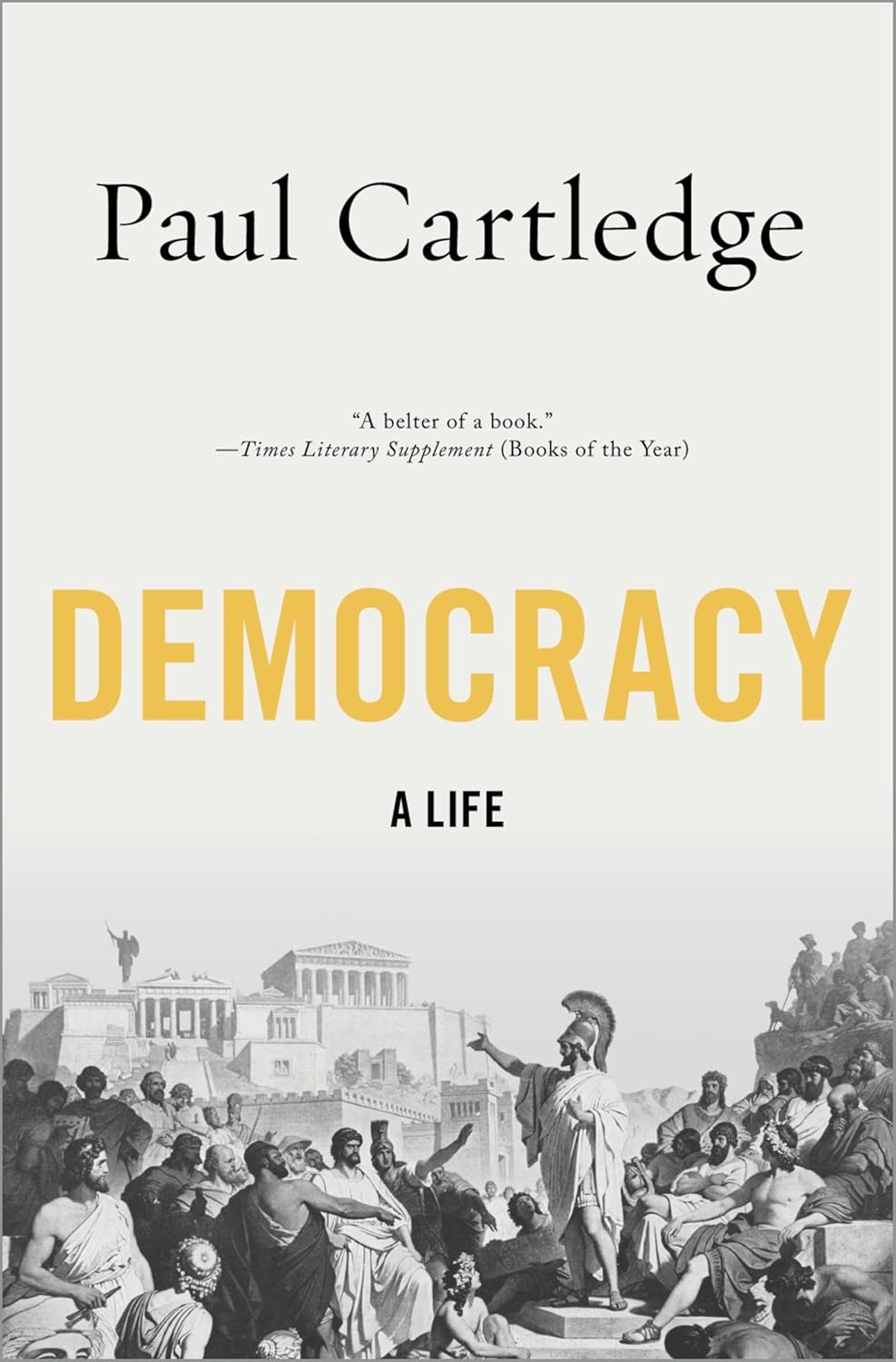
You’d think there would be a lot of great books available about the democracy of ancient Athens, but you’d be wrong. Over the past few years, I have taken several excellent online courses on the subject, including one by Yale University’s Donald Kagan, the American doyen of classical studies. However, I’ve found that I struggle to retain information gleaned from the audio-visual format. I need to read about something to truly absorb it. I was thus looking for a solid popular history of Athenian democracy, a book that explained the systems and critical reforms from Dracon to Solon to Cleisthenes to Ephialtes. I already knew about the Areopagus, Ecclesia, Boule, Archonship, and other features of the Athenian democracy. I just needed somebody to lay it all out from top to bottom and explain how things worked in practice. Alas, that book is evidently not available, believe it or not. Paul Cartledge’s “Democracy: A Life” (2016) is the best I could find – and thankfully it’s a decent substitute for what I was looking for.
The word democracy is derived from the combination of two Greek words: Demos, meaning “the people,” and Kratos, meaning “power” or “control.” Cartledge makes much of this seemingly obvious etymological construction and often uses the expression “the kratos of the demos” rather than democracy. It is particularly noteworthy, that the term “demokratia” may not have been attested until the 420s, nearly a century after the democratic reforms of Cleisthenes. Cartledge emphasizes that democracy in the classical world was not the rule of the many, but rather the rule of poor. It’s an important distinction.
The most radical feature of democratic Athens, at least after the reforms of Cleisthenes in 508 BC, was the introduction of selection by lot to fill the majority of civil administrative positions. It amazes me that this fact isn’t more widely known today. There’s nothing more technically democratic than having any citizen eligible for filling any government post at any time. It is the ultimate expression of what the Greeks called “isonomia,” defined as the equality of status and respect under the law. The ultimate objective being “eunomia,” which Cartledge describes as “the happy condition of lawfulness or law-abidingness, whereby citizen knew their place and obeyed the laws and the law-enforcers.” It is also important to remember that the Greeks thought of tyranny not necessarily as cruel and oppressive rule but rather as seizing and holding power outside any existing legal framework.
As we turn to the practicalities of Athenian Democracy, which was my primary interest in reading this book, let us first define Athens itself. The city-state of Athens was comprised of the city itself, the Port of Piraeus, and the surrounding countryside Attica. The total population in the fifth century was perhaps 250,000. Half of the population was slaves and only 25,000 to 50,000 (10%-20%) were citizens. Unlike the Romans, the Athenians guarded their citizenship jealously.
Athens had traditionally been an oligarchy. Only citizens from certain families were eligible to serve as Archon, the chief magistrate of the city. After serving their terms, Archons became lifetime members of the Areopagus, a sort of blended senate/ supreme court that heard murder trials and could impeach officials for high crimes and misdemeanors. In 594, the famous lawgiver Solon introduced a variety of democratic reforms, most prominent of which was opening up the archonship to the nouveau riche and the abolition of all existing debts, including the prohibition of debt-bondage, an act known as the “Shaking-off of Burdens” (Seisachtheia).
Nearly a century later (508), Cleisthenes further reformed the Solonian democracy. An aristocrat by birth, Cleisthenes introduced sweeping reforms after the fall the Peisistratid tyranny. The citizenry were distributed across 140 so-called “demes.” The demes were “the ultimate basis of the entire superstructure,” according to Cartledge, and served as a sort of local administrative unit that celebrated their own religious festivals and collected and spent revenue at the local level. Perhaps most importantly, Cleisthenes abolished the four birth-based tribes and created 10 new tribes named after local heroes. To ensure a balance of interests across the polis, all 10 tribes would be made of citizens from cohorts form the city, coast, and inland areas. Each tribe contributed 50 men to the Council of 500, which Cartledge calls “the steering committee of the newly re-empowered Ecclesia (Assembly) that was responsible for final decisions on policy.”
The tribes also played an essential military role. Each contributed a hoplite regiment and a squadron of cavalry to the national defense and one general elected annually by the tribe. Cartledge says the impact of these military reforms was immediate and significant. Financing the national defense was also of highest importance. The combination of internal and external annual revenues was roughly 1,200 talents. The Athenians augmented this revenue with the liturgy tax system to ensure that the super rich “paid their fair share.” Wealthy individuals were assigned the obligation to fund major state projects, such as building, equipping, and manning a trireme or large-scale theater production for major festivals, such as the Panathenaea.
Cleisthenes was also responsible for the introduction of ostracism, a heavy-handed instrument requiring 6,000 votes ostensibly for the elimination of demagogues and to prevent “stasis” or civil strife (it was deployed intermittently between 488 and 416, often against Athens’ most distinguished leaders). Cartledge calls post-Cleisthenic Athens a “hoplite democracy,” an early form of democracy that empowered “the better-off portion of the sub-elite demos” that could afford to serve in the “new-model tribal army.”
Democracy took a giant step forward in 483 when Themistocles persuaded the Assembly to invest the windfall profits from a silver strike into a large fleet of triremes. Athens would build hundreds of these capital ships and each would be powered by 170 economically underprivileged citizen-sailors from the “thete” class. Cartledge writes, “Salamis marked the tipping point in the composition of the city’s armed forces from being an essentially amateur force of moderately rich farmer-hoplites to being a predominately semi-professional fleet of sailors drawn from the swelling ranks of the Athenian poor.”
The importance of the navy as the primary instrument of empire and wealth politically empowered the Athenian underclass. The 200-trireme fleet became the “school of democracy.” Cartledge writes that the term “demokratia” likely carried with it the meaning of “rule of the poor masses.” In what I find to be one of the most amazing and underappreciated aspects of classical Athenian democracy, in about 487 the polis moved away from popular elections for key offices, such as the Archonship, and instead began choosing candidates in a sortitive process (i.e. by lot), which in theory is a democratically equalizing procedure (the most demanding financial and military posts remained elective). All told, there were over 1,200 domestic posts that were filled by lot. Next, in 462, the Areopagus, the last bastion of the conservative Athenian plutocracy, was politically emasculated by Ephialtes and his young mentor, Pericles.. In 457, eligibility for the top offices was opened up to the hoplite class. Public pay for office holding was likely introduced around this time as well. These reforms “midwifed a new, improved demokratia at Athens,” Cartledge writes, “in name now as well as in fact, at once a kratos of the demos and of the demes.” It would not be without its critics, many of them Athenian philosophers, who saw the burgeoning demokratia as a disguised form of tyranny – the collective and constitutional tyranny of the masses over the elite few.
When thinking about the structural changes and various reforms enacted over the years, Cartledge argues that there were really four distinct democracies at work in Athens in the classical period: 1) 508 to 462 (the Cleisthenic democracy); 2) 462 to 404 (the democracy of Ephialtes and Pericles); 3) 403 to 336 (what Cartledge calls “the” Athenian democracy); and 4) 336 to 322 (the Lycurgan democracy). (Note that Cartledge evidently does not consider the Solonian democracy of 594 to be a true democracy.) Frankly, I think he is splitting hairs. One can point to several differences between the fifth and fourth centuries (e.g. abandonment of ostracism, re-codification of Athen’s laws, payment for Assembly attendance, increased number of Assembly meetings) but these hardly add up to distinct forms of government. If anything, they highlight how pure Athenian democracy was. There were roughly a thousand Greek city-states at the time and many of them were democratic, although few were as committed to rule by the poor masses as Athens. In fact, Athens was remarkably politically stable between 508 and 322 and Cartledge admits as much.
The locus of power in the various Athenian democracies was the Ecclesia (Assembly) and the Dikastria (People’s Court). The importance of the Assembly and the decrees and laws it passed are well understood. The political importance of the courts is much less well appreciated. Cartledge says that courts and trials are “fundamental and central” to understanding Athens in the fifth and fourth centuries. The courts sat 150-200 days a year. There were no judges or state prosecutors. The rules of evidence or procedure were lax. The juries were chosen by lot and were enormous, consisting of 501 citizens, a number of jurors far too large to pack or bribe. Any citizen could bring another to court on almost any charges he wished. However, if the prosecutor failed to get 20% of the votes from the jury he would face a heavy fine and suffer significant personal political damage. If he won the case a second vote would be taken to establish the punishment. Aristophanes famously lampooned the soap opera aspects of the People’s Court in his drama “Wasps” (422). “Oligarchs or crypto-oligarchs always hated the power over them that the democratic court system provided to the demos,” Cartledge says. The courts were part of the reason that Alcibiades famously referred to Athenian democracy as “acknowledged lunacy.”
The Roman Republic destroyed Greek democracy and any sense of genuine political freedom in the second century. Polybius explicitly stated that the improbable rise of Rome was no accident. The key to explaining both Rome’s survival against Carthage and its rise to conquer the Hellenistic world was tied directly to its form of government, namely its unique blend of elements of monarchy, oligarchy, aristocracy, and democracy in the form of the “Populus Romanus,” the Roman version of the demos. Nothing about the Roman system of government reflected the classic democratic formula of one citizen, one vote. Rather, the Roman Republic was distinctly timocratic – that is, voting eligibility and power depended on one’s property qualification. For instance, Class I voters, the top one of five property-census groups, accounted for 45% (88 of 193 voting centuries) of the voting power in the powerful centuriate assembly. Cartledge writes that, “Polybius grossly misprised and overestimated the popular element in Rome’s Politeia.”
After the fall of Rome there was nothing remotely approaching Athenian democracy until the late eighteenth century. Early modern European philosophical and political thinkers, such as Thomas Hobbes (1588-1679), were often virulent anti-democrats. Hobbes even claimed that it was Thucydides who taught him how superior was the rule of the one wise man to that of the ignorant, undisciplined masses. Cartledge writes that it was only the American and French Revolutions that revived democracy as a “desirably practical idea,” but even then it was often the Roman Republic or the timocratic-aristocratic Athens of Solon that captured the imagination of the most forward political thinkers of the day, such as Montesquieu and Rousseau, not the truly democratic Athens of Pericles. It is no accident after all, that Washington DC today boasts a Capitol Hill and a Senate, rather than an Acropolis and a Boule or Areopagus. Americans celebrate “We the People,” but for nearly all of Western civilization, including much of our own history, there have been those who have feared the tyranny of the unenlightened, ignorant, fickle majority.
In closing, over half of the current members of the United Nations are labeled as democracies (120 out of 192), but Cartledge is still pessimistic about the future of truly democratic government around the world. He says that there is no direct institutional legacy of Athenian direct, active and participatory democracy anywhere in the world today. Most so-called modern democracies are hardly democratic at all. Much of this, he confesses, has to do with sheer size of modern governments. These larger political organizations ultimately adhere to the so-called Iron Law of Oligarchy. Cartledge concludes that the future of direct, participatory democracy is dim even in spite of the remarkable rise of information technology that facilitates greater citizen connectivity and potential engagement.
 What's Tim Reading Now?
Leave a comment