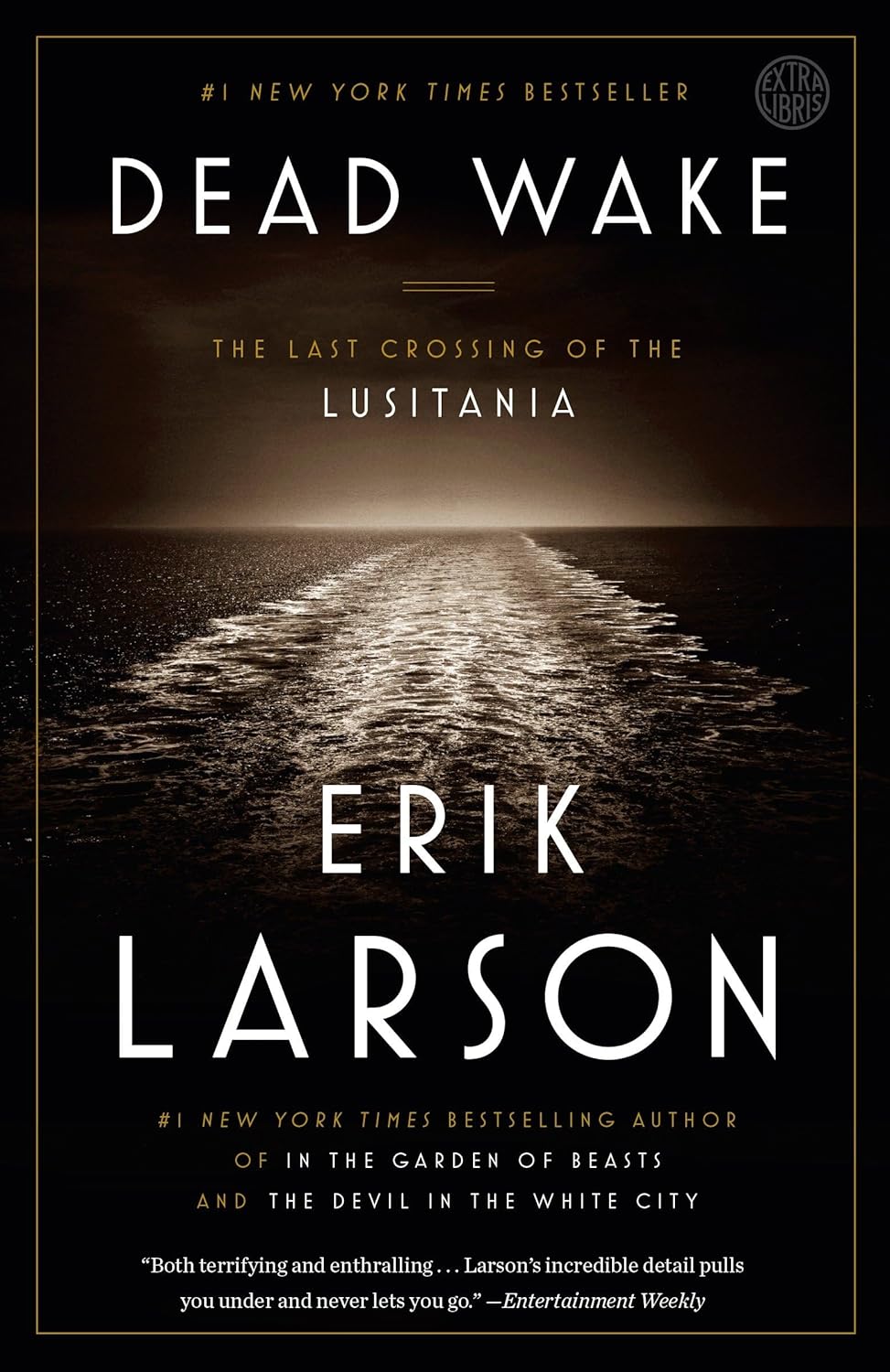
The sinking of the Cunard luxury liner Lusitania on May 7, 1915 is perhaps the most dramatic waypoint on America’s three-year long political and diplomatic journey before formal military intervention in the First World War. Bestselling author Erik Larson adds much texture and new detail to this familiar story in “Dead Wake: The Last Crossing of the Lusitania.”
The torpedoing of the Lusitania was one of those events that everyone seemed to expect, yet shocked the world when it actually happened. The day before the Lusitania sailed from New York City the German Embassy in Washington issued an unambiguous warning in newspapers aimed squarely at passengers making the upcoming transatlantic voyage: “vessels flying the flag of Great Britain, or of any of her allies, are liable to destruction” and travelers sailing on such ships “do so at their own peril.” Amazingly, the general reaction to this unveiled threat was nonchalance. The Cunard manager in New York issued an official response to the German warning: “The truth is that the Lusitania is the safest boat on the sea. She is too fast for any submarine. No German war vessel can get her or near her.” Famous last words, as they say.
The Lusitania was a majestic ship. Launched in 1907, she had made 201 crossings of the Atlantic by May 1915. Moreover, she was one of the famed “greyhounds” of the Cunard line capable of achieving more than 25 knots (about 30 miles an hour). She was under the command of Captain William Thomas Turner, a crusty but capable old sea dog. Larson provides interesting biographical sketches of over a dozen passengers, some wealthy, some not; some of whom survived, some of whom didn’t. He notes that everyone was well aware of the submarine threat, yet most remained incredulous. “Lots of talk about submarines, torpedoes and sudden death,” said Alfred Vanderbilt, heir to the enormous railroad fortune and the most famous man on the Lusitania passenger list, “but I don’t take much stock in it myself. What would [Germany] gain by sinking the Lusitania?” (Vanderbilt was supposed to be a passenger on the Titanic, but changed plans at the last minute. His luck ran out on the Lusitania.) Most passengers shared Vanderbilt’s perspective. “Aboard the Lusitania, there was a good deal of gallows humor,” Larson writes, “but it was spoken from a position of comfort and confidence.”
Larson tells his story largely from three alternating viewpoints: life aboard the Lusitania, life inside U-20, the German submarine that would sink her, and life at Room-40, the highly classified code-breaking unit in London that closely monitored all German naval wireless communication.
Germany’s submarine force was relatively modest in early 1915. She possessed less than thirty operational submarines in her fleet, only maybe seven of which would be on patrol in the waters around Great Britain at any given time. Moreover, each submarine only carried seven torpedoes, two of which the captains always retained in reserve for the trip home, and the torpedoes themselves had an effective rate of just over 50%. All in all, it doesn’t sound like a threat that could press the world’s greatest naval power’s back up against the wall, but it did. Not only was the German submarine fleet small, but because of Room-40 the British knew the general location and intended course of every boat the left the main submarine base at Ems. Such was the case with U-20 in the first week of May 1915. British naval intelligence knew the boat was off the southern coast of Ireland and was under the command of a competent and aggressive captain, Walther Schwieger. Larson writes, “It was like knowing that a particular killer was loose on the streets of London, armed with a particular weapon, and certain to strike in a particular neighborhood within the next few days, the only unknown being exactly when.”
All of this begs the question: how did the British let this happen? As Larson tells the story, there seems to be a fair bit of negligence and miscommunication between the Lusitania and the Admiralty – and perhaps even a generous dash of outright conspiracy. First, a few important facts are in order. U-20 hit the Lusitania with one torpedo at 2:10pm on a beautiful, sunny afternoon with calm seas about 12 miles off of Kinsale Head, Ireland. She sank in just 18 minutes, taking 1,198 (123 Americans) of the 1,959 (61%) passengers onboard to the bottom. (By comparison, when the Titanic sank three years before, in the dead of night in the frigid waters of the North Atlantic, she took 2 hours and 40 minutes to sink and claimed the lives of 1,500 of the 2,240 (67%) onboard.) Larson notes that the single torpedo shot that sunk the Lusitania so fast was something of a miracle. A year later, it took Schweiger three torpedoes to sink a smaller passenger liner, and still the ship took 28 hours to finally sink.
Despite the persistent warnings from German authorities, the Lusitania ran no emergency drills during the five-day journey across the Atlantic. When the torpedo hit only six out of twenty-two lifeboats were ever launched. The passengers had never been properly instructed in how to put their life jackets on correctly. Scores died when they jumped overboard with improperly worn life jackets, which flipped them upside down and held them under water.
Captain Turner – who never left the bridge, yet somehow miraculously survived – was the immediate target for blame by the British Admiralty. According to Richard Webb, director of the Admiralty’s Trade Division, in the week after the tragedy: Captain Turner “appears to have displayed an almost inconceivable negligence, and one is forced to conclude that he is either utterly incompetent, or that he has been got at by the Germans.” To this the feisty First Sea Lord Jacky Fisher added: “I hope Captain Turner will be arrested immediately after the inquiry whatever the verdict of finding may be.” The Admiralty didn’t let up on Turner. An official inquiry began on June 15, 1915, the Admiralty’s lead attorney, according to Larson, “questioned the captain in harsh fashion, as if the proceeding were a murder trial with Turner the prime suspect.” In the end, Turner was exonerated of any wrong doing and kept his job at Cunard. The author finds the Admiralty’s persistent and strident efforts to pin the blame on Turner rather inexplicable. “Why the Admiralty would seek to assign fault to Turner defied ready explanation,” he writes, “given that isolating Germany as the sole offender would do far more to engender global sympathy for Britain and cement animosity toward Germany.”
So what would explain the Admiralty’s failure to provide destroyer escorts to the Lusitania once it arrived in dangerous waters? It knew from the code breaking efforts at Room-40 that a German submarine was actively operating off of Southern Ireland. The enemy captain was well aware that the famed passenger liner was scheduled to pass by on her way to Liverpool. According to distinguished twentieth century naval historian Patrick Beesly, who has studied the case of the Lusitania closely: “on the basis of the considerable volume of information which is now available, I am reluctantly compelled to state that on balance, the most likely explanation is that there was indeed a plot, however imperfect, to endanger the Lusitania in order to involve the United States in the war.” Yikes! Those are Beesly’s words, not Larson’s, but the author doesn’t refute them nor does he provide any more plausible alternative explanation.
If British authorities really secretly sacrificed over a thousand innocent civilians in the hopes of dragging a reluctant United States into the war, they were sadly disappointed with the result. The fate of global democracy may have hung in the balance, but the recently widowed US president Woodrow Wilson was, according to Larson, completely preoccupied by his breathless amorous pursuit of the dashing widow Edith Bolling Galt. The president kept his mouth shut for a full week after the sinking of the Lusitania. When he finally did respond, the letter of protest to Berlin was “firm and direct, but not bellicose,” according to Larson. As soon as Wilson put down his pen, he dashed off a saccharine note to his new lover: “I have just put the final touches on our note to Germany and now turn – with what joy! – to talk to you. I am sure you have been by my side all evening, for a strange sense of peace and love has been on me as I worked.”
Wilson’s rather tepid response to the Lusitania’s sinking successfully kept the US out of the war for the time being, but his measured words were still too much for the weak-kneed secretary of state William Jennings Bryan, who resigned on June 8, 1915 in what has to be one of the more pusillanimous acts in American diplomatic history. Wilson himself called him a “traitor.” The United States wouldn’t declare war on Germany for another two years after the Germans announced an uncompromising policy of unrestricted submarine warfare.
Meanwhile, the 761 survivors of the Lusitania disaster were offered a lifetime 25% discount on all future sea travel with the Cunard Lines (seriously).
 What's Tim Reading Now?
Leave a comment