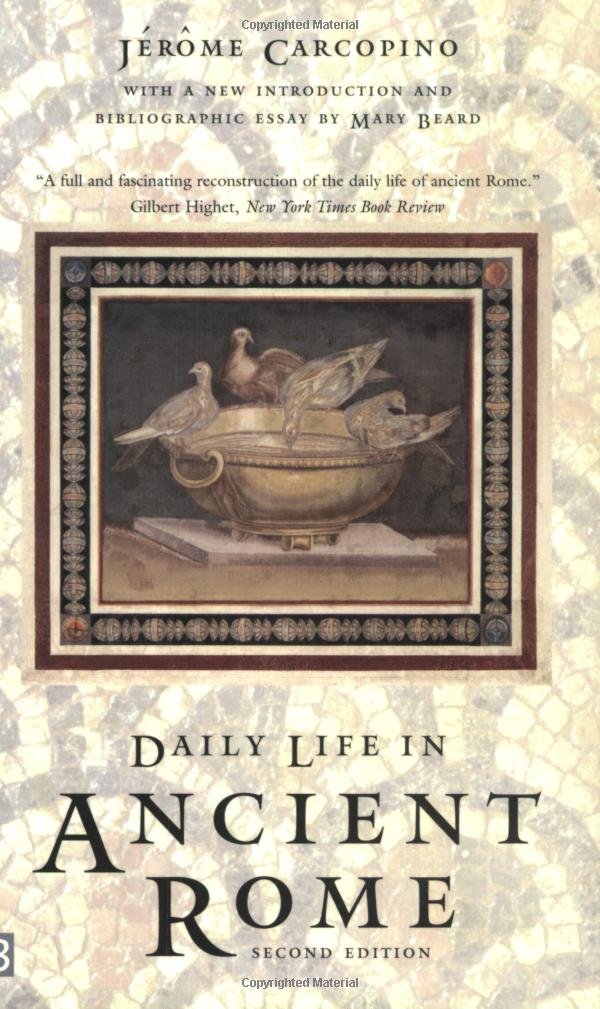
France in 1939 was preoccupied by the menacing actions of neighboring Nazi Germany. Meanwhile, French classist Jerome Carcopino was preoccupied with putting the finishing touches on “Daily Life in Ancient Rome: The People and the City at the Height of the Empire” (1939). It was considered a valuable and influential work when it was first published almost a century ago and remarkably remains in print to this day.
Ancient Rome, like many other epochs, often falls prey to the “great man theory” of history. The story is told mainly from the perspective of a handful of political and military leaders like Cicero, Caesar, Augustus, Hadrian and others of similar stature. What I loved about this book is that it concentrates more on “the man on the street,” What was it like to live, work and play in late first century Rome during the time of the early Antonines when the empire was at its apogee? That is what Carcopino seeks to address in “Daily Life in Ancient Rome.” He delves into some of the most basic but often overlooked aspects of life, from the design and construction of modest family homes and common daily activities to how time was kept and how food was prepared.
In the year 100 AD the city of Rome, known as the Urbs Romae, covered some eight square miles and was home to over one million people, a third of whom were slaves. The city was chaotic. “High and low, patrician and plebeian, rubbed shoulders everywhere,” Caracopino writes, although the hustle and bustle was almost exclusively male (the author says women in ancient Rome were much like like women in devoutly Muslim countries today – out of sight and out of mind). Streets and alleyways fanned out in all directions in an inextricably tangled web. “Down to the end of the empire,” the author says, “the street system of Rome represented an inorganic welter rather than a practical and efficient plan.” Traffic congestion was so severe that Julius Caesar forbade the use of transport carts in the city of Rome during daylight hours. The noisy stream of night traffic “condemned the Roman to everlasting insomnia.”
Romans lived cheek-by-jowl. Shabbily constructed and more or less identical apartments known as insulae towered five stories (the height limit set by Augustus) above the street and rested on foundations of a mere nine hundred square feet. Building collapses were common, as were fires (there were no building inspectors or fire department). Poorly supplied with water, light, and heat, the insulae were dark, cramped death traps. Yet, constantly rising rents is a subject of eternal lamentation in Roman literature.
Carcopino says that the Roman ruling class was in constant need of replenishing in the first and second centuries when the empire was at its height. In the year 65 AD, after the emperor Nero had been overthrown, only half of the senatorial families that existed during the reign of Claudius were still around. By the time of Trajan some thirty years later, only one of the patrician families restored by Julius Caesar over a century still existed.
A yearly income of 20,000 sesterce (approximately $18,000 in 2023 dollars) was the ‘vital minimum’ necessary to survive in Rome in the early second century. It is estimated that up to 175,000 Romans were on public assistance at this time or roughly twenty percent of the freeborn population. No one could reckon themselves rich with less than twenty million sesterces, the author says.
Roman families, at least among the aristocracy, are described as increasingly unstable, unhappy, and unproductive. Romans married for political and economic purposes mainly and only rarely for feeling. Consequently, adultery and divorce were epidemic. The happy examples of marital union – Trajan and Polina, Hadrian and Sabina, Antonius and Faustina – were the rare exceptions, Carcopino says. By the end of the first century many upper class marriages were childless.
Roman education left much to be desired, according to the author. Classes were held everyday or the year, with the exception of short eight day holidays in the summer. The sole focus was reading, writing, and counting, although advanced study in rhetoric was valued by the litigious upper classes, “Instead of happy memories, serious and fruitful ideas, any sort of intellectual curiosity vital to later life,” Carcopino writes, “school children carried away the gloomy recollection of years wasted in senseless, stumbling repetitions punctuated by savage punishment.” Rome never had much use for philosophers anyhow. In 161 BC the Senate expelled philosophers, including the Stoic Diogenes, from the city. Vespasian famously repeated the exercise in 71 AD.
The Roman calendar was dominated by festivals and holidays. An astonishing 159 days (43% of the calendar!) were expressly marked as holidays, with 93 being devoted to games given at public expense, which could cost as much as one million sesterces. The roughly 150,000 idle poor in Rome never had to wait more than a day or two for some publicly funded entertainment. “The Caesars saw to it that the Roman plebs suffered from neither hunger or ennui.” The star gladiators, charioteers, and actors were the A-list celebrities of their time. The theater of Pompey (55 BC) likely accommodated up to 25,000, the Colosseum (72 AD) could hold 50,000 spectators, the nearby Circus Maximus racetrack (first built in the sixth century BC but significantly reconstructed by Julius Caesar and Augustus) could hold a mind-boggling 250,000. By the time of Caligula the Circus Maximus would host twenty-four, seven-lap races a day. The only gambling allowed in ancient Rome involved betting on physical activities.Surprisingly, the Romans showed little interest in the Olympic games. Augustus, Nero, and Domitian all tried and failed to introduce a Roman version of the Greek games.
In addition to the games, races, plays and public readings, Romans spent a part of everyday at the barber and the baths. The former kept the Romans clean shaven and fashionably styled while the latter kept him clean and refreshed. Both served as important centers of camaraderie, gossiping, and to a certain extent social leveling.
In many ways “Daily Life in Ancient Rome” shows its age, but it is still a valuable resource for any serious student of ancient Rome looking to gain a better appreciation of the daily life in Rome during the age of the Antonines.
 What's Tim Reading Now?
Leave a comment