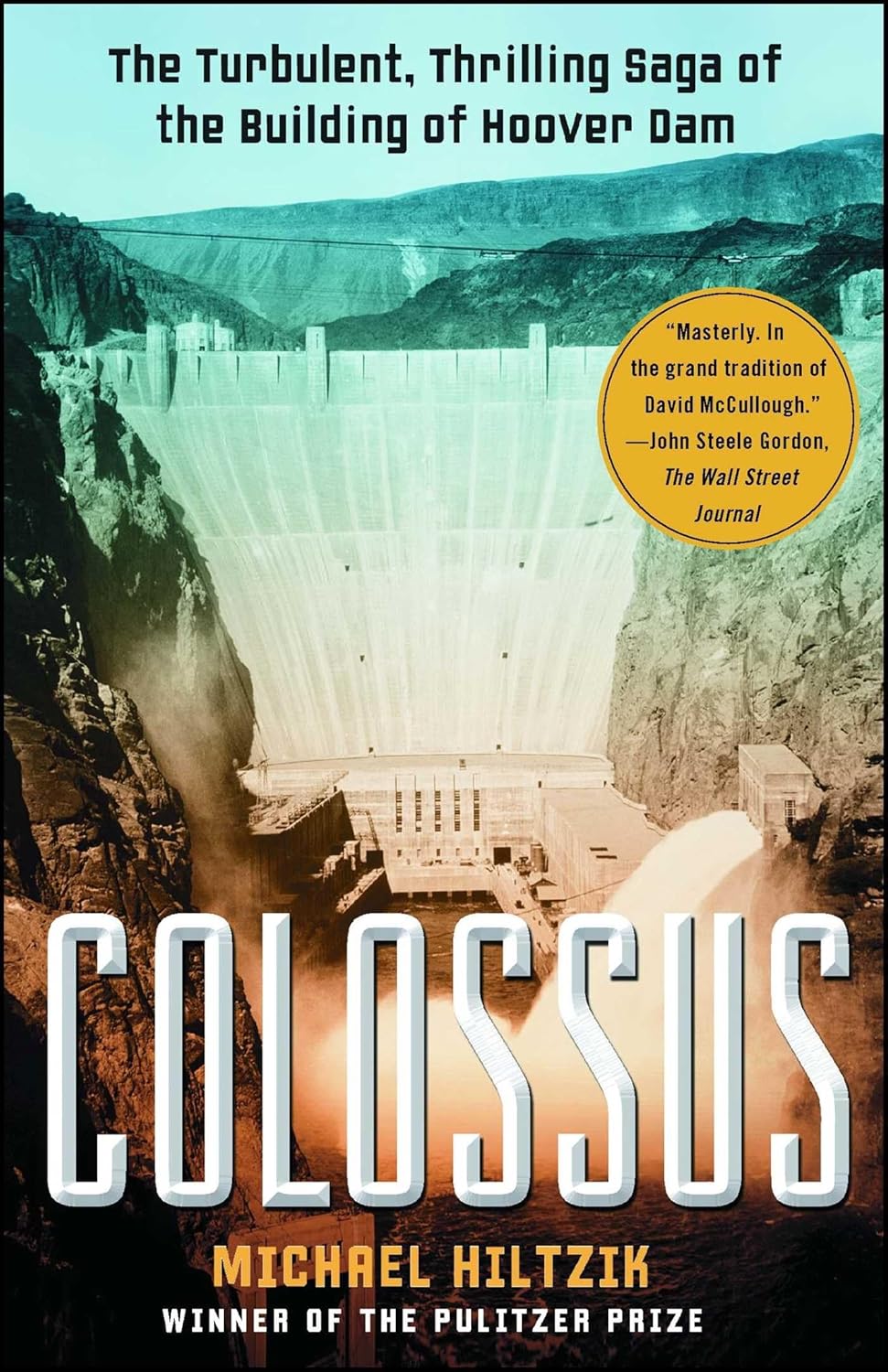
Great projects can make for great reading. I loved reading about the building of the Erie Canal (Bernstein), the transcontinental railroad (Bain), the Brooklyn Bridge (McCullough), and the Panama Canal (McCullough again). With “Colossus: Hoover Dam and the Making of the American Century,” Michael Hiltzik takes his place in this esteemed circle of bestselling historians.
Taming the Colorado River would prove to be an engineering nightmare and a political hairball. For decades beginning in the late nineteenth century private interests attempted to harness the unpredictable and heavily silted Colorado River to irrigate the parched Imperial Valley of southern California. By the turn of the century it was clear that only the focused power of the federal government could achieve the objective.
On January 12, 1907, President Theodore Roosevelt delivered to Congress his sweeping vision for bringing the Colorado River under the aegis of the United States Government for the purpose of developing a vast program of flood control and irrigation. “It was the most audacious deployment of government resources ever proposed for the continental United States,” Hiltzik writes, “the grandest plan for an American public work since the Panama Canal.”
Ironing out the details would not be easy. Hiltzik writes that the seven states (WY, CO, NM, AZ, NV, UT, CA) that shared ownership of the Colorado were like “seven squabbling entities mutually suspicious of each other’s designs on the precious stream cascading down for their mountains, flowing through their pastures, and scouring gorges in their desert expanses.” Arguably the central figure in getting the feuding states to agree to a formal compact governing access to the proposed dam’s irrigation and hydroelectric power was Commerce Secretary Herbert Hoover.
Hiltzik is no fan of Hoover’s. Throughout the book he has nary a nice word to say about him. He describes him variously as “stiff and sober,” a “prickly and insensitive leader,” typified by his “officiousness” and “imperious manner.” His disagreeable character aside, Hiltzik asserts that Hoover grossly overinflated his role in the creation of the dam that bears his name. “The dam that was to rise from the floor of Black Canyon did not resemble anything that [Hoover] had ever favored,” he writes, “and it encompassed features, such as the government-owned power plant, that he had actively opposed.”
However, the fact is Hoover successfully led the commission that created the Colorado River Compact, which settled the water management rights between the seven states and would later become known as the Law of the River. Moreover, it would serve as the model for most future interstate compacts in the United States relating to the management of rivers.
Hoover believed that he played the preeminent role in the dam’s creation and it seems obvious to me that other well-informed men of the era felt that way, too. For some reason Hiltzik sees things differently. In Hoover’s memoirs written decades after the completion of the dam, the former president wrote, “the chairmanship of the Colorado River Commission which had paved the way for its construction … my personal guidance of its engineering … [and] the legislation authorizing it, which had been largely prepared by me.” Hiltzik bristles at Hoover’s temerity, saying it distorts his “real role almost beyond recognition.”
The $165 million for the Boulder Canyon Project Act was the single largest appropriation bill enacted by Congress up to that time. In many ways the act ushered in a new age in federal authority and spending. In the early 1930s, before the New Deal, the US federal budget amounted to maybe 3% of GNP. By the close of the century it would approach 20%.
Construction of the long awaited dam began in 1931 as the country was in the early, punishing grip of the Great Depression. Tiny Las Vegas, a dusty railroad junction with less than 5,000 residents, was soon swarming with over 10,000 unemployed men looking for work. Basic sanitation services were pressed to the breaking point, not to mention the paltry 20-man city police force. At its peak, construction at Hoover Dam employed over 5,000 men (virtually all of them white).
The dam would be built by a group of contractors known as the Big Six, “a consortium of strong-willed self-made men,” including Henry Kaiser and Dad Bechtel, whose fledgling construction enterprises were more or less launched by their participation in the Hoover Dam project. Heltzik writes disparagingly about Six Companies Inc., as the company was officially known. To begin with, he claims that the workers were shamefully nickel-and-dimed at nearly every turn. Owing to the remote worksite, Six Companies controlled virtually all of the housing, food, and transportation in the vicinity of the project site. The company squeezed out a profit in each one of these compulsory services it provided its workforce. For instance, workers (who were nearly all working paycheck-to-paycheck) would not be paid for the time required commuting to and from the worksite, which could take up to an hour, but the company charged them everyday for the cost of the bus trip.
More seriously, Hiltzik claims that the management’s punishing work schedule imperiled their workforce. “The company’s concern with safety sometimes appeared to be little more than rhetorical,” he says. Led by the implacable superintendent Frank “Hurry Up” Crowe, work on the dam virtually never ceased as three shifts worked around the clock, seven days a week for months on end. The author is somewhat mystified by this punishing emphasis on speed as the Big Six would ultimately complete the project two full YEARS ahead of schedule, but would reap no reward or incentive for the herculean effort required to do so. According to Hiltzik, “All that can be said is that many men paid for the Big Six’s construction record with their lives.” Exhausted men frequently slipped and fell to their deaths or committed serious accidents at the worksite. Overall, roughly a hundred men lost their lives during construction.
Hiltzik claims that management’s responsibility for workplace deaths may have been much more sinister than simply pushing men too hard. One notable area of concern was carbon monoxide poisoning during the construction of the massive tunnels designed to divert the flow of the Colorado River during the construction of the dam. First, the Big Six refused to invest the $300,000 required for safer electric equipment. Next, according to Hiltzik the company sought to cover up deaths from carbon monoxide poisoning by having the onsite hospital reclassify those deaths as pneumonia in an attempt to avoid paying large settlement claims to families.
President Franklin Roosevelt was proudly on hand for the dedication of Hoover Dam (then known as Boulder Dam) on September 27, 1936. He would shamelessly commandeer the project that had been championed and shepherded along by three Republican administrations and turn it into a towering achievement of his ambitious New Deal. The dam was over half completed by the time Roosevelt took office in 1933, but he couldn’t resist appropriating it as his own. “It represented gainful employment, cheap hydroelectric power, reliable irrigation, and protection from the obstinate elements, all wrought from the forbidding land by a visionary federal government embarking on a new role in national life,” Hiltzik writes.
The Hoover Dam was truly a colossus. It would be 726 feet tall, twice as tall as any dam on earth. The massive reservoir that would become Lake Mead would be the largest manmade body of water on earth, eight times larger than the reservoir made by Egypt’s Aswan Dam.
The naming of the dam was a political hot potato. In 1931, secretary of the interior Ray Lyman Wilbur stunned many when he announced (evidently only on his own authority) that the massive new dam would be named for his boss, Herbert Hoover. Naming a major public work for a sitting, first-term president was unprecedented and it struck many as wildly inappropriate. Almost immediately after taking over as secretary of the interior in 1933, New Dealer Harold Ickes had the name changed to Boulder Dam, a move that Henry Chandler’s reliably Republican Los Angeles Times called an “almost inconceivably petty political pique.” The issue would only be settled once and for all in 1947 when the Republicans recaptured Congress for the first time since 1933 and quickly and officially renamed the dam for Hoover, the nation’s first engineer president.
In closing, “Colossus” is a well-researched and absorbing account of one of the greatest engineering feats of the twentieth century. As Hiltzik aptly and eloquently summarizes, “Hoover Dam was born in the Jazz Age, built in the Machine Age, and in every respect represented the Modern Age. It stands today as the perfect melding of form and function, a landmark of engineering, architecture, and muscular industry.”
 What's Tim Reading Now?
Leave a comment