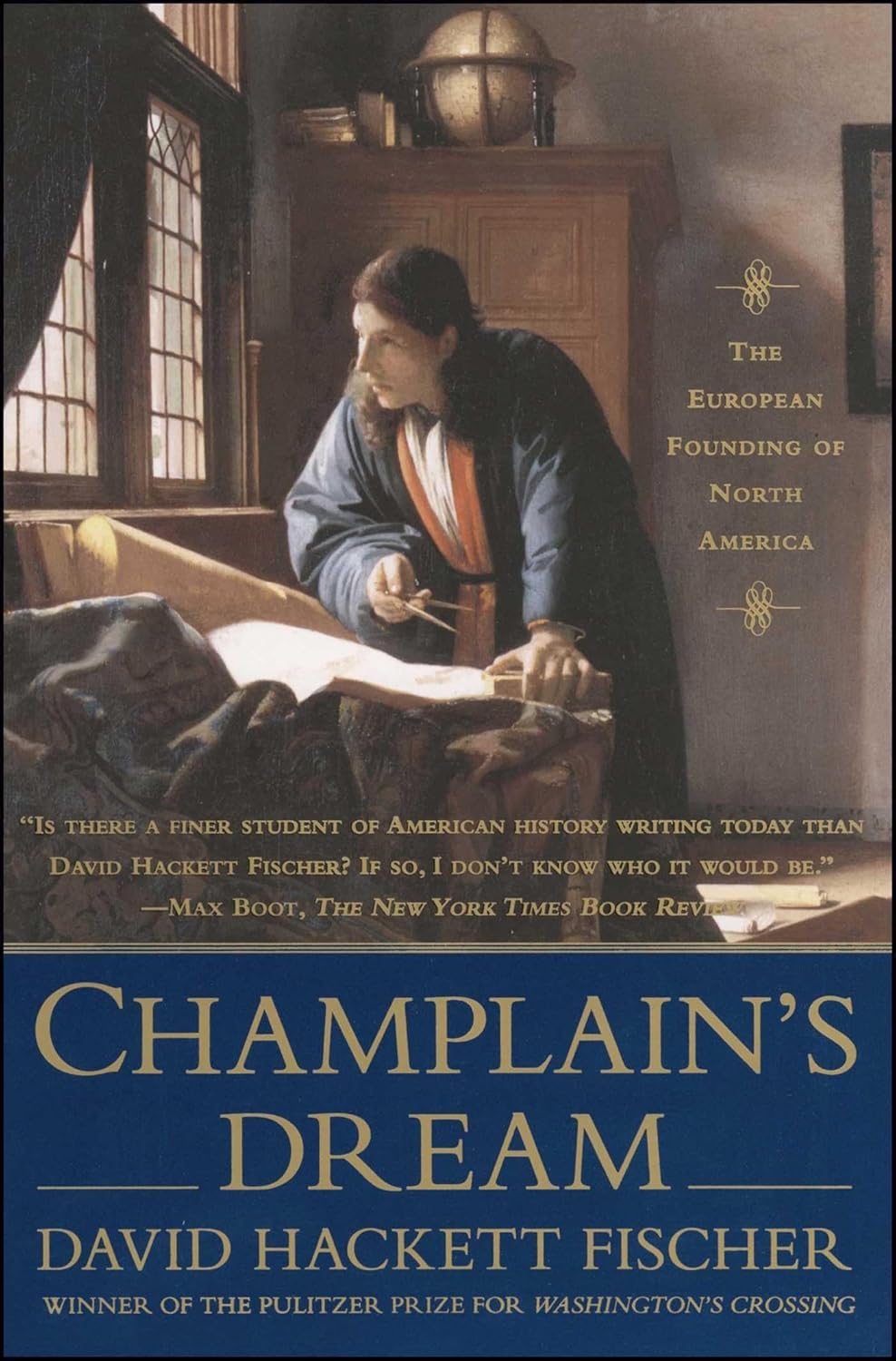
Samuel Champlain was born in the Atlantic coastal village of Brouage in 1574 during a time of religious upheaval in France (nine religious wars between 1562 and 1598). Fischer speculates that Champlain was baptized and born Protestant and then converted to Catholicism, to which he remained deeply devoted for the rest of his life. “[Champlain] came of age in the midst of a broad diversity of language, culture, religion, and ecology,” Fischer says, and this would shape his sincere curiosity of different people and his tolerance for differences in attitude and behavior. Champlain recognized a common humanity in the people of America and Europe and Fischer says that this universal spirit “lay at the heart of Champlain’s dream,” which he tells in “Champlain’s Dream” (2009), his epic tale of colonial ambitions in the New World.
It is possible, but unproven, that Champlain was the illegitimate son of King Henry IV (r. 1589 to 1610). Fischer says it would help explain Champlain’s otherwise inexplicable privileges at court and the royal patronage that proved fundamental to his prosperity and success in the New World. The Edict of Nantes and the Peace of Vervins, both signed in 1598, established peace between Catholics and Protestants in France and peace between France and Spain in Europe, respectively. The peace treaties meant that King Henry IV was free to set his sights externally in an effort to make France a global power. A French presence in North America was a critical part of that design.
Champlain’s first trip abroad was to the Spanish empire in the Caribbean and Central America. Fischer says that Champlain was horrified by the barbaric cruelty and exploitation of the Spanish regime that he witnessed on that trip. The experience was fundamental in shaping Champlain’s career in New France and his promotion of a cooperative spirit and cultural tolerance, which was further bolstered by Champlain’s “gift for getting along with others.” He sincerely hoped to convert the Indians to Christianity and co-exist with them.
The French had been trying to establish themselves in the New World for nearly a century before Champlain got involved. Between 1535 and 1601 the French attempted six settlements along the St Lawrence Valley (Jacques Cartier), southeastern coastline (Jean Ribault), and Sable Island in the Grand Banks (Marquis de la Roche). All of them were unmitigated disasters. Champlain studied these failures closely, Fischer says, and derived some essential lessons learned for his future endeavors. First, Champlain put a high premium on detailed and thoughtful planning. Previous efforts were seemingly improvisations and they all paid the consequences. It was important to explore thoroughly and pick the site of settlement thoughtfully and carefully. Second, order and authority were critical for the survival of the colony. The individual settlers needed to be relatively reliable and hardworking, and they needed to submit to discipline in order to maintain group productivity and cohesion. Third, the expedition needed to raise significant capital and acquire significant provisions in order to ensure the colonists received an ample supply of food. Fourth, Champlain believed that New France should only have one official religion – Roman Catholicism – but should extend toleration to other faiths. Fifth, the local indigenous population should be treated with dignity, fairness, and respect. Finally, the New France colonies needed the “broad vision, energy, and resolve” of the monarchy in order to ensure that the necessary financial, material, and human resources were made available on an ongoing basis.
Champlain sailed for New France in 1603. The purpose of the expedition was twofold: trade (beaver skins and fish, mainly) and exploration of suitable sites for permanent settlements. He successfully solicited support from the local Algonquin Indian tribes of the St Lawrence Valley, who in turn viewed the French as a potentially powerful ally against their mortal enemy – the Iroquois nation. Fischer says that Champlain was more careful and systematic than any of his predecessors in his exploration of the area and quickly gained a remarkably clear idea of the entire Great Lakes and Hudson Bay region. Nevertheless, it would not be easy going.
The Mayflower would not land at Plymouth until 1620, yet by 1604 the northeastern coast of North America was already humming with European visitors. After extensive exploration of the St Lawrence Valley, Champlain decided to attempt the first permanent French settlement on Saint-Croix Island on the western coast of the Bay Fundy, in an area known to the French as Acadia, believing it would be more temperate than the freezing lands around the Saguenay River to the north. Fischer, after praising Champlain’s attention to detail and studious exploration of suitable settlement sites, calls the decision “a calamitous choice.”
Between 1604 and 1606, the French continued to closely explore the coastline from the Bay of Fundy south to present day Massachusetts Bay. A collection of scraggly Frenchmen bounded around in the vicinity of Plymouth Rock and engaged in deadly clashes with local Indians a full decade before the English Pilgrims and Puritans arrived.
A theme in “Champlain’s Dream” is that the founders of New France had to struggle on two fronts for most of the seventeenth century. The threats on the forward front were obvious and deadly: hostile Indian tribes, freezing winters, encroaching European powers, and poor communication. But there also existed a hostile and persistent threat to their rear back in France, which consisted of political subterfuge, rumor mongering, smuggling, and never ending lawsuits. The only way New France could be founded and then self-sustaining was by exploiting the vast wealth of the New World. In the case of New France that meant establishing and maintaining a monopoly in the highly lucrative beaver skin trade. But even as early as 1607 there were upwards of eighty ships trading illegally in the St Lawrence Valley challenging the authority of crown-granted monopolies over the fur trade.
The French shifted their focus from the wide and crenelated Bay of Fundy to the St Lawrence Valley, which had several strategic choke points that made the entire region easier to control. In 1608 Champlain established a strong fort on a high rocky promontory that the Indians called Kebec, the “narrowing of the waters.” The goal, quite distinct from the English and Spanish, was to allow a small number of Frenchmen to control a harmonious long distance trade, mainly in furs, with many Indian nations.
Fischer says that peace and stability in the St Lawrence Valley was pivotal to Champlain’s strategy in establishing New France. The Mohawks in present day upstate New York were a major impediment to that plan. They were members of the feared Iroquois nation, which Fischer says “were known for cruelty, in a very cruel world.” In the summer of 1609 Champlain undertook a daring plan to surprise, shock, and humble the mighty Mohawks, the most eastern tribe in the Iroquois nation. Accompanied by only sixty allied Montagnais and Algonquin warriors, accompanied by two Frenchmen armed with arquebuses, Champlain plunged into the Iroquois lands and paddled down the 125-mile long lake that he named after himself, Lake Champlain (at almost the same exact moment Henry Hudson was sailing up the river that would be named after him). In perhaps my biggest surprise of the book, Fischer says that the Mohawk warriors, clad in wooden armor and shields, met the small Montagnais-Algonquin-French force head-on in a phalanx-like formation. The French arquebuses decimated the Mohawks, killing roughly fifty warriors, including all three Mohawk chiefs. It was “a pivotal event in the history of Indian warfare,” according to the author. Never again would Indian warriors attempt to march on western-armed foes in close order combat. Meanwhile, Champlain emerged as a “mythic figure” among the tribes of the St Lawrence Valley for his role in planning and executing the decisive victory against overwhelming odds. A fragile quasi-peace was maintained for roughly a full generation, from 1610 to 1634, exactly as Champlain planned and hoped.
Champlain’s dream looked bright in 1610 – but then tragedy struck. King Henry IV – Champlain’s patron, mentor, protector, and friend – was assassinated by a religious fanatic opposed to his policy of religious toleration. The thirty-seven-year-old Italian-born Queen Marie de Medici was made regent for her son and heir apparent, the nine-year-old future King Louis XIII. Marie de Medici quickly aligned French policy more closely with the Catholic Church. Champlain lacked direct access to the new queen regent. Those around the crown resented the power and influence that Champlain – a mere commoner – wielded with Henry IV. Meanwhile, merchants from rival French cities competed with one another ruthlessly to capture market share in the lucrative fur trade, all while also grossly mistreating the Indians. Champlain’s lofty designs in New France suddenly looked imperiled.
In 1613 Champlain made several astute maneuvers that dramatically improved his prospects. First, he arranged for a prince of the blood, Henri de Bourbon, prince de Conde, to be named Viceroy of New France with full powers to license all trade in the region. Second, he formed a new investment group called La Compagnie du Canada. The object was to unite the three rival centers of trade in France – La Rochelle, Rouen, and Saint-Malo – in a single venture, all licensed by the viceroy. The investors were granted a monopoly on the fur trade for eleven years in exchange for contributing 1,000 crowns per year and sending six families of permanent settlers every year.
Meanwhile, Champlain was determined to establish peace and stability in New France by deterring future aggression from the hated and feared Iroquois nation. In 1615 Champlain led an allied expedition of Algonquin and Huron warriors to attack a major Iroquois fort on Lake Onondaga near modern day Syracuse, New York. It was a bold march deep into enemy territory that resulted in heavy enemy casualties in an attack against a formidable installation. Champlain failed to take the fortress using European-style siege tactics, but Fisher says that the Indians on both sides were greatly impressed by the fighting process and technical sophistication of European soldiers. “Champlain’s campaign against Onondoga was a successful example of limited war purposes of peace and stability,” Fischer concludes. Champlain’s towering reputation among the Indians grew. “He was a soldier and a man of the world,” Fischer writes, “who acted like a holy man.” The Algonquin of the St Lawrence River Valley looked at him in admiration and amazement. Champlain was certainly ethnocentric, Fischer says, but he was “more generous and large-spirited” than often given credit for by modern scholars and detractors.
By 1617 Quebec was more like a military post or a transitory work camp than an established community, but Champlain was unswerving in his vision of a permanent French colony in the New World. He was aided in this effort when King Louis XIII seized power from his mother, Maria de Medici, in that same year. Unlike his conservative mother, Louis XIII sought to expand French power around the world, which included both converting Indians to Christianity and discovering a northwest passage to Asia. The private investors who supported operations in New France had no interest in permanent settlements, which they considered costly and frivolous. The native Americans were violent and cruel and not to be trusted, they said. The investors were more interested in quick profits from monopoly rights over fur trading. They had every intention of keeping the Protestants out. “They thought that Champlain’s grand design was bad for business,” Fischer says. Over a decade after its founding, Quebec was still dependent on the home country for food and politically unstable. Champlain was more mediator than administrator. “He had to keep peace between Catholics and Protestants, Indians and Europeans, soldiers and civilians, seaman and shopkeepers, farmers and traders, rival companies and royal officials … it was a constant struggle to keep the peace in the St Lawrence Valley.”
In 1628 the formidable Cardinal Richeleiu took personal control over all of New France with the creation of the Company of the Hundred Associates. The entire colony was made a fief of the company, capitalized at 300,000 livres (each of the one hundred stockholders were required to invest 1,000 livres). New France had just 55 settlers. New Netherlands had 270, New England 800, and Virginia 1,275. New France had survived three consecutive decades of failure in the early seventeenth century. How it did so, Fischer says, “is not only an unknown but a mystery.”
To make matters worse, the English were literally gunning for the fur trade in the St Lawrence Valley. In 1628 the Hundred Associates’s first cargo of beaver furs from New France was captured by an English raider named Louis Kirke within the waters of the St Lawrence River. English King Charles I responded to this success by creating the Company of Adventurers to Canada with the explicit mission of stealing a monopoly over the fur trade from the French while simultaneously destroying all French settlements in the region. In July 1629 Kirke formally captured Quebec from Champlain, “the worst defeat of [Champlain’s] career,” according to Fischer (the Treaty of Susa, signed by England and France three months before Quebec was taken, eventually returned all seized territory to France in exchange for cash-strapped English King Charles I receiving the 2.4M livre dowry he was owed for marrying Louis XIII’s sister, Henrietta Marie). By 1630, the Hundred Associates had spent nearly all of their capital (270,000 out of 300,000 livres) with precious little show for it.
The easy conquest by the English seemed to energize the French. When the Treaty of Susa granted France something of a “do-over,” the Champlain-led French responded with gusto.
After nearly three decades of touch-and-go operations in New France with a light footprint and trade-focused strategy, the French returned to the St Lawrence Valley in 1633 intent on establishing a self-sustaining permanent settlement. Unlike the Spanish or English in their colonial American domains, Champlain encouraged the Indians to live close to French settlements and to interact with them, although he also brought large contingents of Jesuits to convert them. Finally, Fischer says, after three decades of trying to mold France’s corner of the New World into a stable, prosperous, peaceful, self-sufficient, and growing community, Champlain was at last in full control of New France.
Between 1633 and 1635 thirteen ships arrived in Quebec carrying 650 settlers. Roughly half of these settlers returned to France, but a sustainable French population had finally been established. Another thousand French settlers would arrive by the end of the decade. Over the next two decades 3,500 more arrived, and 9,000 more would come by the end of the century. All told, between 1608 and 1633 less than a hundred Frenchmen arrived in the New World. Between 1633 and 1700, just under 15,000 French men and women settlers came to Quebec, mostly from the Seine and Loire valleys. Moreover, each French immigrant woman had, on average, eight live births. “The only biblical commandment these Christians consistently obeyed,” Fischer smirks, “was to increase and multiply.” Sustained population growth in Quebec was fundamental to Champlain’s design for New France and no one did more to facilitate and promote that growth than him. Fischer suggests that Champlain was swimming upstream the entire time. Across the seventeenth century French families proved far more reluctant to relocate to America than their counterparts in England, Germany, or other parts of Europe, a phenomenon that Fischer says has never been adequately explained.
Champlain believed that the earlier French endeavors failed because of erratic leadership, poorly situated settlements, lack of preparation and food supplies, low quality settlers leading to a breakdown in discipline and group cohesion, and the unnecessary mistreatment of the local Indians leading to their alienation and lack of cooperation. It would take him decades, but he would eventually overcome all of these failures.
Champlain died of a stroke in 1635. He had lived a hard life. Between 1599 and 1633 he made at least 27 Atlantic crossings. He died a man of considerable means who dedicated his life to a singular and arguably heroic national mission, yet he received no notable honors from either Louis XIII or Cardinal Richelieu. According to Fischer, Champlain’s dream was the establishment of a Christian ideal in a new virgin land that embraced all humankind – Catholic and Protestant, European and Indian – but there was nothing of equality, democracy or republicanism in Champlain’s thinking. He was a confirmed monarchist. But he possessed a strong moral compass and his integrity set the tone for New France in the seventeenth century. Unlike the Spanish, who compelled the Indians to work for them, or the English in Virginia who abused them, or the English in Massachusetts who chased them away, Champlain sought to live with them in an admirable spirit of amity and concord. “This war-weary soldier dreamed of a new world where people lived at peace with others unlike themselves,” Fischer says. “In a world of cruelty and violence, Champlain was heir to an ethical tradition that had deep roots in the teachings of Christ.”
Fischer ends this remarkable biography with a glowing encomium to his subject: “[Champlain’s] largest contribution was the success of his principled leadership in the cause of humanity. That is what made him a world figure in modern history. It is his legacy to us all.”
 What's Tim Reading Now?
Leave a comment