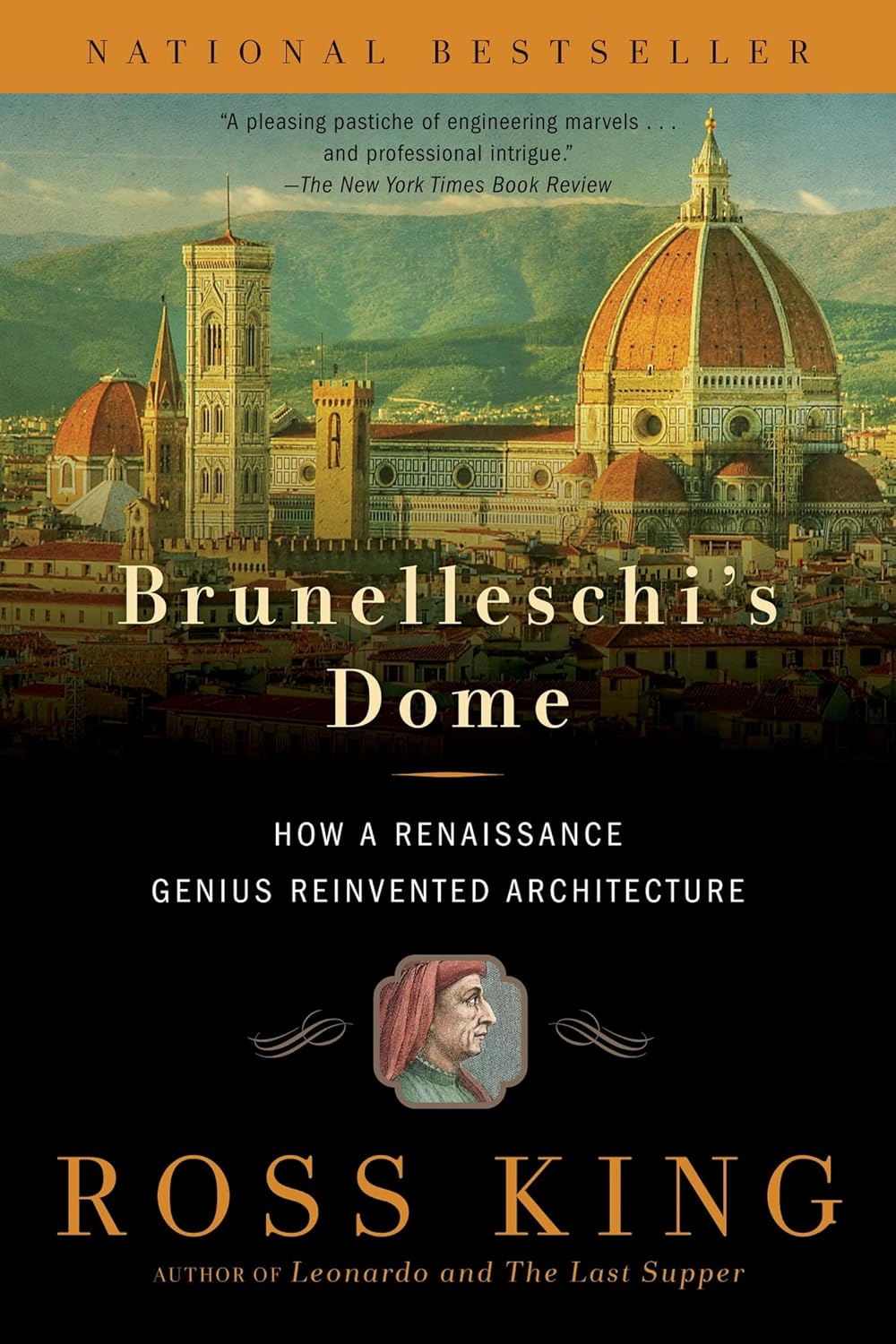
Ross King has a PhD in eighteenth century English Literature from York University in Canada, yet he has made a name for himself as a popular historian and biographer of the Italian Renaissance. Over the past two decades, he has written lively biographical narratives of artist Michelangelo (2003), bookseller Vespasiano da Bisticci (2021), and architect Filippo Brunelleschi (2000). King’s books are all highly accessible and informative. However, I’m not certain they all meet the highest standards of the academy. For instance, Bisticci’s fifteenth century writings have been largely discredited by scholars since at least the mid-twentieth century (Elizabeth Eisenstein, a celebrated historian of the printing press, once wrote that Bisticci’s writings are “virtually worthless”) yet King never acknowledges that the primary sources for his book about Bisticci, “The Book Seller of Florence,” have long lived under a dark cloud of scholarly suspicion.
The unbuilt dome of Santa Maria Del Fiore, whose foundation stone was laid in 1296, was “the greatest architectural puzzle of the age.” Florentine architect Neri di Fioravanti created a revolutionary double shell design in 1367, but exactly how to construct the dome remained something of a mystery for over half a century. The homely, irascible, and secretive genius Filippo Brunelleschi would eventually finish the job in 1436.
The author suggests that Brunelleschi was deeply influenced by his exploration and study of the ancient ruins of Rome, where he spent over a decade (often with his sculptor friend Donatello) after he lost the competition to create the baptistry doors in Florence to his lifelong rival Lorenzo Ghiberti. The Romans made extensive and inventive use of concrete domes and arches after the great fire of 64 AD. The Pantheon of Hadrian, constructed between 118 and 128, with a dome spanning 142 feet across and rising 143 feet in the air, seemed to defy the laws of nature. The problem architects in the ancient world and during the Renaissance had to solve was that brick and stone do not respond well to the lateral thrust or “hoop stress” generated by a large dome. Coffered concrete was thought to be the only solution.
By the time he reached middle-age Brunelleschi hadn’t accomplished much. He was mainly known for his application of the vanishing point in linear perspective to the art of painting, best exemplified by his camera obscura that rendered the Baptistery of San Giovanni in perfect perspective.
Brunelleschi proposed to construct the dome without the use of any center structuring. “So astonishing was the plan,” King writes, “that many of Filippo’s contemporaries considered him a lunatic.” The Opera del Duomo, the organizing group in charge of building the cathedral and dome, selected Brunelleschi as the capomaestro (essentially the project foreman), but it did not award Brunelleschi or anyone else the 200 florin prize for submitting the winning design on how to build the dome. To make matters even worse, Lorenzo Ghiberti was also named a capomaestro and received the same three florin a month salary as Brunelleschi for doing next to nothing, all while collecting the monstrous salary of 200 florins per year from the Cloth Merchant’s Guild (Arte di Calimala) for his ongoing work on the Baptistery doors. (Brunelleschi would eventually have his pay tripled to 100 florins per year while Ghiberti’s remained at 36 before being suspended entirely in 1425.)
In order to construct the dome Brunelleschi designed and built a hoist capable of lifting 1,700 pound beams one hundred feet in the air. King says that the contraption was “one of the most celebrated machines of the Renaissance.” It leveraged a giant screw that was turned by oxen. It required one of the longest and heaviest ropes ever manufactured up to that time (600 feet long and weighing over 1,000 pounds). A single ox could lift a thousand pound payload to the height of 200 feet in less than fifteen minutes. Roughly fifty payloads a day were lifted to the workers. Over the course of the project it would lift over 70 million pounds of brick, stone, mortar, and marble. The author says that Brunelleschi’s hoist “probably excelled any hoist ever constructed.” The Opera awarded Brunelleschi 100 florins for his incredible innovation. King says that Brunelleschi’s inspiration for this ingenious contraption remains a mystery.
Brunelleschi’s dome eventually consumed over four million bricks, many of them laid in the unique and beautiful herringbone pattern that was one of the secrets of its strength and stability. The herringbone pattern was essential to the dome’s construction and allowed it to be built without elaborate centering infrastructure. Where Brunelleschi learned of the herringbone bond is, like many of his innovations, unknown. Ingenuous as it was, it didn’t provide enough strength alone to prevent the dome from collapsing inward on itself. To do that, Brunelleschi devised a nine level circular skeleton (King suggests this may have been a deliberate emulation of Dante’s nine-level Inferno) over which the external octagonal structure of the dome took shape.
Not all of Brunelleschi’s technical innovations were mysterious triumphs. In 1426 Brunelleschi experienced one of his most expensive and humiliating failures. It had to do with his attempt to conquer one of the most pressing transportation challenges of the day: How to more quickly and efficiently ship high quality marble from the quarry at Carrara to Florence? Overland transportation was twelve times more expensive than waterborne conveyance. The water route from Carrara to Florence was roughly 75 miles. The finished marble would be transported by cart from the quarry to the port town of Luni. From there, the marble was loaded on boats and shipped 25 miles south to Pisa at the mouth of the Arno River. From there it was a 50 mile trip up the Arno, which was often silted up and barely navigable. Brunelleschi devised a giant amphibious cart that was meant to be capable of transportation over land and sea. It was dubbed “the Monster” (Il Badalone). He believed that it would cut transportation costs in half. The Monster launched from a dock in Pisa in 1428 with 100 tons of fine white marble on board. Halfway to Florence the ship sank and all the marble was lost. Brunelleschi had funded the entire operation out of his own pocket. He lost 1,000 florins or roughly a third of his net worth at the time and a full decade of his salary as capomaestro of the Duomo. “His reputation as the modern Archimedes was damaged,” King says.
Next, in 1430, Brunelleschi was dispatched as a secret weapon of sorts in Florence’s conflict with Lucca, a small neighboring wool- and silk-weaving city. Brunelleschi proposed to reverse the flow of the Serchio River, turning Lucca into an inundated island cut off from the outside world. Instead, the river swept away Brunelleschi’s dam and inundated the Florentine camp. It was a defeat more humiliating than the sinking of the Monster. His salary as capomaestro of the Duomo was cut from 100 to 50 florins. And then he was arrested and briefly imprisoned for failure to pay his trivial annual dues (12 soldi or roughly one day’s wages) in the Masons Guild, an act of retribution the author says was unprecedented. The author speculates that the Albizzi faction in Florence, longtime rivals of the Medici (who were steadfast Brunelleschi supporters), were likely behind it. To make matters worse, in 1434 Brunelleschi’s adopted son, 22-year-old Buggiano, absconded with his father’s money and jewels, and fled to Naples.
After 140 years of continuous construction, Santa Maria del Fiore was finally consecrated on the Feast of the Annunciation (March 25th) in 1436. Five months later, and after sixteen years of nonstop construction, Brunelleschi’s dome was consecrated as well. King says that Brunelleschi’s work was widely recognized as “an engineering feat whose structural daring was without parallel.”
Brunelleschi died on April 15, 1446. He was granted the rare honor of entombment within the cathedral of Santa Maria del Fiore. He was a genius who raised architecture to an art form. Unlike the anonymous Gothic builders of the Middle Ages, Brunelleschi’s name was recognized and admired both by his contemporaries and posterity. According to Giorgio Vasari, the Renaissance artist and biographer, Brunelleschi was a genius sent from heaven to renew the moribund art of architecture, almost paralleling how Christ had come to earth to redeem mankind. Today, Leonardo da Vinci is far better known and celebrated, but Brunelleschi’s achievements may be more impressive for the simple fact that his most innovative contraptions and solutions were actually built and successfully deployed, and not simply confined to graceful sketches in a notebook, as they were with Leonardo.
 What's Tim Reading Now?
Leave a comment