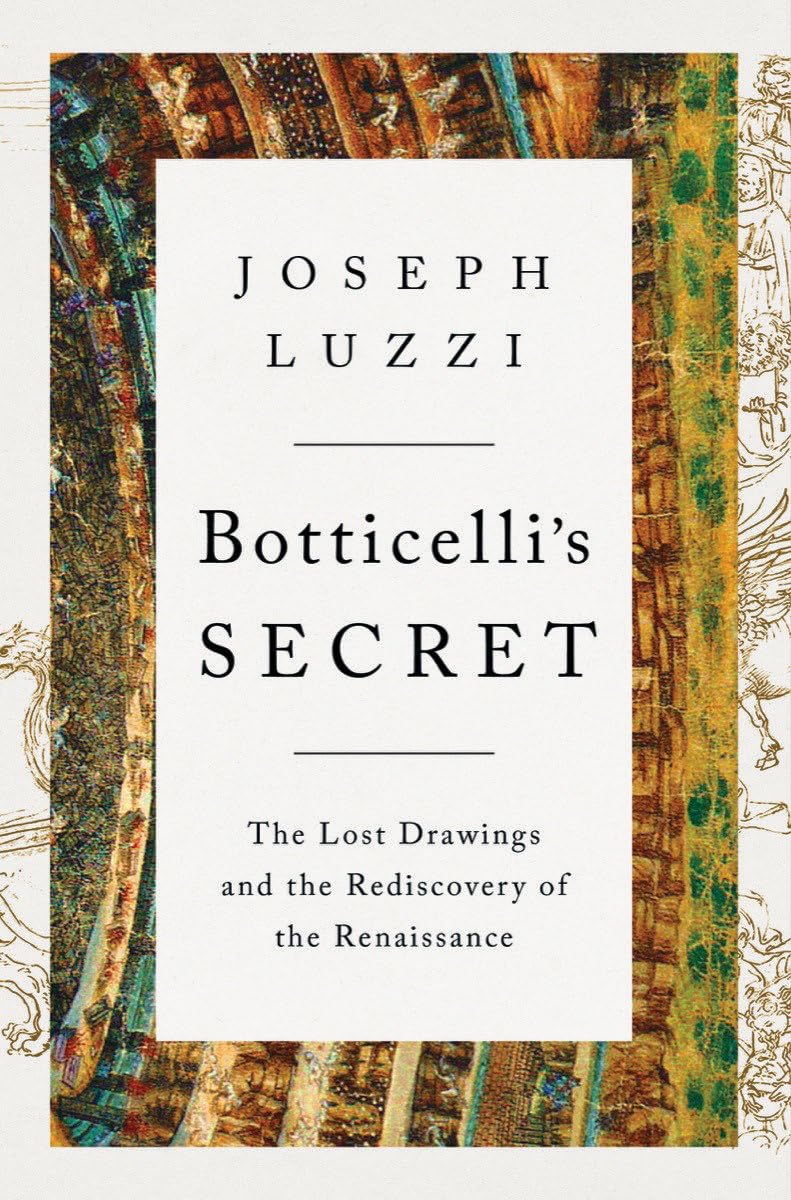
There aren’t many histories of the Italian Renaissance written for a lay audience, besides a few excellent examples by Ross King. Joseph Luzzi is a literature professor at Bard College in upstate New York. I get the sense that he wrote “Botticelli’s Secret: The Lost Drawings and the Rediscovery of the Renaissance” (2022) just for fun, which is one of the most attractive perks still left to tenured professors at obscure colleges looking to keep life interesting. In a nutshell, “Botticelli’s Secret” tells the story of the rediscovery of Sandro Botticelle as an important artist of the Italian Renaissance, an event triggered by the 1882 acquisition of 92 long forgotten illustrations of his of Dante’s Divine Comedy by Friedrich Lippmann, a prominent German art historian and director of the Berlin Kupferstichkabinettfrom, from the Duke of Hamilton in Britain.
Luzzi explores several themes in “Botticelli’s Secret.” First is the enduring mystique of Dante Alighieri’s (1265-1321) Divine Comedy (Commedia), which was written over a period of twelve years (1308-1320) and completed just before his death in 1321. The work reflects the medieval worldview while incorporating Dante’s innovative literary and philosophical ideas, making it a cornerstone of both Italian literature and world literature. Luzzi shows that its popularity has waxed and waned dramatically throughout history.
The Divine Comedy was something of an instant international bestseller in early fourteenth century Italy. It was particularly popular with the masses, an incredible achievement in a time when most adults were illiterate. The populo minuto (common man) of Florence knew Dante’s verses by heart, the way teenage girls today can recite Taylor Swift lyrics. A century later, during the infamous Bonfire of the Vanities, the Divine Comedy was the one book Savonarola refused to burn (Luzzi says that was because Dante and Savonarola shared a common loathing of materialism and the love of money, and both had a soft spot for apocalyptic thinking.)
Not everyone was smitten with Dante. Petrarch (1304–1374), the “Father of Humanism,” viewed Dante’s rockstar status with suspicion. The poet’s popularity, he believed, was evidence of his “literary uncouthness,” Luzzi says. Dante was the poet for the working class, who preferred his “raw rhymes” to Petrarch’s “refined sonorities.” Petrarch thought that “literary language should be for the educated few, not for mass consumption” and he was intent on making Dante “old news.” Luzzi contrasts the two men as refined and established versus pedestrian and unsettled: “If Petrarch was decorated and emeritus,” he says, “Dante was itinerant and adjunct.”
A second theme of “Botticelli’s Secret” is the unique genius of Sandro Botticelli (1445-1510). To begin with, Luzzi places Botticelli within the broader context of Renaissance Italy. Quatrocento Florence was a special place, powered by a cocktail of civic pride and self-promotion, where stone and marble workshops numbered over fifty, and woodworkers outnumbered butchers. Luzzi writes that the “Renaissance workshop [bottega] changed the history of art through its emphasis on versatility.” Michelangelo and Leonardo were painters, sculptors, architects, and engineers. Donatello, Bruneleschi, Ghiberti, and Botticelli were all originally trained as goldsmiths, a craft Luzzi says “required attention to detail, a graceful line, and a penchant for decorative effect.” The Renaissance was also collaborative. Some of the most stunning works of the Renaissance, such as the Brancacci Chapel and Sistine Chapel, were group efforts, including Botticelli.
Bottecelli was a man of limited formal education, although Luzzi claims (with limited evidence) he was a “vigorous autodidact” (e.g. nothing written by Botticelli has survived, not even a will). He apprenticed under Fra Filippo Lippi during his teens and opened his own bottega in 1465 at the age of twenty. Demand for art was great, but competition was ferocious. The most prominent artists in Florence at the time were Verrochio and Pollaiulo. Botticelli quickly developed his own style, which then became his unique visual brand, a critical part of Botticelli’s rise and fall as an artist, according to Luzzi. By 1475 he was proclaimed Master of Painting, one of Florence’s highest artistic honors, and served as the unofficial family painter for the all-powerful House of Medici, the “Kennedys of Renaissance Italy,” in one of Luzzi’s memorable turns of phrase. Botticelli immortalized the Medici family as Renaissance Wisemen – “the giver of gifts,” Luzzi says – in “The Adoration of the Magi” (1476). It’s an art piece that Luzzi says perfectly captures the “nexus of power, money and influence” of the Medici family in late fifteenth century Florence; “the painting is an homage to present Medici glory as well as a paean to its future,” he says.
In 1480, at the height of Botticelli’s creative talent, Lorenzo the Magnificent’s first cousin (both were grandsons of Cosimo de Medici), Pierfrancesco de Medici, commissioned him to produce illustrations for a hand-scripted copy of Dante’s Divine Comedy. Luzzi says that it was a suitable commission for Botticelli, as he had much in common with Dante: they had a shared tongue in the Tuscan Italian dialect, a deep and abiding love of their hometown of Florence, and a common appreciation of the fragility of beautiful works.
Luzzi says that Botticelli’s Dante project was a “secret” in the sense that he worked on it sporadically over fifteen years (1480-1495) in between other, more important commissions. Moreover, it was barely commented upon during his lifetime. Only one of Botticelli’s one hundred illustrations of the Divine Comedy made the complete artistic journey from sketch to drawing to painting: “The Map of Hell.” The entire project was quickly forgotten after it was completed. But Luzzi argues that the Dante cycle is a masterpiece. In short, Bottecelli’s illustrations are a Renaissance interpretation of a Medieval magnum opus. “To behold the drawings was to witness the transition of a new historical era,” Luzzi says.
Botticell’s towering reputation at that time pulled him in multiple directions. In 1481 he put aside his Dante commission in order to help fresco the walls of the recently completed Sistine Chapel, an assignment Luzzi says was intended as a goodwill gesture from the Medici in the aftermath of the bloody Pazzi Conspiracy of 1478. It is possible that Pierfrancesco himself distracted Botticelli by commissioning the masterpieces that would become known as “Primavera” (1482) and “Birth of Venus” (1486). Luzzi notes Botticelli had one muse in particular – Simonetta Vespucci, reportedly the most beautiful woman in Florence – who he would turn into “the face of the Italian Renaissance.” She starred in some of Botticelli’s most memorable pieces, such as the “Birth of Venus” (1486) and “Venus and Mars” (1485). Just as Dante had Beatrice and Petrarch had Laura, so Botticelli had Simonetta.
Luzzi makes much of the fact that Botticelli built a recognizable and desirable “brand.” By the late fifteenth century his bottega was working overtime to churn out altarpieces and devotional paintings. The author says that the talent of Botticelli’s assistants varied widely and quality control over bottega output slipped. Then came the puritanical regime of Savanarola (1495-1498). Luzzi says that Botticelli’s trademark style – that is, “graceful, secular beauty” – went up in flames, both literally and figuratively, and never fully recovered from the shock of the Bonfire of the Vanities.
As bad as Savanorola was, no one did more to torpedo Botticelli’s historical legacy – and the importance of the Dante cycle in particular – than the sixteenth century artist, architect, and art historian Giorgio Vasari (1511-1574). Unfortunately, nobody seemed to care that “Vasari was never in the business of fact,” according to Luzzi. Vasari wrote that Botticelli was a talented but deeply flawed artist who fell victim to a combination of profligacy, poor lifestyle choices, and religious zealotry. Luzzi says that Vasari attributed Boteccelli’s acceptance of the Divine Comedy commission as simply an opportunity for the unlettered artist to burnish his limited intellectual credentials.
A third theme of Luzzi’s book is the curious fall and rise of Botticelli’s international fame and influence. Vasari very nearly sunk Botticelli’s reputation for all time. Or, as Luzzi puts it: “Vasari’s biography became Botticelli’s obituary.” To Vasari, Botticelli’s art was too pretty; his figures too slight and immobile. His personal affairs were profligate; his unique talent wasted. Botticelli’s reputation was at its nadir in his final years and he struggled to find commissions that would pay him a respectable wage. Luzzi claims that he died nearly penniless after decades of being one of the most prominent and well-compensated artists in Florence. His Dante project was quickly and almost completely forgotten; Vasari’s denunciation of it had become the canonical view. Botticelli’s historical reputation seemed to fall in tandem with Dante’s. Both were largely shunned in the seventeenth and eighteenth centuries, particularly during the hyper-rational Age of Reason. In 1756, Voltaire crowed “Nobody reads Dante anymore.”
Renaissance art had limited appeal among the wealthy collecting classes, even as late as 1900. In the late nineteenth century, a small group of art historians and intellectuals, such as Walter Pater (1839-1894) and John Ruskin (1819-1900), began to revitalize interest in Botticelli, although even they still recognized his limitations as an artist (many believed that Bottecelli was too “pretty” a painter to be taken seriously). But his modern reputation continued to grow.
Dante and the Divine Comedy were slowly resurrected in the nineteenth century (the first complete English translation of the Commedia didn’t appear until 1802). Paintings by Botticelli still languished in obscurity. In 1848, a group of British intellectuals – led by the Rosetti brothers, William Hunt, and John Millais – founded the Pre-Raphaelite Brotherhood, a society of like-minded art lovers that rejected Vasari’s long accepted argument that the High Renaissance of Michelangelo, Leonardo, and Raphael represented the zenith of artistic excellence. Rather, the Pre-Raphaelites embraced the artists of the Quatrocento, Botticelli in particular. The great art historian John Ruskin was also a significant fan of Botticelli’s. He called him “the greatest Florentine workman” of the age. Henry Wadsworth Longfellow’s translation of The Divine Comedy, still considered by many the best ever English translation, appeared in 1865. In 1881 Longfellow and Charles Eliot Norton, Harvard’s first professor of art history, established the Dante Society of America, one of the nation’s first scholarly associations, whose membership included Oliver Wendell Holmes, Henry David Thoreau, and Ralph Waldo Emerson. By the 1880s Britain and the broader English-speaking world was caught up in a full blown “Victorian cult of Botticelli,” according to Luzzi. Boston’s Isabella Stewart Gardner, assisted by the young and ambitious art scholar Bernard Berenson, began compiling America’s first art collection exclusively focused on the Italian Renaissance, with artwork by Botticelli being a particular focus.
Luzzi says that it was John Ruskin, Walter Pater and the Pre-Raphaelites “who rescued [Botticelli’s Dante cycle] from its Vasari-induced oblivion.” The cycle was acquired by German collector Friedrich Lippmann. “Sportsman, scholar, and savant,” according to Luzzi, Friedrich Lippmann was very much the proverbial Renaissance man he so admired. The 1882 acquisition of Botticelli’s Dante cycle was, in Luzzi’s estimation, a curious “mix of nationalism and connoisseurism,” as the recently unified Germany was looking to establish itself as the new cultural center of Europe.
Luzzi writes that the Dante cycle said many things about Botticelli and Florence more broadly. First, he was a genuine Renaissance man, not only highly capable in many mediums of art, but also that he was a man of letters and capable of sophisticated literary interpretation. Second, the cycle demonstrated Botticelli’s ability to translate Dante’s quintessentially medieval narrative into illustrations that are quintessentially Renaissance. Third, the cycle captured the “Florentine ethos,” the intimate connection between wealthy patron and gifted artist, “the supreme embodiment of the Florentine marriage of art and politics and its accompanying belief that beauty can reshape the world.” According to Herbert Horne, the eminent fin-de-siecle English scholar and art collector, Botticelli did not merely illustrate Dante’s cantos; he effectively communicated their essence. It was a verdict that fully legitimized the Dante cycle in the early twentieth century. “Once forgotten,” Luzzi writes, “Bottecelli is now ubiquitous.”
 What's Tim Reading Now?
Leave a comment