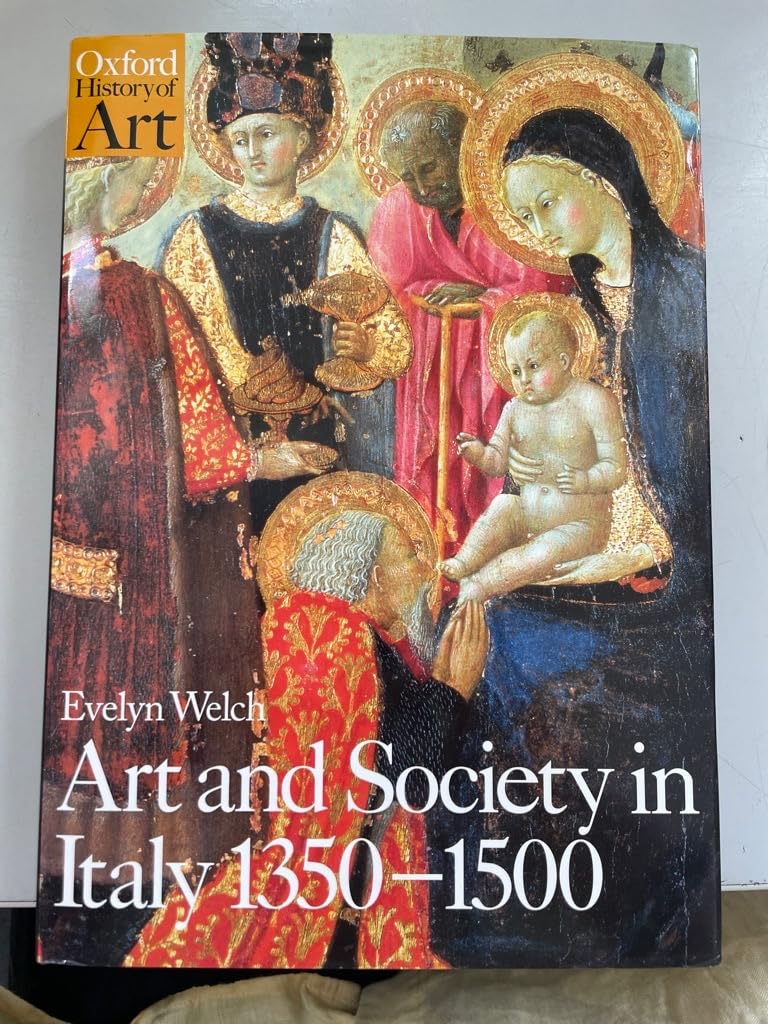
The Renaissance gave birth to individualism, nationalism, secularism, and capitalist entrepreneurism. It could also be argued that the Renaissance gave birth to the modern concept of art and the artist. “Art and Society in Italy, 1350-1500” (1997) by Evelyn Welch has a lot to say about this phenomenon without saying very much at all. Her book provides a comprehensive examination of Italian art during the Renaissance, exploring the interplay between artistic production and societal factors. Welch discusses the techniques, materials, and methodologies employed by artists, including the roles of workshops, guilds, and the distribution of artistic labor. It pays particular attention to religious art and its placement within sacred spaces, analyzing how art functioned within religious contexts. Yet, if you possess an even rudimentary understanding of Renaissance studies there won’t be much in “Art and Society in Italy” that will surprise or inform you.
Artwork developed dramatically during the Renaissance, from the stiff, frontal figures of the Gothic period to the spatial illusion, dramatic gestures, and naturalism of Raphaela and Michelangelo. But, Welch cautions us, much about artwork stayed the same. For instance, much of it served the same purposes (e.g. burial spots, liturgical apparatus) and often employed the same techniques (e.g. true fresco in tempera paint). Indeed, Welch argues “the change in style and a continuity in purpose need equal consideration.”
Welch argues that the dynamism of the northern Italian economy and its cultural achievements are directly related to its central position as the entrepot to continental Europe and its role as a cross-cultural center of exchange. “No single city was self-contained,” she says. It’s essentially the same argument that Matt Ridley makes in “The Rational Optimist: How Prosperity Evolves” (2010).
The author also embraces British art historian Michael Baxandall’s concept of the “period eye.” That is, the idea that how people perceive and interpret art is shaped by the cultural, social, and economic context of their time, including even the smells, sounds, and ephemeral visions that accompanied the viewership of the art. In the case of Renaissance art, Baxandall argued that viewers in that era would have had a different way of seeing and understanding art compared to modern viewers because their visual habits, expectations, and values were influenced by their daily experiences, education, and cultural norms. For example, during the Renaissance, merchants who dealt with fabrics and measurements were likely attuned to precision, proportion, and texture in a way that influenced their appreciation of art. Similarly, religious teachings and rituals of the time deeply informed how people interpreted biblical scenes or symbolic imagery. In short, the “period eye” is about understanding that art isn’t just universal or timeless—it’s deeply tied to the ways people in a specific historical period saw and made sense of the world. In the case of fifteenth century Italy, deeply held religious values and the importance the Catholic Church placed on imagery drove the need for art in its many forms.
During the period under consideration (1350 to 1500), materials and artistry were closely linked. For instance, marble, bronze, and porphyry were the most valuable materials, followed by gold and silver, and were reserved for the most culturally important works of art. The next rung of materials included wood, clay, and glass. In the contracts drafted between patron and artist, the type, quality, and responsibility for acquiring valuable materials often dominate the document, rather than the style, subject-matter or iconography of the piece. When it came to paintings, the frame was often the most expensive part of the commission. Even though painters and sculptors transitioned from craftsman or artisans to artists during this period, art still remained primarily an economic activity.
Art studios operated much like any other craft artisan workshop in Florence. All artists needed to be members of their local guild, an organization unlike modern notions of a trade union. The guilds established rules for the quality of work and its materials, and in defining forms of assessment and arbitration. The guild did not set wages or prices, nor did they negotiate with employers. Painters, such as Leonardo, Botticelli, and Fra Angelico, were members of the Guild of Doctors and Apothecaries (because their paint pigments were sourced from apothecaries), while sculptors, such as Donatello and Michelangelo, were members of the Guild of Stone and Woodworkers. Welch says that these formal organizations did little to curb cutthroat competition, underbidding, denigration of rivals, and the stealing of materials and ideas, although there are many examples of close collaboration between artists as well, such as Donatello and Michelozzo on the tomb of anti-pope John XXIII (Baldassare Cossa) and Botticelli, Perugino, Ghirlandaio, and Cosimo Rosselli on the walls of the Sistine Chapel.
The purposes art served were dependent on when and where it could be seen. Many pieces spent most of their lives in storage or behind curtains and iron grills or in monasteries off-limits to all by a small portion of the population, especially those of the ultra-orthodox Observant wings of the Franciscan or Dominican orders. During this period wealthy families began to colonize specific parts of churches to include dedicated chapels and tombs, which had the effect of democratizing some of the most lavish commissions as they were available to be viewed by the regular church-going public.
The political situation on the Italian peninsula in the fourteenth and fifteenth centuries was, in Welch’s words, “complex and mutable.” The subject of an art piece, particularly a secular theme, usually carried heavy political overtones. Images were more often of a religious nature and usually had three purposes: first, to instruct the ignorant and illiterate; second, to keep alive the mysteries of the faith and the example of the saints; and third, as a means of exciting devotion. Yet, many during the period of the Renaissance treated images “as permeable screens between the powers of heaven and the needs of earth.” (Interestingly, Exodus 20:4 states explicitly that, “Thou shall not make unto thyself any graven image, nor the likeness of anything that is in heaven above nor the earth below.”)
The leading families of fifteenth century Italy often aped the feudal aristocracy of northern Europe, including the wholesale fabrication of family coat of arms. Welch says that these heraldic symbols were like brand logos of major corporations today. They were omnipresent – on coins, seals, pennants, banners, and buildings – and overt symbols of political authority. Each one evoked a different meaning. Cities had their own distinctive symbols: the lion (often associated with the Guelph party), David, and Hercules all represented Florence; the winged lion and the Evangelist Mark represented Venice. “The respect which was required for these images was equivalent to the respect called for national flags today,” Welch says, “an attack on the image of the state was equivalent to attacking the state itself.”
Welch says that in neo-Aristotelian terms, “the prince or wealthy individual had a duty to spend lavishly on appropriately grandiose works of art.” In the words of Neapolitan humanist Giovanni Pontano in 1498: “the magnificent man is made great through great expenditure.” Fabulous works of art thus contributed to the glory and honor of one’s house and city. A concerted effort at improving Rome’s physical appearance was part of the papacy’s late fifteenth century effort to re-establish itself as the dominant spiritual and temporal authority. Rome, a city with few distinguished artists of its own,”eventually became a ritual destination for artists as well as pilgrims,” Welch writes. The Eternal City quickly became the center for the display of international wealth and standing.
The display of wealth was not divorced from the display of charity, Welch says, nor was it seen as contradictory to Christian virtue. Clothing and jewelry was often more expensive and more controversial than traditional forms of art, such as paintings and sculptors. Marriages were arranged and always included a dowry, a substantial portion of which would be spent on furniture for the new couple, including fabulously painted and gilded chests, known as cassoni. Many of these chests were adorned with scenes from classical history painted by some of the leading artists in the city. Tapestries, valued for their functionality (insulation), durability, and portability, were an extremely expensive, and consequently most prized, form of decoration and possession. It is worth pointing out that Renaissance Italians made no distinction between what we would classify as fine art versus decorative art. The vast majority of these possessions were stored rather than displayed, Welch says, and the process of extracting and exhibiting the objects on special occasions or to show to special guests was part of the ritual of display. Many leading families, such as the Medici, had special rooms in their palaces known as studiolo, where precious art objects could be privately stored, examined, and enjoyed.
In summary, Evelyn Welch’s “Art and Society in Italy, 1350–1500” explores how art was deeply embedded in the social, economic, and cultural structures of Renaissance Italy. She emphasizes that art was not created in isolation but was shaped by guilds, workshops, and the demands of wealthy patrons who used it to reflect power, piety, and status. Art served practical functions in religious, political, and domestic settings, making it an integral part of everyday life. Welch also highlights the collaborative nature of art production, where patrons and audiences played active roles in shaping its creation and meaning.
 What's Tim Reading Now?
Leave a comment