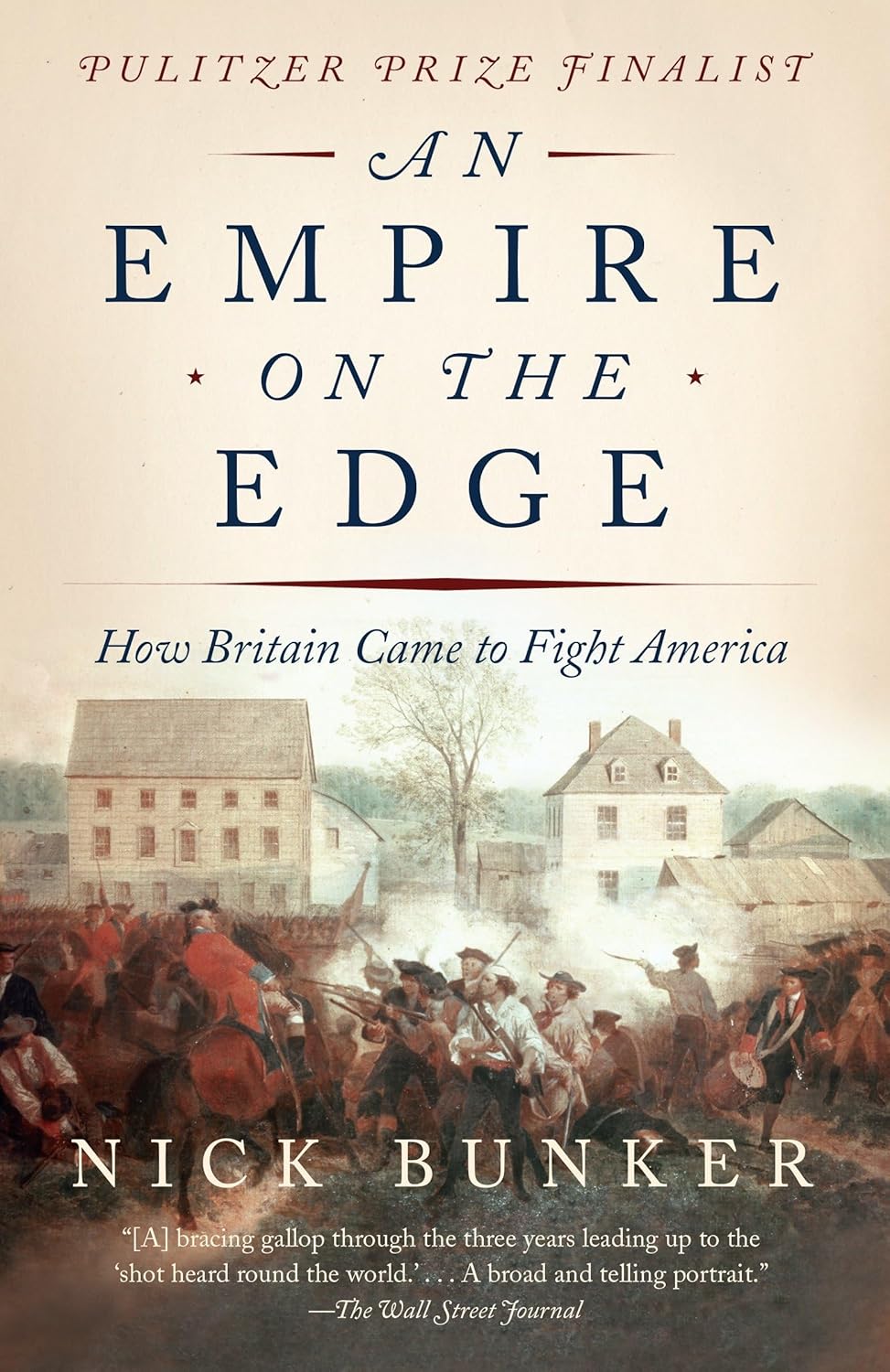
The events leading up to the American Revolution have been endlessly debated. In “An Empire on the Edge: How Britain Came to Fight for America,” journalist-turned-historian Nick Bunker lays out a crisp narrative that argues, it seems to me, that the conflict between mother country and colonies was more or less unavoidable by 1775.
The Boston Tea Party of 16 December 1773 is the historical pivot upon which Bunker’s narrative of the outbreak of the American Revolution turns. In Part One, The Empire of Speculation, the author provides the backdrop to the tumultuous events that led to the Declaration of Independence.
To begin with, Bunker stresses that the British government struggled mightily in managing what was an ill-defined and ill-led imperial enterprise. “In America the British had only a make-believe empire,” he writes, “a loose mosaic made from tiles without a pattern.” The British knew very little about their kaleidoscopic collection of colonies on the far side of the Atlantic. For instance, according to Bunker, British authorities did not know the population of their thirteen colonies nor where their precise boundaries were. As to the tangible value they provided the empire that was anyone’s guess. To be sure, North America provided robust fisheries in the North Atlantic, a rich supply of raw materials in everything from timber to hemp, served as a captive market for British manufactured goods, and supported the wealthy sugar plantations of the West Indies, but the aggregate value was unclear. What was clear was the inability of the colonies to pay for their own administration. Bunker claims that the annual cost of the North American imperial administration was 400,000 pounds; colonial taxation, meanwhile, collected at best 50,000 pounds. Why not then just do away with all taxes? Because, Bunker claims, the British government needed every shilling it could collect and wanted to demonstrate that it possessed the right to tax and legislate the colonies as it saw fit.
The year 1772 was one of crisis in Great Britain. There had been a serious run on banks following the insolvency of a notoriously speculative financial institution in London. A drought had led to widespread crop failures and spiraling food prices. War clouds appeared to be gathering over Europe as France threatened to intervene in a domestic crisis in Sweden, a staunch British ally. And the venerable East India Company teetered on the brink of bankruptcy because of mismanagement of its position in Bengal, India and over supply of tea. Indeed, by the fall of 1772, the price of tea and the share price of the East India Company were on the verge of collapse. With nearly 10% of the British government’s entire income coming from taxes levied on Chinese tea, the situation was dire. Thus, when news reached London that a Royal Navy schooner called the Gaspee, which was tasked with apprehending smugglers along the coast of Rhode Island, had been attacked and burned by rioters, it was not the most pressing issue on the plate of British prime minister Lord North.
In Part Two, The Sending of the Tea, Bunker describes the events of 1773 that led to the Boston Tea Party and, by extension, the American Revolution. The East India Company was on the brink of bankruptcy and saddled with nearly 17 million pounds of tea, only 7 million of which it could hope to sell in the British domestic market. Lord North and his ministers settled on a solution that appeared to settle several nettlesome issues all at once. The Tea Act of May 1773 allowed the East India Company to sell tea directly to the colonies without first passing through middlemen in London. This move would allow the company to undercut the price of Dutch smugglers, who provided the colonies with as much as 80% of its tea, and raise as much as one million pounds in desperately needed cash to stave off bankruptcy. However, the tea would still carry the threepenny per pound tax authorized under the Townshend Act, which would be used to the pay the salaries of the crown officials serving in the colonies and confirm Parliament’s right and ability to tax the colonies.
A key theme in Bunker’s narrative is the absence of any unifying structure and purpose to the British Empire. “The British Empire in America had no plan,” he writes, “and it had no center of command. It had no guiding vision, and it had no high ideals.” It served only one crude purpose and that was the economic betterment of Great Britain, however hazily defined that might be practice. Bunker maintains that Lord North and the Crown never really took the colonists’ political arguments seriously. To the British Cabinet, he says, “American demands for liberty seemed to be nothing more than a fraud, a masquerade behind which the colonists were intent on tax evasion.”
The tea set sail for the colonies in the early autumn of 1773 destined for the major ports of entry: New York, Philadelphia, Charleston and Boston. Colonial resistance was resolute and widespread. In each port colonial merchant consignees were assigned to receive the shipment. In New York and Philadelphia patriot mobs intimidated the consignees into refusing the shipments. In Massachusetts, colonial Governor Thomas Hutchinson, whose son was one of the consignees, refused to back down. The Boston Tea Party, when it came on 16 December 1773, was a surprise to no one. Boston patriots had held public meetings for the previous month openly vowing that the tea would never be offloaded. “Far from being just a protest against an irksome tax,” Bunker writes, “the Tea Party meant rejection of British rule in its entirety.”
Part Three, Down the Slope, explores the political and economic aftermath of the Tea Party and the events that led to the opening shots fired at Lexington and Concord in April 1775. After years of collective disinterest, the crisis in America suddenly took center stage in London. The year 1774 was dominated by headlines about the Tea Party and other acts of colonial disobedience. The flames of discord were fanned by the likes of solicitor general Alexander Wedderburn, who gave a very public dressing down to Benjamin Franklin before the Privy Council in January 1774, and MP Charles Van, who threatened that Boston, like ancient Carthage, must be destroyed. Meanwhile, news from the colonies was sporadic and incomplete; rumor and hearsay filled the void. In Bunker’s estimation, Lord North’s hands were virtually tied. “Unless the British cabinet surrendered and simply ignored the Tea Party – which it could not do – some kind of armed conflict was all but inevitable.”
Lord North, who held a commanding majority in Parliament and the complete trust of King George III throughout the crisis, responded with a litany of bills designed to punish Boston for its intransigence. Known as the Coercive Acts (or Intolerable Acts), the British announced that the port of Boston was to be closed and the centuries old royal Massachusetts provincial charter revoked. General Thomas Gage would be sent to Boston as both commander in chief and governor general, accompanied by 3,000 redcoats to help restore order to the city. To make matters worse, the British cabinet later passed the Quebec Act, which granted emancipation for the Catholic, French-speaking settlers of the province and provided them the right to settle further in the Midwest in lands that had been eyed by American colonists. It only succeeded in uniting the colonies in rage and disbelief against the mother country. In response, the first Continental Congress was called in Philadelphia in September 1774, which ultimately agreed to impose an economic boycott on British trade.
Bunker frequently chides Lord North and, to a lesser extent, colonial secretary Lord Dartmouth, with a complete lack of imagination when tackling the colonial problem. “At the heart of British policy there lay nothing but a void,” he says, “… If the empire were to last, it would have to be reformed entirely, with some grand, overarching scheme for all the colonies, not merely Massachusetts.” But North and Dartmouth had no answers. They preferred to see the issue as a local problem confined to New England rather than a system wide rebellion. Their historical analogy of choice was, according to Bunker, the Jacobite insurgency in the Scottish Highlands of 1745. Lord North and his fellow ministers were prepared to fight a new battle of Culloden, keeping the fighting isolated to a brief, local war in Massachusetts. On November 19, King George III himself wrote, “Blows must decide whether [the colonies] are to be subject to this country or independent.”
Bunker makes clear that the British government completely misread the situation. However, it is equally clear that there were no easy answers. “For as long as the Declaratory Act remained in force,” Bunker says, “with its assertion that the British could make what laws for America they chose, their conflict with the colonies would not be resolved.” Repealing the Declaratory Act, which was passed by the Rockingham Whigs in the wake of the Stamp Act in 1766, would essentially be granting de facto independence to the colonies, a step neither Lord North nor George III were willing to go in 1774. Some sort of commonwealth arrangement with the crown, such as Australia and Canada enjoy today, may have succeeded in preventing war, but nobody in London was prepared to go that far in the late eighteenth century.
“An Empire on the Edge” is a satisfying read, rich in historical detail and written in a fresh, engaging style. Even if you’ve read a lot about the period, as I have, you’ll likely learn much here.
 What's Tim Reading Now?
Leave a comment