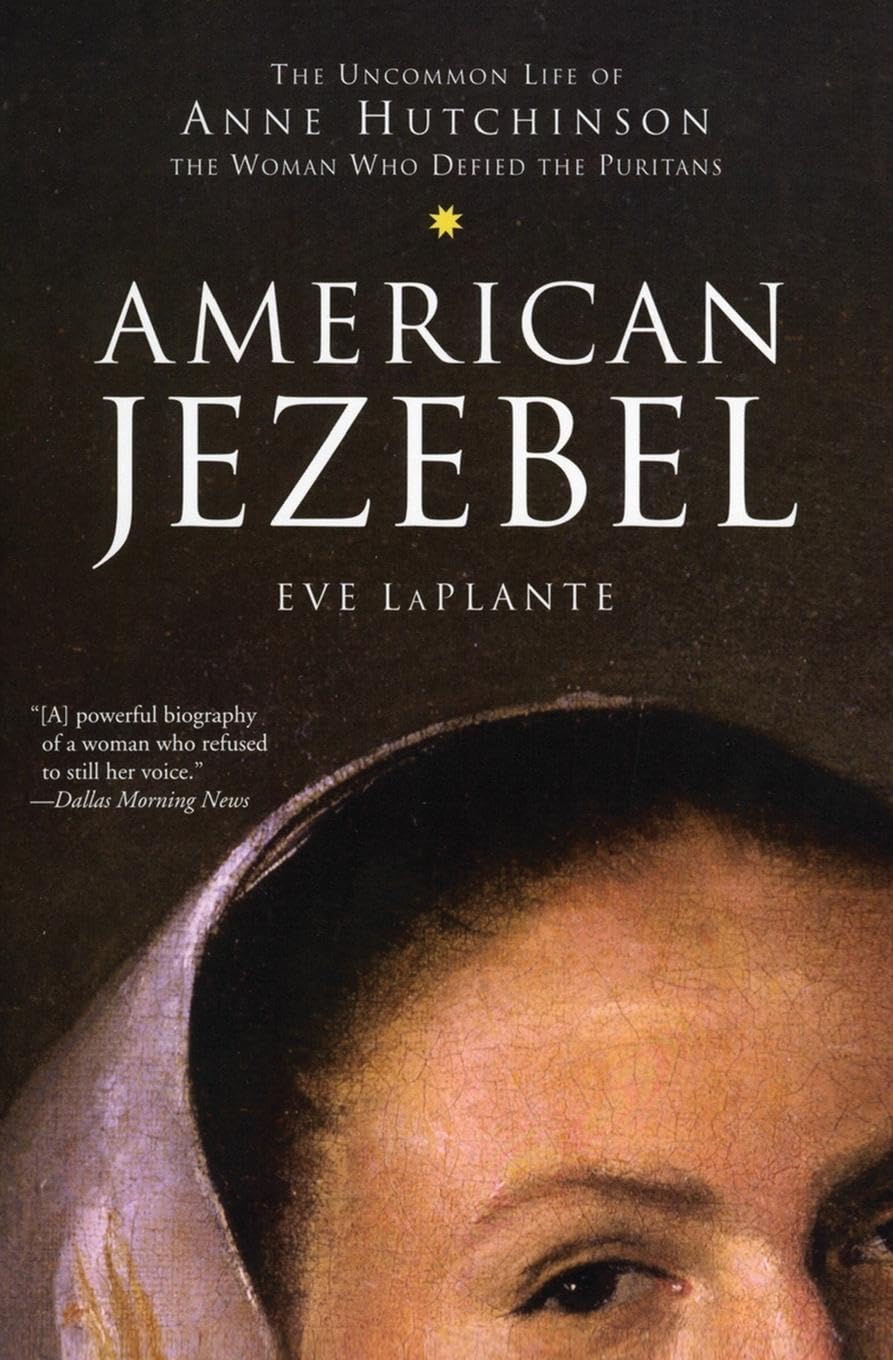
Freedom of speech has arguably never been more important in America than it is right now in 2022. The issue has been shaping us from the moment European colonists arrived on American shores in the early seventeenth century. The legendary case of outspoken Boston Puritan Anne Hutchinson resonates today for a variety of reasons. “American Jezebel” by Eve LaPlante is a gem of a book. It is well written, creatively structured, and exhaustively researched. Overall, it is a much better book than I was expecting it to be when I picked it up for a dollar at a library book sale.
Anne Hutchinson was born in 1591 in Alford, England to the Cambridge-educated Puritan minister Francis Marbury. From a young age, LaPlante writes, Hutchinson displayed “a willingness to question and even to show contempt for authority, a confidence in the rightness of one’s own views, a deep faith in God, and a desire to share that faith through teaching.” She would eventually carry those qualities to the New World and they would quickly get her and her large family banished from Massachusetts.
In 1612, she married Will Hutchinson, a wealthy merchant, and settled in her hometown of Alford. The young couple and their growing family would eventually travel dozens of miles every Sunday to the neighboring city of Boston to hear the Puritan minister John Cotton preach. In the early 1630s, Cotton ran afoul of the leadership of the Church of England and fled to the New World. Will and Anne Hutchinson and their eleven children followed him to Boston in 1634.
When the Hutchinson family arrived in the Massachusetts Bay Colony, the total population was just five thousand settlers. The relatively well-educated and wealthy Hutchinson family were welcomed with open arms. They built an impressive home in Boston across the street from the colonial governor, John Winthrop. Shortly after arriving, Anne Hutchison began welcoming local women to her home on Thursday afternoons to review Scripture and discuss the subject of that week’s sermon. Things quickly went sideways. It had been common for Puritan women to organize these Thursday Bible Studies, but Anne Hutchinson soon took things to a whole different level.
Three things combined to make Anne Hutchinson’s private discussion groups dangerous to the colonial leadership. First, she adopted and amplified John Cotton’s teaching that humans are completely unable to effect their own salvation. “Under Cotton,” LaPlante writes, “the Boston congregation had split doctrinally from the rest of the churches.” Hutchinson’s Thursday meetings further fomented that split. Cotton and Hutchison’s collective doctrines are now termed Antinomianism, which literally means “against or opposed to law.” In theology, antinomianism means that the moral law is not binding upon Christians, who are under the law of grace. Hutchison, taking her cue from Cotton, argued that, “Neither sanctification (the outward appearance of grace) nor justification (actually being saved) can come to one who was not elect from the beginning of time.” Salvation is a completely inner experience, dependent on one’s relationship with the Holy Spirit. Moreover, “any striving after signs of grace was a sure sign that grace was not present.” Basically, you were born saved or damned and there was little you could do about it. According to Hutchinson, the other ministers of Massachusetts, John Winthrop included, were preaching a “covenant of works,” the belief that one could earn your way into heaven based of certain earthly good behavior, which to true Puritan’s smacked of Catholicism and the Anti-Christ. To be sure, these were fighting words.
Second, Hutchinson’s meetings quickly became wildly popular, drawing dozens of enthusiastic attendees, including the women’s husbands. According to LaPlante, after just a couple of years in Boston, “Anne Hutchison possessed the strongest constituency of any leader in the colony.” It was one thing to question the religious teachings of the leading ministers of the colony; it was another to do so before a large and growing sub segment of the colonial population.
Finally, Hutchinson’s gender made her a conspicuous and unusual threat. Women simply weren’t leaders and certainly didn’t challenge men on issues pertaining to the proper interpretation of Scripture. Anne Hutchinson was, to put in mildly, way out of line.
Hutchinson and her family had only been in the colony for a couple of years before John Winthrop had her hauled before the Great and General Court of Massachusetts in November 1637. A council of Puritan ministers – serving collectively as prosecutor, judge and jury – eventually convicted Hutchinson of heresy on account of her purported revelations and sedition because she had questioned and criticized the colonial ministers. Reverend Hugh Peter undoubtedly spoke for many when he accused Hutchinson of essentially not knowing her place: “You have rather been a husband than a wife; and a preacher than a hearer; and a magistrate than a subject.” Indeed, it was the forty-six-year old mother’s unusual “pride and aggressiveness” that so shocked and offended the likes of John Winthrop and his colleagues. Surely her unnatural confidence and poise under examination was a sign of satanic possession. John Cotton, her erstwhile mentor and teacher, turned on Hutchinson in the end: “And so your opinions fret like a gangrene and spread like a leprosy, and infect far and near, and will eat out the very bowels of religion, and hath so infected the churches that God knows when they will be cured.”
Anne Hutchinson was found “not fit for our society” and banished from the colony. With Hutchinson safely out of the Massachusetts Bay Colony, John Winthrop was confident, LaPlante writes, “that Antinomianism was discredited, sanctification and justification were linked, and women were again meek.”
The Hutchinson family and dozens of her supporters relocated to Portsmouth, Rhode Island. Anne had been pregnant (with her sixteenth child) during her trial and miscarried when settling into her new home. The fetus was terribly misshapen. News of the deformed birth reached John Winthrop and Hutchinson’s other opponents back in Boston who all took it as a clear sign of God’s disfavor with her. Anne’s beloved husband and first governor of Rhode Island, Will, died in 1642. She relocated again, this time to the Dutch settlement in present day New York City. She and six of her children were hacked to death in 1643 in a raid by Siwanoy Indians, a tragedy that Winthrop and others again attributed to divine punishment.
Anne Hutchinson’s legacy is significant. For starters, LaPlante writes that she is “the true midwife of Harvard.” In the seventeenth century, college and universities were dedicated primarily to training clergy. Winthrop and his fellow ministers moved to establish Harvard University shortly after Anne Hutchinson’s trial in effort to shore up Puritan religious orthodoxy. Never again, it was hoped, would renegade ministers and their precocious female followers disrupt the community. More directly, and perhaps more amazingly, Anne Hutchinson’s legacy in America includes no less than three US presidents among her direct descendants: Franklin Delano Roosevelt, George Herbert Walker Bush, and George W. Bush.
 What's Tim Reading Now?
Leave a comment