Behavioral economics has been all the rage among business types for well over a decade now. I was first introduced to the field in 2012 when my employer at the time, consumer software maker Intuit, hired behavioral economics pioneer Dan Ariely to consult with the company. As part of the process the company had us all read Ariely’s bestselling book “Predictably Irrational” and I was immediately captivated with his work. The one think that bothered me, however, was that much of Ariely’s surprising insights were derived from simple experiments that he ran usually on campus where he was teaching. The experiments would often involve 20-year-old undergraduates making a decision based on a nominal reward of one dollar. I couldn’t help but wonder: do the results of these experiments apply to the “real world”?
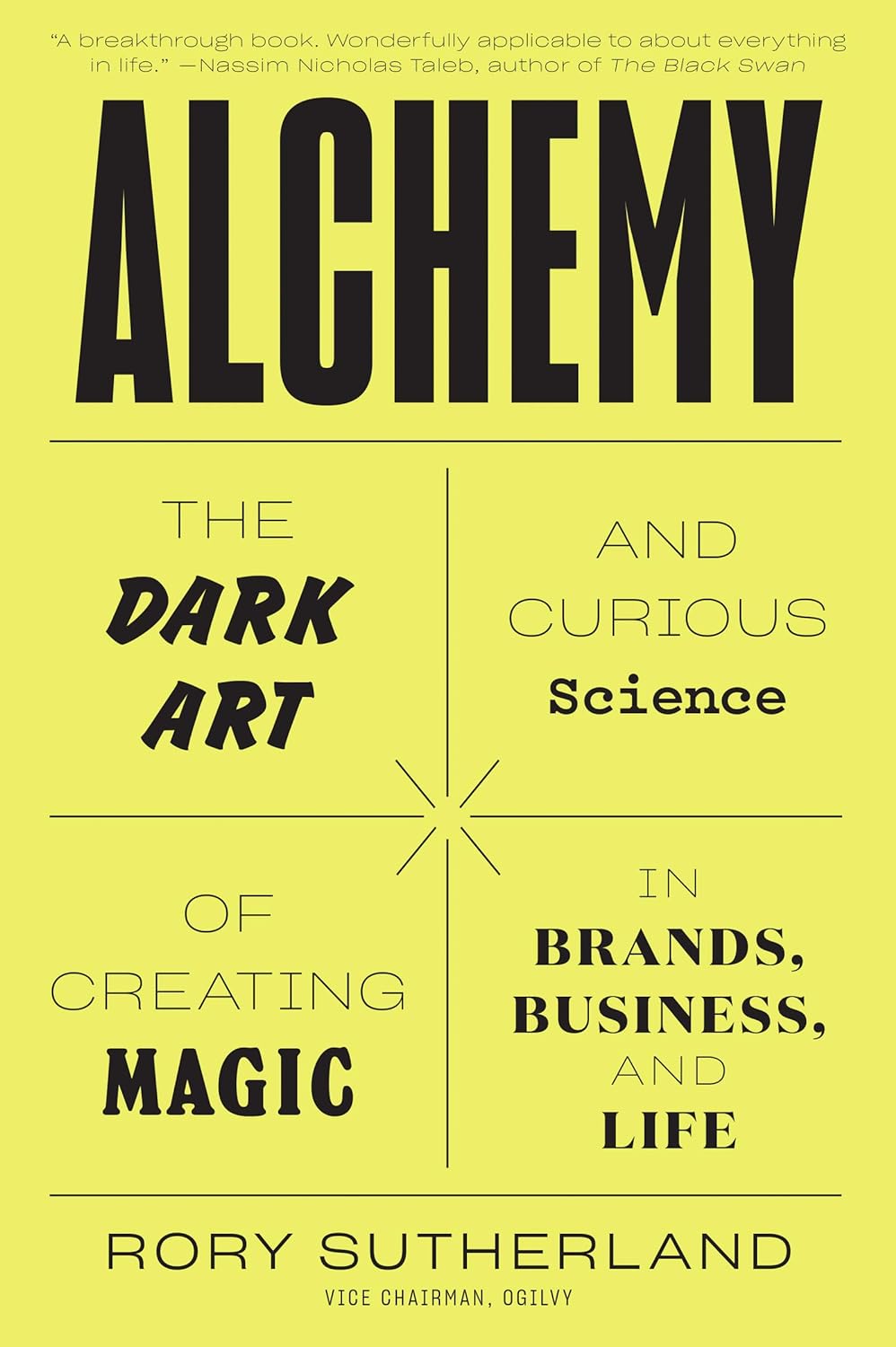
I discovered “Alchemy: The Dark Art and Curious Science of Creating Magic in Brands, Business, and Life” by Rory Sutherland because my son had been assigned to read it in his undergraduate economics class. What immediately convinced me to read the book was that its author was vice chairman of the world renowned advertising agency Ogilvy. I was hoping it would have all the fascinating and head-scratching insights from Ariely’s work, only based on actual multi-million dollar marketing campaigns and brand building exercises. Alas, that is not really what “Alchemy” is all about. Rather, it is a rather scattershot delivery of almost random anecdotes, some more interesting than others, with virtually no research or academic citation whatsoever. Most disappointingly, “Alchemy” is based hardly at all on Sutherland’s long and successful career in the advertising world.
Here are a couple of examples to make my point (note that none of them come from the author’s experience at Ogilvy). In one case, Sutherland writes about how one high end theater in London found that offering discounted seats to their email distribution list produced lower sales than if they offered no discount at all. How can this be? Sutherland’s theory is that a discounted price signals a lower quality show, which explains the lower conversion rate. OK. That makes sense. But is it true? Did the theater actually interview the customers to determine the motivation for their seemingly irrational behavior? Maybe. Sutherland never says. He just postulates the answer and leaves it that.
In another example, Sutherland writes about a coffee shop down the road from his home in London. First, a coffee shop opens and then goes out of business after a year or so. Another proprietor gives it a shot and he too goes out of business after maybe a year. Finally, a third (and highly risk tolerant) businessman gives it a go and evidently seems to succeed. Why? Well, Sutherland noticed that the third proprietor put fancy chairs and tables out front of the shop whereas the first two just had a couple of benches. Sutherland goes on to theorize that the tables and chairs performed all kinds of wonders in signaling to pedestrians and drivers that the shop was not only open for business but also of high quality, resulting in substantially improved business results. He may very well be right. But how do we know that? By all accounts, Sutherland never actually spoke to either of the three owners nor did he speak to any of the customers who may have patronized the establishment in any of its three iterations. In other words, Sutherland’s making a wild assed guess.
One final example is illustrative. In discussing the power of the placebo effect Sutherland makes an off-handed comment that the “door close” button in elevators is completely fake. That is, the author is saying that highly sophisticated publicly traded companies like United Technologies (parent of Otis) are deliberately manufacturing “ghost buttons” in their elevators that don’t work and then going out on million dollar sales calls to major office builders and saying, “here’s our latest line in commercial elevators that includes many fantastic features, including this “door close” button that doesn’t actually work.” Like nearly everything else in “Alchemy” this claim was not substantiated. I found the claim to be highly improbable. I then went online to do my own research. It turns out that the topic is actually open to some debate, which I admit surprised me. (There are statements from the elevator industry that the claim is absolutely false and other claims that the industry allows the “door close” button to quickly wear out and never repair them.) What left me cold, however, was the feeling that I couldn’t trust anything I was reading in “Alchemy.”
Sutherland’s central premise is sound. He argues that business executives tend to view the world through a pair of virtual binoculars where one lens is market research and the other is classic economic theory. Both lens are cracked, he says. He stresses that there are certainly occasions to leverage logical approaches to problem solving, but advises readers to always keep an open mind. “This book is not an attack on the many healthy uses of logic or reason,” he writes, “but it is an attack on a dangerous kind of logical overreach, which demands that every solution should have a convincing rationale before it can even be considered or attempted.”
In the prologue he cites the example of Red Bull. Can you imagine if someone came to you and said that they’re going to take on Coca-Cola by launching a drink that costs more, comes in a smaller can, and tastes terrible? He claims this is an example of profiting from being illogical. The problem with Sutherland’s example, of course, is that Red Bull never actually competed with Coke. Just consider each drink’s tagline: Coke is “Refreshing” whereas “Red Bull gives you wings.” Coke is selling refreshment; Red Bull is selling a buzz. Sutherland never acknowledges this simple and obvious fact, which makes everything about Red Bull’s innovative strategy suddenly rational and logical.
In closing, “Alchemy” reads a bit like a casual airport bar conversation with a cheeky British business colleague who is going a bit out of his way to be provocative. He’s telling random stories and throwing out theories explaining seemingly illogical outcomes, some of which kind of make sense, many of which don’t. It’s all well and good because you’re just passing time before your flight and the conversation is entertaining if nothing else. That’s what “Alchemy” felt like to me anyway. As a business executive with over twenty years experience in Silicon Valley I can’t say that I took anything of lasting value from “Alchemy,” but it was an easy and often enjoyable read.
 What's Tim Reading Now?
Leave a comment