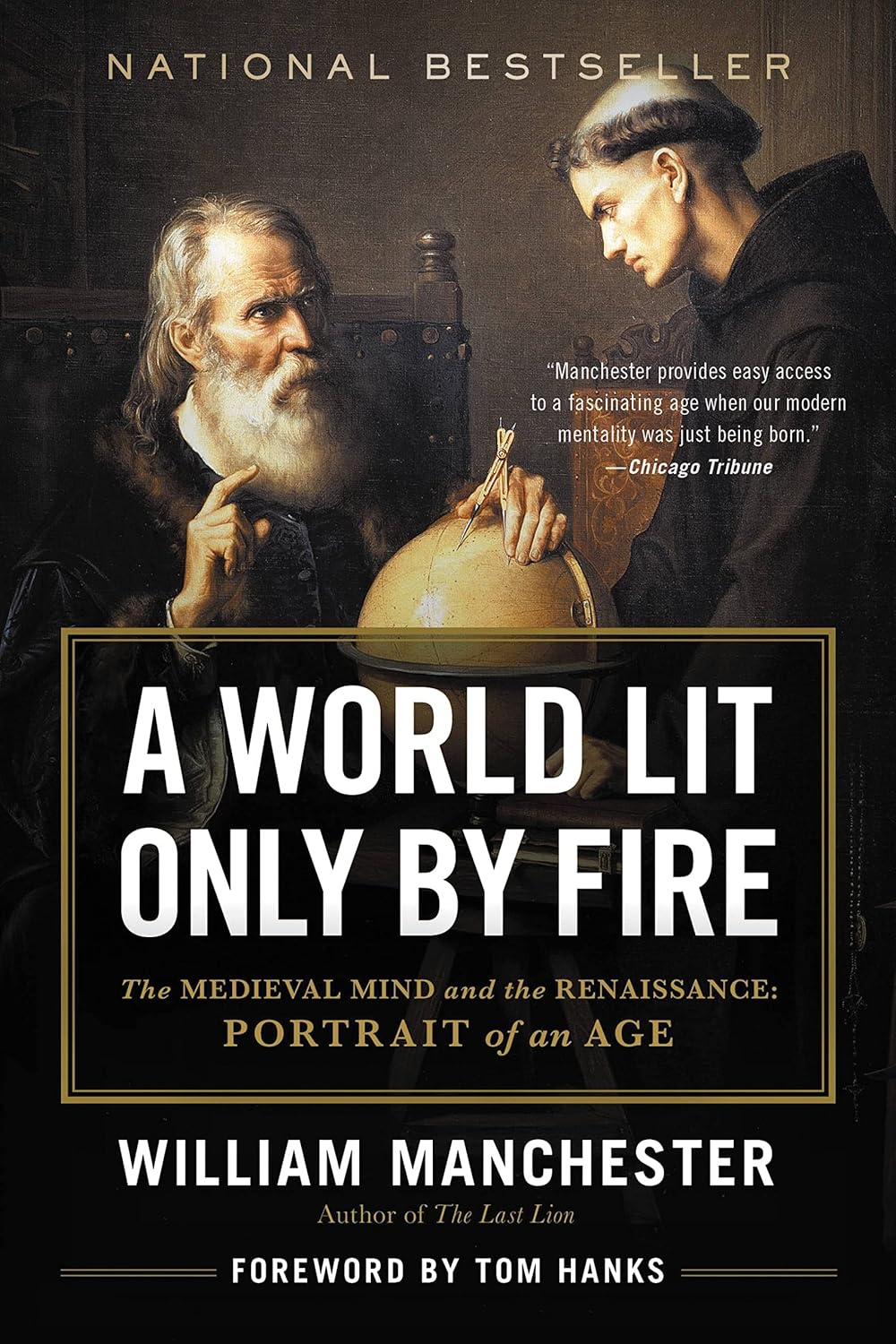
William Manchester (1922-2004) had an unusual career. He was seriously wounded in battle on Okinawa and went on to earn a master’s degree in English from the University of Missouri. From there he went to work for the famed journalist H.L. Mencken at the Baltimore Sun in 1947. In 1951 he became an editor and adjunct professor at Wesleyan University in Middletown, Connecticut and never left. A prodigious writer, Manchester went on to publish eighteen full-length books, covering everything from General Douglas MacArthur and Winston Churchill to a history of the German arms maker Krupp and this book about the Renaissance, “A World Lit Only By Fire: The Medieval Mind and the Renaissance” (1992). Manchester calls his history a “Portrait of an Age,” but I found that he dedicates about half of his 300-page narrative to just two notable and parallel events from around 1520: the apostasy of Martin Luther and the global circumnavigation of Ferdinand Magellan.
If you do a bit of digging, you’ll soon discover that William Manchester has quite a few fans – and perhaps even more detractors. Medieval scholars positively loathe this book. I mean they really, really hate it. Factually incorrect and meretricious (they argue), they would like nothing more than to burn all copies in some sort of modern academic auto-da-fe. Just like the Catholic Church with Erasmus’s “Praise of Folly,” first published in 1511 and outselling all books other than the Bible for decades, Medieval scholars hate “A World Lit Only By Fire” not only for what Manchester wrote, but how he wrote it and the tremendous popular reception it received. Manchester makes the usually dull subject of the Middle Ages sparkle with life – and readers lapped it up. Over the thirty years after it was first published “A World Lit Only By Fire” remains one of the most popular books about the Renaissance on Amazon and has sold perhaps millions of copies. That a lowly adjunct professor with a lowly masters degree in English from lowly Missouri should be a national bestselling author of a popular history of the Renaissance marred by inaccuracies really rubs some folks in the academy the wrong way. Actually, they’re pretty pissed.
What do Manchester’s detractors hate about this book? Mainly that he’s wrong. They hate how he paints the Late Middle Ages (1300-1500) as a world of complete darkness and ignorance. Manchester says peasants walked around naked, never bathed, and had no concept of time. Nearly everyone in Europe lived in isolated, insular, and incestuous villages so small that last names were unnecessary. The average adult was barely five feet tall and only slightly over one hundred pounds. Cannibalism was not unknown. For ten centuries virtually nothing changed, except perhaps for the invention of windmills and waterwheels. “Travel was slow, expensive, uncomfortable – and perilous,” he says. There was no need for travel rewards points in Medieval Europe. The portrait of the age before the Renaissance is, according to Manchester, “a melange of incessant warfare, corruption, lawlessness, obsession with strange myths, and almost impenetrable mindlessness.” No wonder his critics, most of whom chose to make their life’s work studying this dark period, say that this is a gross misrepresentation.
In other areas, they say he is flat out lying, such as his claim that the Pied Piper of legend was, in fact, a real person who was a pederast and serial killer. Manchester even provides details: on precisely June 20, 1484, he says, the Pied Piper of Hamelin kidnapped 130 children from the Saxon town of Hammel and “used them in unspeakable ways.” (Neither Google nor ChatGPT has any idea where Manchester came up with these things.) It must be said that Manchester’s critics may have some legitimate points.
Europe after the fall of the Roman Empire was dominated by the barbarians, Huns and Goths mainly. No sooner had these barbaric tribes conquered Rome than they, in turn, were conquered by the Roman Catholic Church, which was then infiltrated and subverted by the tribal paganism it was supposed to destroy. The end result, Manchester argues, was a sort of Christian/Barbarian amalgamation of customs and holidays. This society, while “diverse and colorful,” was also “anarchic, formless, and appalling unjust.” Once the amalgamation was complete (Manchester never speculates when), “Catholicism had found its greatest strength in total resistance to change.”
This steadfast resistance to change was led by the pope, the Vicar of Christ in theory, but by the early sixteenth century, more often than not, more like a Roman Emperor, which is to say a common thug. In the early 1500s, at the dawn of the Reformation, the papacy was represented by, in Manchester’s words, “the least devout, least scrupulous, least compassionate, and among the least chaste – lechers, almost without exception.” In the infamous words of Pope Leo X (served 1513-1521): “God has given us the papacy. Let us enjoy it.” Even popes with seeming redeeming qualities had no redeeming qualities according to Manchester. For instance, Pope Julius II (served 1503-1513), who supported the work of Michelangelo and laid the first stone for the monumental Basilica of Saint Peter in 1506, was nevertheless, “In both temperament and accomplishments … closer to Genghis Khan than Saint Peter.”
The weapon that ultimately caused the edifice of papal venality to collapse was the printing press, invented by Johann Gutenberg in 1458. “One of the great monuments in the history of western civilization,” according to Manchester, the printing press was, in reality, a weapon of mass destruction capable of spreading subversive ideas, even if half of the continent’s adult male population was illiterate. By the early sixteenth century the Catholic Church formally recognized the threat; the Fifth Lateran Council in 1516 prohibited the printing of any new volume without its consent. The target at that time was the controversial celestial ideas of Copernicus, but it would come in handy the following year when Martin Luther nailed his 96 theses on the church door in Wittenberg. It would be too little, too late. “The days when the Church’s critics could be silenced by intimidating naive peasants, or by putting the torch to defiant apostates, were ending.” Emerging from the ashes of ignorance and intolerance was humanism, which the author claims was “the rarest of cultural phenomena, an intellectual movement which alters the course of both learning and civilization.” It was also the greatest threat the Church had ever faced.
The spark that lit the Reformation was almost comical, at least in Manchester’s telling of the story. Johann Tetzel, a Dominican friar in his 50s, sold indulgences in central Europe. Indulgences were one of the Catholic Church’s primary revenue sources and Tetzel was, according to Manchester, “a sort of Medieval P.T. Barnum” … “a peddler of paradise passports.” A local priest and professor of philosophy named Martin Luther was not amused by Tetzel’s “papal letters.” Manchester says that the heresiarch Luther was the opposite of Tetzel in many ways: “wilful, selfless, intolerant, pious, brilliant, contemptuous of learning and art, but powerful in conviction and driven by a vision of pure, unexploited Christianity.”
Luther declared Tetzel’s “paradise passports” to be frauds. Tetzel, for his part, thought he could easily intimidate the lowly priest and humanist. He was mistaken. At first Luther’s protestations were civil and moderate. He simply argued that “peddling pardons like Colosseum souvenirs trivialized sin by debasing the contrition.” But Luther’s resistance soon became broader and more truculent. In addition to having the audacity to condemn the Vatican’s primary source of funds, he quickly added religious relics, pilgrimages, and the power of the saints to his growing list of outrage. Pope Leo X, “a poet and man of honor” according to Manchester, vacillated. The pontiff and leading patron of the Renaissance waited three full years before responding vigorously to Luther’s challenge. Manchester considers the unnecessarily slow response as criminal negligence; a more decisive and ruthless pope could have and would have crushed Martin Luther, thus strangling Protestantism in the cradle. Most of the early humanists had been ordained priests. Many helped promulgate the Protestant Reformation. The net result, Manchester says, was that “Reason itself had become suspect: tolerance was seen as treachery.”
The religious revolution and the shattering of the medieval world was, according to the author, “the greatest European upheaval since the barbarians’ conquest of Rome.” The same time period also witnessed the Age of Discovery, when a relatively small number of Spanish and Portuguese explorers discovered more of the world than all of mankind had done before them since the beginning of time. Christopher Columbus’s “discovery” of the New World is perhaps best remembered, but Manchester says that the Portuguese exploration/invasion of the Indian Ocean had far larger and more immediate economic, political, and social consequences.
Manchester’s treatment of Magellan’s circumnavigation is rather extensive and overall quite accurate, but there were a few points of his narrative that do not tightly align with other historical accounts, such as Laurence Bergreen’s fantastic book, “Magellan: Over the Edge of the World” (2003). For instance, according to Bergreen (but overlooked by Manchester), Magellan possessed no official direction from the Spanish government to seek converts to Catholicism on his harrowing trip, yet that is ultimately what led to his demise in the Philippines in 1521. Bergreen says that Magellan was unwittingly saved from the ravages of scurvy during the 100 day journey across the Pacific by eating small amounts of apple quince everyday. However, the explorer interpreted his inexplicable good health to divine intervention, a celestial gift he repaid by recruiting as many new Christians as he could find. Manchester’s telling of the story leads the reader to believe that Magellan’s proselytizing was officially sanctioned, which it evidently was not.
The last remaining ship of the expedition, the flagship Victoria, captained by Juan Sebastian del Cano since the death of Magellan on Cebu, limped home in September 1522 after a journey of 39,000 miles. For a period of time, Cano was the hero of the hour, “exalted and aggrandized,” according to Manchester. But eventually the truth came out, thanks to the detailed records of the expedition’s official chronicler, Antonio Pigafetta. Erasmus may have been the wisest man of the age, Manchester says, while Leonardo was the most gifted, but Mangellan was ultimately “the era’s greatest hero.” “He still is. He always will be,” Manchester writes. It’s a good thing, I suppose, that the author didn’t live to see the emergence of cancel culture, because I’m pretty sure that Magellan and all of his fellow sixteenth century explorers are, today, fully and completely canceled.
 What's Tim Reading Now?
Leave a comment