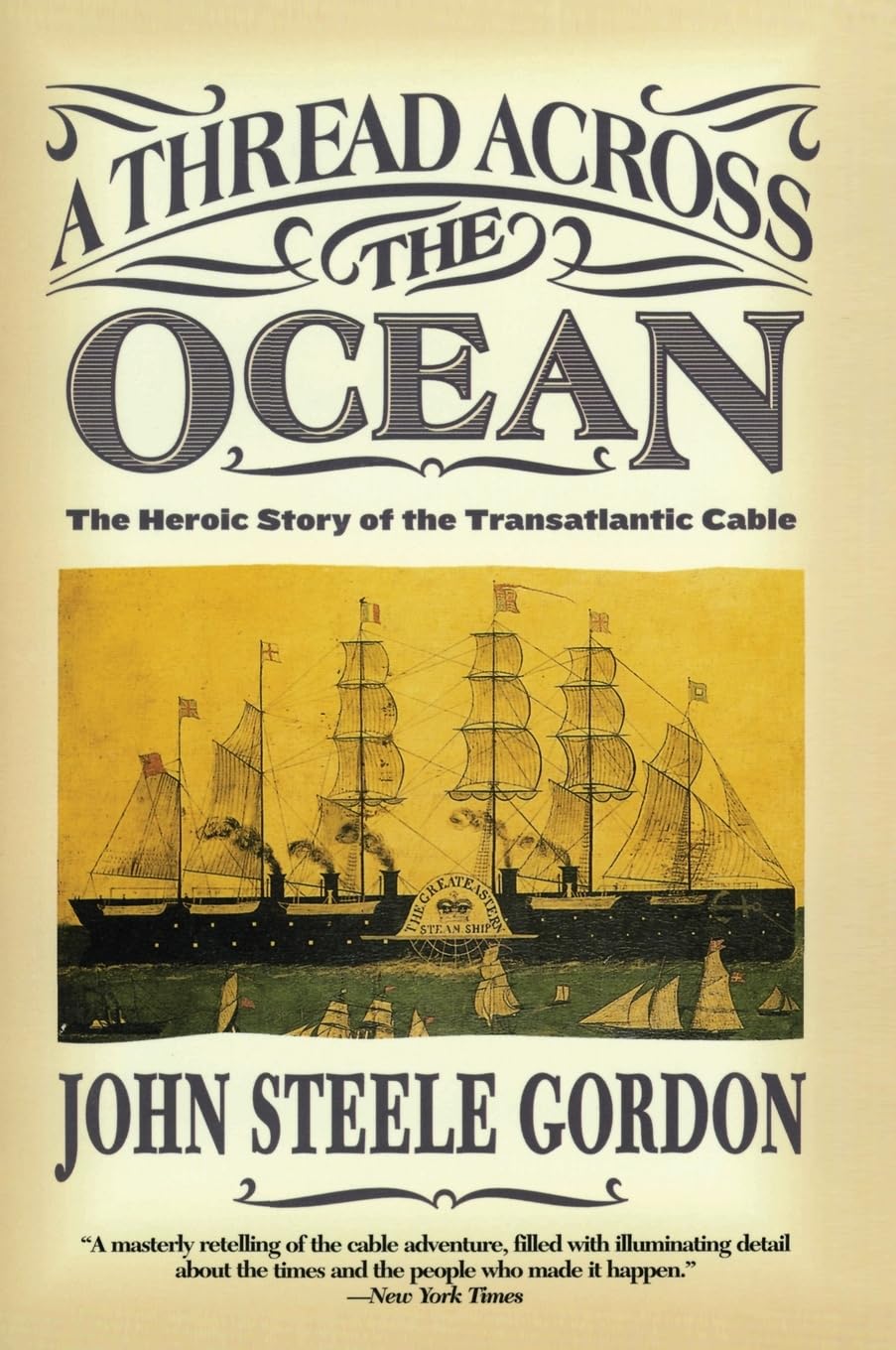
I love well researched, character-driven narratives about great projects. Notable examples include David McCollough on the building of the Panama Canal (1977) and Brooklyn Bridge (1972), David Haward Bain on the transcontinental railroad (1999), Richard Rhodes on the Manhattan Project (1986), Peter Bernstein on the Erie Canal (2006), and Michael Hiltzik on the Hoover Dam (2011). John Steele Gordon tells a similarly amazing (but now largely forgotten) tale in “A Thread Across the Ocean: The Heroic Story of the Transatlantic Cable” (2003).
The hero of this story – Cyrus Field – is probably someone you’ve never heard of. But he was once one of the most famous entrepreneurs in America in a time crowded with famous entrepreneurs. Moreover, he accomplished something even the most celebrated scientists of the day thought was a physical impossibility: near real time communication between London and New York City. And he accomplished this amazing feat almost immediately after the US Civil War and before the transcontinental railroad and Suez Canal were completed.
Samuel F.B. Morse sent the first long distance telegraph from Baltimore to the White House in 1844. His message: “What hath God wrought?” In less than twenty years the White House was connected to California via telegraph. The electric telegraph is one of those amazing inventions, along with the television and automobile, that is attributable to no one man or group of men, yet went on to completely change the world.
When Cyrus Field first grasped onto the idea of laying a transatlantic cable in 1854, the longest underwater cable in the world was 110 miles long and lay at a depth of no more than 1,800 feet. A cable stretching across the Atlantic from Newfoundland to Ireland would have to be over 2,000 miles long and rest at over 15,000 feet deep. Field likely wouldn’t have begun the herculean project if he had known it was going to take him twelve years and five attempts to achieve success.
Cyrus Field was born in 1819 the eighth of ten children in western Massachusetts. He and his siblings were conspicuously successful: one brother was a state senator, another a bridge-builder of national renown, and another was even a US Supreme Court justice. Cyrus made his name in commerce in New York City. Cyrus W. Field and Company was one of the leading paper and printing supply wholesalers in the country. By 1852, Field and Company was doing almost one million dollars in revenue and Cyrus, still in his early 30s, was one of the richest men in New York. He went into semi-retirement and began traveling extensively across South America and Europe.
Field was introduced to the idea of the transatlantic cable by Samuel Morse in 1854. Field knew little of the science or technology behind the telegraph. Morse, for his part, understood little of what would be required to successfully lay a cable over two thousand miles across the Atlantic and three miles beneath the surface. After initial deep sea soundings seemed to suggest that the path across the Atlantic from Newfoundland to Ireland was ideal for submarine cable, Field jumped in with both feet, enlisting his neighbor and legendary New York entrepreneur Peter Cooper in the enterprise. In March 1854 the group established the New York, Newfoundland, and London Telegraph company, absorbing the assets and debts of a bankrupt Canadian company in Newfoundland. Cooper would be president of the company, while Field focused on raising capital for the company. He would ultimately make fifty crossings of the Atlantic in pursuit of capital for the project.
The executive team that built the transatlantic cable was American – “five of the most successful and savvy businessmen in New York,” according to Gordon – but the capital, supplies, and expertise was almost all British. The British were the only ones capable of manufacturing submarine cable in the 1850s. It relied on a rare rubber-like substance called gutta-percha, which does not deteriorate when submerged in water for long periods. Nevertheless, according to Gordon, the biggest mistake Field would make was rushing the construction and installation of the transatlantic cable. Laying the cable would bedevil the team for over a decade. With each attempt they made incremental improvements to the cable, its insulation, and the method of laying the cable from the rear of military ships, most of them jerry-rigged for the purpose.
The New York, Newfoundland, and London Telegraph Company exhausted nearly all of its $1.5 million in capital just in laying cable from New York to Newfoundland, which was actually one third of the way to Ireland. To raise additional funds in Britain, Field formed the Atlantic Telegraph Company in 1856. He estimated that the cost of laying cable to be $350,000. Field issued 350 shares at $1,000 each. Field himself took 88 shares – a 25% stake in the company and almost twice the investment of all other American shareholders combined. The US and British governments offered support in surveying, ships, and eventual annual payments for priority access to the line to the tune of $140,000 a year. (The Senate and House bills providing support to the telegraph barely passed.)
Electricity flows through a copper wire at less than 10 percent the speed of light. A copper telegraph wire laid in seawater can be further dramatically degraded. William Thomson, the future Lord Kelvin, was one of the brightest minds of his generation (Gordon says he was “half Einstein, half Edison”) and served as a consultant on the transatlantic cable for many years. He deduced that a cable laid in seawater was affected by the law of squares: the retardation of the telegraph signal was inversely proportional to the square of the cable’s length (e.g. a signal passes through a hundred mile long cable only one percent as fast as through the same cable that is ten miles long). The implications for the transatlantic cable were profound. All 2,500 nautical miles of the cable was ready in 1857 at a cost of $225,000. The plan was to use converted warships to lay two cables from Newfoundland and Ireland, and then splice them together in the middle of the ocean. Incredibly, the team undertook this tremendous feat with hardly any experimentation of the cables or testing the paying-out machinery, training of the crew, or rehearsal of intricate ship maneuvers at sea. Consequently, hundreds of miles of cable were lost on several occasions when the cable snapped under its own weight.
The transatlantic cable was completed and briefly operational in August 1858. It worked for only three weeks. The first transatlantic telegraph was a 99 word message from Queen Victoria to President Buchanon. Unmentioned at the time was that the short message had taken over sixteen hours to transmit, averaging over ten minutes per word. Gordon writes that “public jubilation turned to scorn.” Gordon is quick to point out that the issue was the state of undersea telegraph technology around 1860. Up to that point, he says, over 10,000 miles of undersea cable had been installed but only about 3,000 miles of it was still operational.
Electrical engineering was in its infancy. Critical units of measurement – such as watt, volt, and ampere – were only just being defined. Thus, advances in submarine telegraphy and electrical engineering more generally exploded in the years immediately following the Civil War. The Atlantic Telegraph Company would exploit these advances by rigorously testing the new cables for both electrical conductivity and the integrity of his seawater insulation. The team also had a new ship to lay the cable, the gargantuan, 693-foot-long “Great Eastern.” “Perhaps no ship in human history was so nearly unique as the ‘Great Eastern’,” Gordon writes, “almost every aspect of her was an innovation or a record.” The brainchild of Isambard Brunel, one of greatest entrepreneurial engineers of the nineteenth century, the “Great Eastern” was five times larger than any ship ever built when she was completed in 1858. She remained the largest ship on the world’s ocean until the ill-fated Lusitania was launched in 1907.
Field liquidated his highly successful paper company after the Civil War and put all of his eggs in the Atlantic Telegraph basket. He was soon teetering on the edge of bankruptcy. Field had to hit the road once again to raise capital for yet another attempt at the seemingly cursed Atlantic cable crossing. This time it took six years to raise the money. The equipment and supplies were significantly better. The copper wire was almost three times heavier than the last model. The insulation was twice as thick and the cable twice as heavy. It was estimated that the new cable could hang for ten miles before it would snap under its own weight.
With the exception of Field, the fourth attempt to lay the transatlantic cable was an almost purely British affair. The cable was designed and manufactured completely in Britain. The giant cable laying ship (“Great Eastern”) was British made and manned. Ninety percent of the capital was British, as was nearly all the technical expertise. Even with all of the enhancements, the cable snapped once again, requiring a fifth attempt. Field possessed many admirable qualities, but none was more pronounced than his “indomitable optimism,” according to Gordon. After the fourth failure, Field said, “All who were on that voyage felt a confidence such as they had never felt before.” The Atlantic Telegraph Company raised £600,000 by issuing 120,000 preferred shares and paying the junk bond rate of 12 percent at £5 per share. Field and his teammates were able to create the impression that this was all proven technology now and success was just a matter of time. And they were finally right. The transatlantic cable was completed on July 27, 1866.
Gordon never estimates the total cost to build the transatlantic cable in five attempts over a decade, but based on my own research, it cost about $7.5 million or roughly $150 million in 2024. The transatlantic cable proved to be highly profitable once it became operational. The initial rate was $10 per word with a ten word minimum. Nevertheless, over just two months in 1867 the cable transmitted 2,772 messages. By the 1870s the cable was delivering roughly $500,000 profit a year. But competition came quickly. The “Great Eastern” alone laid five different lines across the Atlantic. By 1900 there were 15 operational lines connecting Europe and North America. Incredibly, the telegraph wire would remain the primary means of communication for nearly a century until the first transatlantic telephone wire was completed in 1956.
Gordon never says what percentage of the two telegraph companies Cyrus Field ultimately owned, nor does he estimate how much money he ultimately made from the venture, although it certainly made him a very wealthy man, at least for a time. Field was virtually wiped out in the stock market crash of 1887. He died deeply in debt in 1892 at the age of 72. Field is not remembered today the way the Big Four or Ferdinand de Lesseps are, but he ought to be.
Gordon concludes “A Thread Across the Ocean” with this encomium: “[Field] laid down the technological foundation of what would become, in little over a century, a global village.”
 What's Tim Reading Now?
Leave a comment