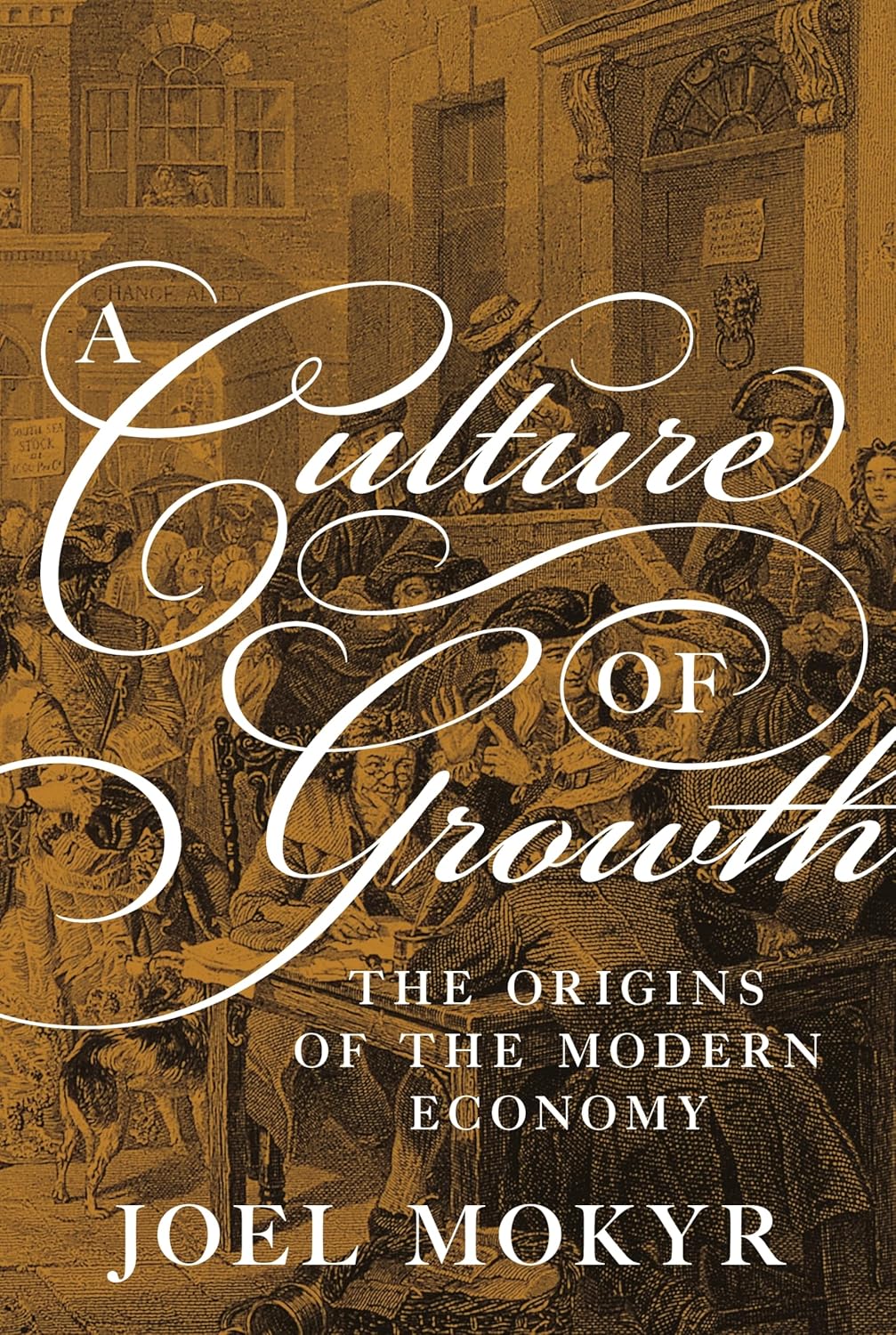
The Economist magazine recently held up “A Culture of Growth: The Origins of the Modern Economy” (2016) by Joel Mokyr as one of the three most outstanding books of all time in explaining the emergence of global capitalism. That’s pretty high praise.
Mokyr’s writing is dense and scholarly, yet it remains remarkably lucid and accessible. In this study of early modern Europe (1500–1700), he focuses on the evolving attitudes and beliefs that shaped distinct cultural outlooks—while acknowledging that “culture” itself is a “vague and mushy word.” He defines it as “a set of beliefs, values, and preferences, capable of affecting behavior, that are socially (not genetically) transmitted and that are shared by some subset of society.” During this period, Mokyr argues, a profound shift occurred in how Europeans viewed and interacted with Nature, particularly in their growing willingness and capacity to harness it for material benefit. “It is the basic argument of this book,” he writes, “that European culture and institutions were shaped in those centuries to become more conducive to the kind of activities that eventually led to the economic sea changes that created the modern economies.”
Perhaps the most significant intellectual breakthrough of this period was the emergence of the very idea of progress. For most of human history, change was glacial, if not imperceptible. In 1200, for example, your life would have looked much like that of your grandparents. Mokyr argues that it wasn’t until the years 1500 to 1700 that material progress became something identifiable, possible, desirable—and achievable through deliberate policy and effort. This era, he writes, gave rise to “a culture of practical improvement, a belief in social progress, and the recognition that useful knowledge was the key to their realization.” These transformative beliefs were championed by what Mokyr calls “cultural entrepreneurs”—visionaries who reshaped the intellectual landscape. Chief among them were Francis Bacon (1561–1626) and Isaac Newton (1642–1727), whose influence helped anchor the idea that human advancement was not only desirable, but attainable.
Mokyr notes that Francis Bacon was not a great scientist himself—his mathematical skills were limited, and he made no lasting scientific discoveries. Yet his contribution was profound: he introduced the transformative idea of useful knowledge and the possibility of sustained technological progress. In essence, Bacon argued that “the true and legitimate goal of the sciences is to endow human life with new discovery and resources.” This vision laid the foundation for what Mokyr calls the “Baconian program”—a model of material progress driven by the interplay between propositional knowledge (understanding how the world works) and prescriptive knowledge (how to apply it), feeding into a self-reinforcing loop of innovation. “Experimental science was not born with Bacon,” Mokyr writes, “but it was transformed beyond recognition.” Bacon’s lasting legacy was the belief that Nature’s secrets could be unlocked through concrete, empirical science grounded in data and experimentation. Knowledge, he insisted, was never final—it should always be corrected, expanded, and improved. This philosophy took institutional form with the founding of the Royal Society in 1660, whose mission was “to increase useful knowledge” and bridge the gap between scientific inquiry and practical invention. Bacon and his followers understood that this transformation would unfold over centuries, not decades. And so it did: his intellectual legacy remained dormant until it ultimately ignited the Industrial Revolution. As Mokyr puts it, “Bacon’s heritage was nothing less than the cultural acceptance of the growth of useful knowledge as a critical ingredient of economic growth.”
saac Newton’s influence was immense, though it largely resonated within a narrow elite of scientists and intellectuals. “His insights,” Mokyr writes, “confirmed the belief in a mechanistic, understandable universe that could and should be manipulated for the material benefit of humankind.” Once nature was made intelligible, it could be harnessed and applied to human needs—just as Bacon had envisioned. Unlike Bacon, however, Newton relied heavily on mathematics as a research tool. “Newton singlehandedly combined the deductive powers of mathematical modeling with Baconian stress on experimental data and observations,” Mokyr notes, “showing that the two were not only capable of coexisting in the same mind but could actually be complementary.” In doing so, Newton helped elevate the status of science and natural philosophy, lending it unprecedented intellectual and cultural prestige. Yet like Bacon, Newton and his followers contributed little directly to technological innovation. (Mokyr suggests that differential calculus may have been Newton’s most practically useful invention.) Newton’s greater legacy lies in his role as a “cultural entrepreneur” who helped foster a new mindset—a culture of progress. As Mokyr puts it, “There were fixed and clear rules by which nature operated, and humankind’s challenge was to discover these knowable rules and take advantage of them.”
Mokyr argues that belief in progress was not sufficient on its own; it had to be accompanied by a willingness to challenge the authority of the past. Francis Bacon, he notes, “launched a full-fledged attack on classical wisdom,” targeting revered figures like Aristotle, Galen, and Ptolemy. For the first time, their teachings were subjected to rigorous scrutiny through observation and experimentation. A steady stream of new discoveries across various fields gradually eroded the prestige of ancient authorities. By the seventeenth century, the once-dominant “slavish veneration of classical learning” was in decline. As Mokyr memorably puts it, “Irreverence is a key to progress.” Doubt, contestability, and skepticism toward received wisdom became defining features of early modern thought—and the driving force behind its burst of creativity.
Mokyr’s central argument is that early modern Europe’s unique combination of political fragmentation and cultural cohesion was the key to its long-term economic success. At the heart of this dynamic was the emergence of the so-called Republic of Letters—a competitive marketplace of ideas and an “invisible college” of internationally connected scholars and intellectuals. This informal but influential network operated on the shared understanding that knowledge was a nonrivalrous good, meant to be distributed and shared freely within the community. Crucially, this intellectual culture thrived within a politically fragmented landscape. That fragmentation, Mokyr argues, brought tangible benefits to forward-thinking scholars. “Hostility among the European powers,” he writes, “led each ruler to protect the gadflies that irritated his or her enemies.” Just as important, rulers had increasingly limited capacity to suppress ideas they found threatening. As Mokyr puts it, “Fragmentation, footlooseness, and the proliferation of printing presses meant that it became increasingly difficult for politically powerful incumbents to suppress subversive and heretic new beliefs generated by cultural entrepreneurs.”
Mokyr claims that the Republic of Letters was the primary institution behind the explosion of useful knowledge across Western Europe, particularly in the early decades of the period known as the Enlightenment (1680-1720), the final stage in the cultural evolution that eventually led to the Industrial Revolution (1760-1840). Careful measurement, precise formulation, well-designed experiments, empirical testing, and mathematics were all encouraged. “Without the continuous emergence of new techniques based on a better understanding of natural processes,” Mokyr writes, “growth will inexorably grind to a halt.” Moreover, these activities were for the first time considered virtuous, respectable, and most of all socially and economically profitable. The most outstanding scholars of the day (i.e. Erasmus, Paracelsus, Descartes, Newton) achieved “rock star status” and a level of social prestige never before enjoyed by scientists and intellectuals. In addition to fame and admiration, they benefited from the patronage of wealthy supporters and thus a certain degree of independence from the conservative university system. According to Mokyr, the results could not have been more dramatic: “The Republic of Letters that began to emerge in Europe around the time of the great voyages and reached a crescendo in the age of Enlightenment is the most significant institutional development that explains the technology-led quantum leap in economic performance heralded by the Industrial Revolution.”
It is important to recognize that the key engineers and inventors of the Industrial Revolution were often not highly educated by the standards of their time. Even today, Mokyr notes, formal education is not strongly correlated with rapid economic development. “Universities were usually bodies that guarded tradition and the intellectual status quo,” he writes, describing early modern European universities as “mostly highly conservative organizations.” As a result, major technological breakthroughs rarely emerged from systematic academic research. Instead, they arose from the merging of hands-on, artisanal ingenuity with emerging scientific insights. “When all is said and done,” Mokyr argues, “the technological revolutions that brought the world economic growth and prosperity were not the result of either artisanal ingenuity or scientific method and discovery, but from the confluence of the two.” However, the reach of these transformative ideas was limited. Only a small segment of the population in a handful of countries embraced this cultural evolution and the growth of useful knowledge. The Industrial Revolution, Mokyr contends, was “an elite phenomenon” and a “minority affair,” driven not by the masses but by a few thousand individuals. “Just as the Republic of Letters was an elite phenomenon,” he writes, “the technological thrust of the Industrial Revolution was the result of the actions of a small and select group.”
Finally, Mokyr addresses the longstanding puzzle known as “Needham’s Question”: Why did China, which had been more scientifically advanced than the West in the eighth century, fail to produce an Industrial Revolution, while Western Europe succeeded? The short answer, Mokyr argues, lies in the contrasting institutional and political structures. In China, intellectual activity was tightly controlled and transmitted through the centralized bureaucracy of the imperial court. While China had no shortage of brilliant minds, a rich tradition in science and technology, and even something resembling a Republic of Letters, it lacked the political fragmentation that allowed for pluralism and cultural entrepreneurship in Europe. Across Europe, there were certainly reactionary and repressive regimes, but, as Mokyr notes, “the interstate competitiveness constrained their ability to enforce a specific orthodoxy.” China, by contrast, was governed by a centralized elite of civil servants selected through a highly competitive, state-administered examination system. “For the purposes of continuity and stability,” Mokyr writes, “it functioned well,” but it was also “a prescription for stagnation,” with an unquestionable authority figure at its core. Chinese politics were inherently conservative, and as with bureaucracies everywhere, radical new ideas were seen as threats to order. Moreover, Chinese scholars tended to venerate classical authorities and lacked the deep-seated skepticism that increasingly defined intellectual life in Europe. “While in Europe,” Mokyr observes, “intellectual sacred cows were increasingly being led to the slaughterhouse of evidence,” in China they remained well fed and comfortably sheltered in the barn. As a result, he concludes, “Chinese scholars never came to believe that useful knowledge and its capacity to generate material progress through its applications was one of the raisons d’être of natural philosophy.”
In summary, Mokyr concludes that “nations and their economies grow in large part because they increase their collective knowledge about nature and their environment, and because they are able to direct this knowledge toward productive ends.” However, for innovation to drive sustained economic growth, it must be continuous and self-reinforcing—a condition that, Mokyr argues, was uniquely realized in Western Europe. The Enlightenment was the catalyst for this scientific and technological progress, itself the culmination of a centuries-long intellectual transformation among Europe’s literate elite beginning around 1500. Europe was neither better organized nor inherently more dynamic than other societies, but its core cultural beliefs shifted profoundly. This new culture embraced pluralism, competition, and the open exchange and critical evaluation of knowledge within a vibrant marketplace of ideas—creating fertile ground for lasting innovation and economic expansion.
 What's Tim Reading Now?
Leave a comment