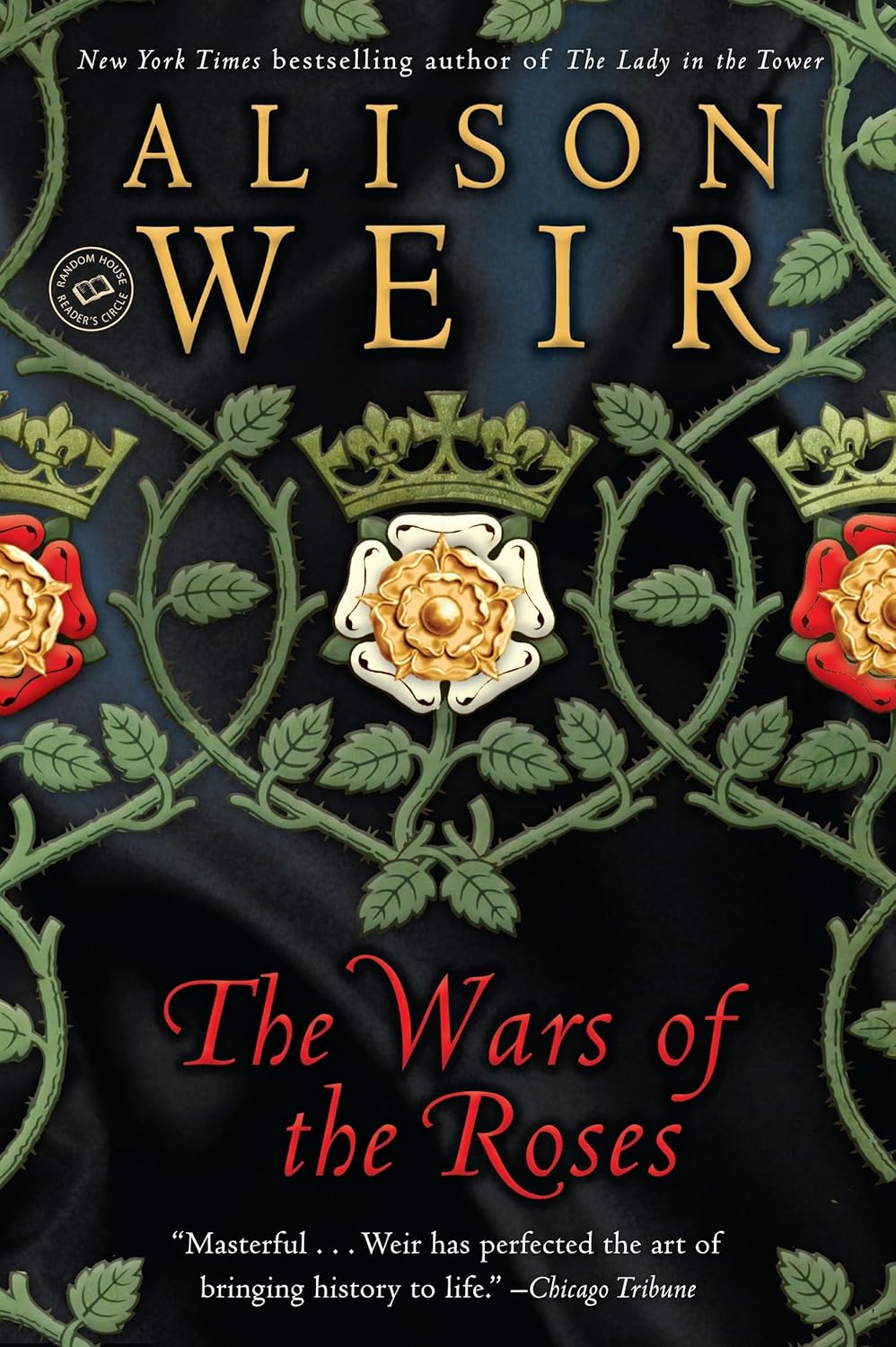
Alison Weir’s “The Wars of the Roses” (1995) offers an absorbing and detailed narrative of the dynastic struggles that engulfed England in the fifteenth century. These conflicts – known more accurately to contemporaries as the “Cousins’ Wars” – fought between the rival houses of Lancaster and York, arose from a crisis of succession that had its roots in the deposition of King Richard II in 1399, whose reign was “one of the most disastrous in English history,” according to Weir. Nevertheless, “His removal from the throne was the catalyst for the dynastic and political instability that characterized the century that followed it.” Indeed, Weir’s story starts with the murder of one king in 1400 and ends with the murder of another in 1471.
When Henry Bolingbroke usurped the throne and became King Henry IV, he set a dangerous precedent, establishing a legacy of contested kingship that would erupt into civil war decades later. The legitimacy of the Lancastrian kings was always in question, particularly in contrast to the claims of their Yorkist rivals, who also descended from Edward III but believed their lineage gave them a stronger right to rule. Weir writes that Henry IV and the Lancastrian kings who followed him were “certainly” usurpers, but the issue remained relatively dormant for sixty years after Henry IV’s accession. The bankruptcy of the Lancastrian kings would prove to be more destabilizing to the monarchy than their usurpation of the crown.
The political instability of fifteenth century England was the result of too many powerful magnates with credible claims to the throne. The violent rivalries took on the shape of political conflict in the late Roman Republic as self-interest, greed, and the prospects of advancement were the determining factors in shifting alliances. The end result was endemic disorder and general lawlessness.
The York claim to the English throne was considered more legitimate by some because it descended from the second and fourth sons of King Edward III, while the Lancastrian line descended from Edward’s third son, John of Gaunt. Crucially, the Yorks traced their claim through both male and female lines, including Lionel of Antwerp (Edward III’s second son) through his daughter, which technically gave them a senior genealogical claim over the Lancasters. However, the Lancastrians held the throne first, starting with Henry IV in 1399, largely due to political power rather than strict hereditary right, and then Henry V, whose reign from 1413 to 1422, including the decisive victory over the French at Agincourt in 1415. Henry V’s reign was among the most successful in English history; his untimely death was “an unmitigated disaster,” according to Weir. His son, the future King Henry VI, was just eight months old when he died. His minority would last sixteen years. Henry VI would never be a great king, nor was he much interested in obtaining military glory. “Therein lay the tragedy of the House of Lancaster,” Weir says. He had many good qualities, she says – “a kindly soul, gentle and generous, honest and well-intentioned” – but they were not the qualities required of a sovereign. “As a man he was virtuous and good,” she writes, “as a king, he was a disaster.”
The wars formally began with the First Battle of St. Albans on May 22, 1455. Richard Plantagenet, Duke of York, supported by his wealthy ally Richard Neville, Earl of Warwick, led an army against the Lancastrian forces under the command of Edmund Beaufort, Duke of Somerset. These men were collectively the richest magnates in England. The Yorkists emerged victorious, Somerset was killed, and King Henry VI was captured. This initial victory established York’s challenge to the Lancastrian throne, though it did not yet remove Henry VI from power. The king, known for his bouts of mental instability and occasional incapacitation, remained a weak figure. His formidable and ambitious queen, Margaret of Anjou – a beautiful teenage French princess and the “complete antithesis of Henry” according to Weir – took firm control of the Lancastrian cause. It took eight years for the mismatched and publicly unpopular marriage to produce an heir, but once it did in 1453 with the birth of Prince Edward, Margaret was determined to secure the succession for their son.
Not since the early fourteenth century, when Queen Isabella, wife of Edward II (known as “the She-Wolf of France”) had a queen of England played such a decisive role in politics. Margaret pushed strongly for peace with her native France and the succession of the territories of Maine and Anjou. Weir says that this aggressive peace policy, the opposite of what the venerated Henry V would have wanted, did not sit well with many in England. By 1447 an eighteen-year-old French girl was essentially ruling England with the assistance of some wealthy land barons, most notably the Dukes of Suffolk and Somerset. Debt skyrocketed and the nation was humiliated by the loss of territory to France. A general perception of misgovernment, corruption, and lawlessness gripped the country. By the 1450s it was being said that “the King was simple and led by covetous counsel, and owed more than he was worth.” The critics weren’t wrong. A popular and quickly suppressed uprising in 1450 known as Cade’s Rebellion briefly occupied London and exposed the fragility of Henry VI’s grip on power. It was a prelude to the coming Wars of the Roses.
As tensions mounted, York allied with the charismatic and fabulously wealthy and popular Duke of Warwick. According to Weir, unlike the more taciturn York, Warwick possessed “the common touch, coupled with lavish, open-handed hospitality and a ready wit.” He would remain for many years the “popular and charismatic face of the Yorkist party.”
At first, York made no effort to press his claim to the throne. Rather, he made a bid for public sympathy by positioning himself as the champion of restoring English pride after the humiliating retreat from France, the removal of the king’s corrupt advisors, and a return to good government. Weir says York was highly successful in drumming up public support, but was unable to dislodge the king’s inner circle nor change their behavior. The precipitating event that led to the Wars of the Roses was the loss of Acquitaine and the English defeat in the Hundred Years War in 1453, the same year the Turks captured Constantinople. “England stood humiliated and disgraced,” Weir says, and England was plunged into a national crisis. At this critical juncture Henry VI suffered a debilitating mental breakdown just as Queen Margaret finally gave birth to a healthy baby boy, thus ensuring a Lancastrian succession. Almost immediately rumors swirled within the Yorkist camp that the infant prince was a changeling or, even worse, a bastard.
Twenty-three-year-old Margaret made a bold and peremptory bid to assume virtual sovereign power in the face of her husband’s incapacitation and her baby son’s impending fourteen year regency. King Henry VI miraculously emerged from his sixteen-month mental incapacitation on Christmas Day 1454 and immediately moved to shunt aside York and Warwick who had, according to Weir, honestly and competently filled the administrative void in his absence. A theme in Weir’s narrative is that York tried on many occasions to negotiate with Henry to avoid bloodshed, but his outreach to the king was always intercepted and suppressed by Margaret and her retinue. When Henry was captured by a Yorkist army after the battle of Northampton in July 1460 they professed their loyalty to him and treated him with dignity and respect. He had, after all, been England’s acknowledged and anointed king for nearly four decades. York wanted to reform the government and be named the heir apparent, not depose Henry. But the Act of Accord named York as heir to the throne, thus disinheriting Henry and Margaret’s son, Prince Edward of Westminster. The conflict between York and Lancaster thus shifted from one of government reform to one of dynastic succession.
York commanded widespread public support, especially in and around London, and in the House of Commons, but consistently lacked aristocratic backing in the House of Lords. The Yorkists won the early battles and York established himself as de facto ruler. On the one hand, Weir says again that York led “with wisdom and moderation,” but on the other hand claims he championed a radical program of reform, including trimming royal finances and the resumption of crown lands. Margaret remained aloof and preoccupied with consolidating leadership over the aristocracy. She eventually introduced conscription, a measure previously only employed by the autocratic kings of France. The Wars of the Roses quickly took on the aspect of North (Lancaster) versus South (York).
One of the most significant events of the war was the Battle of Wakefield on December 30, 1460. York was defeated and killed by Lancastrian forces. His severed head was famously displayed on the gates of the city of York, topped with a paper crown in mockery of his royal ambitions. After Wakefield the conflict became bloodier and more sadistic. However, York’s son, Edward, Earl of March, quickly assumed leadership of the Yorkist cause. Displaying rare military skill and determination, Edward won a decisive victory at the Battle of Towton on March 29, 1461, “one of the most terrible and bloody struggles in English history,” according to Weir; indeed, “probably the most bloody battle ever to take place on English soil.” The overwhelming defeat of the Lancastrians allowed Edward to claim the throne as King Edward IV, effectively establishing Yorkist rule. “Edward IV was not a usurper, as Henry VI had been,” Weir writes, at least not from the Yorkist perspective. But rather “the rightful heir to the crown of the Plantagenets legitimately restored to the throne sixty-two years after it had been usurped by the House of Lancaster.” Moreover, unlike the sickly Henry VI, Edward IV looked every inch a king. Sir Thomas More said of him, “princely to behold, of body mighty, strong and clean made.” He was also “licentious in the extreme.”
The House of York, in the person of Edward IV, was now established on the English throne, but King Henry VI and Queen Margaret were still at large and intransagent – and, more importantly, in possession of a sizable standing army. By the time of the Battle of Townton, the combined armies numbered perhaps 100,000, or roughly two percent of the English population. It is estimated that as many as 40,000 were killed in what became known as “Bloody Meadow,” a casualty rate proportionally higher than the Battle of the Somme in 1916.
Edward IV’s reign was not without its challenges. Unlike Henry, Edward was fiscally responsible, which required that he rein in patronage, revoke some grants and pensions, and scale back continental ambitions in foreign policy. In July 1461, King Charles VII of France died and was succeeded by his son Louis XI, a political intriguer known as the “Universal Spider.” Start and stop relations with Louis and his rival, Philip the Good, Duke of Burgundy, played a pivotal role in the culmination of the Wars of the Roses as both Edward and Margaret sought alliances with the French leaders to bolster their cause.
In 1464, Edward shocked his country when for the first time since 1066 a king married a commoner, Elizabeth Wyndville, one of Queen Margaret’s ladies-in-waiting. Her father, brother, and first husband had all died fighting for the Lancasters. Weir calls the Wyndvilles “a grasping, rapacious clan“ and young Elizabeth “calculating, ambitious, devious, greedy, ruthless, and arrogant.” The ill-advised Wyndville marriage was an act of “appalling political judgment and irresponsibility” on Edward’s part, the author says. In short, Edward threw away the opportunity to make an advantageous foreign alliance in order to marry a completely unsuitable bride who brought with her a disruptive extended family of commoners with no political or financial benefits. “The marriage caused not only scandal but political disruption,” Weir writes. The misguided union completely undermined Warwick’s assiduous attempts to arrange a lasting peace with Louis XI of France.
Edward’s alliance with the powerful and ever-popular Warwick initially secured his throne, but their relationship deteriorated and then ruptured. “Warwick had given up much of his life and much of his wealth to supporting the House of York,” Weir writes, “and his father and brother had died for it,” but that wasn’t enough to keep him tied to Edward’s camp after the Wyndville marriage. The alliance with Burgundy, the political advancement of the Wyndvilles, and blocking strategic marriages advantageous to Warwick all “combined to change Warwick’s loyalty into hatred.” Initially Warwick sought to elevate the King’s younger brother (and Warwick’s son-in-law), the Duke of Clarence, to the throne. In 1470, the heir-less Warwick turned against Edward and restored Henry to the throne in what became known as the Readeption of Henry VI. This Lancastrian resurgence was short-lived. Henry sat on his restored throne “as limp and helpless as a sack of wool,” Weir writes. Meanwhile, “Neither the Lancastrians nor Yorkists trusted [Warwick], and his legendary popularity was fading fast,” mostly the result of his unpopular foreign policy aimed at an enduring rapprochement with France. Edward IV returned from exile; Clarence defected from Warwick. Warwick was killed at the Battle of Barnet on April 14, 1471.
The Lancastrian resistance was decisively crushed three weeks later at the Battle of Tewkesbury, where over a third of their army was killed. Seventeen-year-old Prince Edward of Lancaster was killed in the battle, and soon after the imprisoned Henry VI was murdered in the Tower of London, eliminating the last major Lancastrian claimant. Despite being a weak king who was responsible for decades of misrule and lost England’s valuable possessions in France, Henry saw his reputation soar in the century after his murder as he came to be remembered more as a saintly martyr than an incompetent executive.
With the Lancastrians effectively defeated, Weir says that Edward IV reigned England “firmly and well, unchallenged by any,” until his death in 1483. His sudden passing, however, plunged England into fresh turmoil. His young son and heir, Edward V, was deposed by his uncle, Richard, Duke of Gloucester, who took the throne as Richard III. The disappearance and presumed murder of Edward V and his younger brother in the Tower of London – events that remain one of history’s greatest mysteries – further eroded support for the Yorkist cause. In 1485, Henry Tudor, a distant Lancastrian claimant, challenged Richard III’s rule. At the Battle of Bosworth Field, Richard III was killed, and Henry emerged victorious, establishing the Tudor dynasty and himself as King Henry VII.
Henry VII’s ascension marked the final chapter in the Wars of the Roses, a conflict that signalled the end of the age of chivalry. Royal authority and the gap between the King and the magnates was dramatically narrowed. Thirty-eight peers were killed during the thirty-year conflict (but only thirteen total weeks of actual fighting) and eight noble families were entirely extinguished. The population at large was hardly affected at all. Rather than a true civil war, the Wars of the Roses was more accurately a dispute between noble factions. To solidify his reign and unite the warring factions, he married Elizabeth of York, Edward IV’s daughter, thereby merging the houses of Lancaster and York. This union laid the foundation for the Tudor dynasty, which would rule England for over a century. In the long term, the Tudors centralized royal power, weakened the nobility, and laid the groundwork for the English Renaissance and the modern English state.
Weir’s account of these wars vividly illustrates not only the brutal battles and shifting alliances but also the personal ambitions and betrayals that shaped the course of English history. Through her detailed research and engaging storytelling, she brings to life the figures who fought for power and, in doing so, helped define the future of the English monarchy.
Origins of the Conflict
The roots of the Wars of the Roses trace back to the reign of King Richard II, whose deposition in 1399 by his cousin Henry Bolingbroke—who ascended as King Henry IV—set a precedent for contested succession. Henry IV’s seizure of the crown from Richard II, the legitimate monarch, sowed seeds of dissent that would later manifest in the dynastic conflicts between the descendants of Edward III’s sons: the Lancastrians (from John of Gaunt, Duke of Lancaster) and the Yorkists (from Edmund of Langley, Duke of York).
Key Events and Dates
First Battle of St. Albans (May 22, 1455): Often considered the inception of the Wars of the Roses, this battle saw Richard, Duke of York, and his ally, Richard Neville, Earl of Warwick, defeat the Lancastrian forces led by Edmund Beaufort, Duke of Somerset, who was killed in the skirmish. King Henry VI was captured, marking a significant Yorkist victory.
Battle of Wakefield (December 30, 1460): A pivotal encounter where Richard, Duke of York, was slain by Lancastrian forces. His death propelled his son, Edward, Earl of March, to assume leadership of the Yorkist cause.
Battle of Towton (March 29, 1461): Recognized as one of the largest and bloodiest battles on English soil, Edward led the Yorkists to a decisive victory over the Lancastrians. This triumph enabled Edward to be proclaimed King Edward IV, solidifying Yorkist control over the throne.
Readeption of Henry VI (October 1470): A brief restoration of Henry VI to the throne occurred when the Earl of Warwick, known as the “Kingmaker,” switched allegiance from Edward IV to the Lancastrians. However, this reinstatement was short-lived.
Battle of Barnet (April 14, 1471): Edward IV returned from exile and defeated Warwick’s forces, resulting in Warwick’s death and the collapse of the Lancastrian resurgence.
Battle of Tewkesbury (May 4, 1471): This battle marked the end of significant Lancastrian opposition. Edward IV’s forces decisively defeated the Lancastrians, leading to the death of Prince Edward, son of Henry VI, and the subsequent imprisonment and death of Henry VI, effectively extinguishing the Lancastrian line.
Key Figures
Richard II (1367–1400): The last Plantagenet king whose deposition by Henry Bolingbroke initiated the chain of events leading to the Wars of the Roses.
Henry IV (1367–1413): Formerly Henry Bolingbroke, his usurpation of the throne established the Lancastrian dynasty.
Henry V (1386–1422): Son of Henry IV, renowned for his military successes, notably at the Battle of Agincourt. His early death left the throne to his infant son, Henry VI.
Henry VI (1421–1471): A weak and mentally unstable monarch whose ineffective reign and periods of insanity led to political instability and the rise of rival factions.
Margaret of Anjou (1430–1482): Henry VI’s queen, a formidable and determined leader who championed the Lancastrian cause during her husband’s incapacity.
Richard, Duke of York (1411–1460): A prominent noble with a strong claim to the throne, his opposition to Henry VI’s regime sparked the initial conflicts of the Wars of the Roses.
Edward IV (1442–1483): Son of Richard, Duke of York, his military prowess and leadership secured the throne for the Yorkists after victories at Towton and subsequent battles.
Richard Neville, Earl of Warwick (1428–1471): Dubbed the “Kingmaker” for his role in the deposition and restoration of kings, his shifting allegiances significantly influenced the course of the wars.
Henry VII (1457–1509): Born Henry Tudor, he emerged as the Lancastrian claimant, defeating Richard III at the Battle of Bosworth Field in 1485 and founding the Tudor dynasty through his marriage to Elizabeth of York, thereby uniting the feuding houses.
Conclusion
Alison Weir’s The Wars of the Roses delves deeply into the complex tapestry of ambition, betrayal, and power struggles that characterized this era. By examining the intricate relationships and motivations of the key players, Weir illuminates how this series of conflicts not only determined the fate of the English throne but also ushered in significant political and social transformations, culminating in the rise of the Tudor dynasty and the end of medieval England.
 What's Tim Reading Now?
Leave a comment