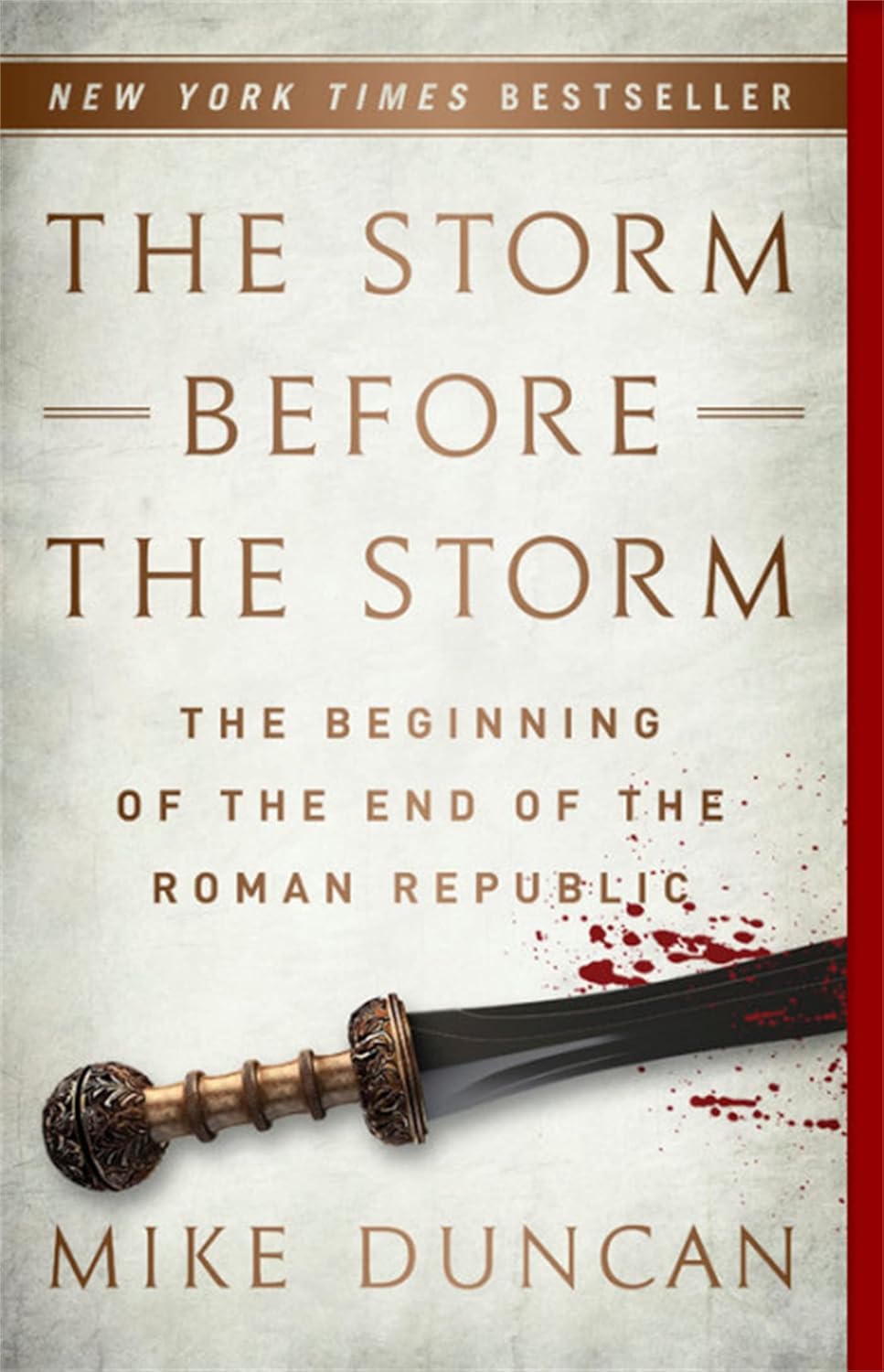
Mike Duncan has an unusual background for a New York Times Bestselling author of ancient Roman history. Possessing nothing more than a political science degree from Western Washington University and a few years experience as a fishmonger, he burst onto the scene in 2007 with his wildly popular podcast “The History of Rome.” I have no doubt that classically trained (and likely envious) scholars of the ancient world roll their eyes at Duncan’s astonishing success, but the simple fact of the matter is that he knows how to tell a good story – and ancient Rome is a great story! In” The Storm Before the Storm: The Beginning of the End of the Roman Republic” (2017) Duncan provides a fast-paced and easily accessible narrative account of the disintegration of long established Roman political norms – the “mos maiorum” or “ways of the ancestors” – that occurred between the destruction of Carthage and Corinth in 146 BC to the dictatorship of Sulla in the aftermath of the Roman Civil War in 82 BC. It is not an entirely novel argument; some noted Roman scholars, such as Princeton’s Harriet Flower, date the fall of the Roman Republic to Sulla’s dictatorship and not Julius Ceasar’s forty years later.
The year 146 BC marked the apex of Roman military dominance in the Mediterranean, as Roman forces destroyed both Carthage and Corinth, eliminating two of the Republic’s most formidable rivals and securing its hegemony in both Africa and Greece. Carthage was conquered by Publius Scipio Aemilianus, grandson of the great Scipio Africanus and scion of the most powerful family in the most powerful city in the world. The assembly waived the qualification requirements for consulship in order to elect Aemilianus in 147 (he was only thirty-two and had held no office above quaestor). In 146, Lucius Mummius, previously awarded a triumph for his victory in Spain, was elected consul, the first novus homo (first in his family to reach the apex of the Roman political system) so elected in forty years. Aemilianus and Mummius could not have been more different socially, but they ended up in the same position, at the same time, and vanquished Roman enemies in the same manner. Moreover, Duncan says that Aemilianus represented “a new spirit of what it meant to be Roman.” He was clean-shaven and classically educated. He raised a personal legion to fight in Spain and had the Assembly waive long held qualification requirements for high office as well as legislate his opponents into oblivion. It was a playbook soon adopted by Marius, Sulla, and Caesar.
“The triumph of the Roman Republic,” Duncan writes, “was also the beginning of the end of the Roman Republic.” The conquest of new provinces enriched the Roman elite, deepened social inequality, and strained the traditional institutions of the Republic. As wealth and slaves poured into Rome, the senatorial aristocracy bought up small farm holdings, the traditional backbone of Roman society and military power, and began working the sprawling latifundia with slave labor. The elite became increasingly corrupt and self-serving, and competition for high office traditionally reserved for descendants of the great families, intensified. “The senatorial aristocracy,” Duncan says, “was sliding into repressive oligarchy.” Meanwhile, poor rural farmers found themselves not only dispossessed and dislocated from their traditional way of life, but also excluded from the benefits of imperial expansion.
Slowly, but steadily, the long held traditions of the Roman Republic began to give way. In 139 a tribune, a role designed to be the “sentinels against the tyranny of the senatorial aristocracy,” passed a law requiring secret ballots for elections, a decisive blow against the tight patronage network controlled by the senatorial oligarchy. Next, in 133, came the rise of Tiberius Gracchus, a tribune who sought to redistribute public land to the poor, an act, which if secured, would dramatically upset the political balance in Roman politics as Tiberius and his extended Claudian family would inherit thousands of new, loyal patrons.
Rome traditionally confiscated about a third of a defeated enemy’s land. Legally, Roman citizens weren’t allowed to own more than about 300 acres of this ager publicus (public land), although in practice many wealthy Roman aristocrats owned sprawling estates. Tiberius Gracchus proposed a novel piece of legislation called the Lex Agraria, which aimed to reclaim public land from Roman that possessed more than 300 acres and redistribute the land in small lots that could not be resold to landless citizens. Though his reforms were rooted in Republican ideals of civic equality, Tiberius violated longstanding norms. First, he presented the Lex Agraria directly to the Assembly without giving the Senate the opportunity to register their opinion. Second, Tiberius and his supporters arranged to depose his fellow tribune, an ally of the Senate named Marcus Octavius, who had been obstinate in registering his veto power against the Lex Agraria. Third, Tiberius immediately ran for re-election to tribune, an act that was not technically illegal but broke all tradition. In short, Tiberius bypassed the Senate, so they had Octavius veto the reading of the land bill, so Tiberius shut down all public business vetoing any other bill before the assembly. Tiberius had Octavius deposed and then the Senate denied the new three-person land commission the necessary funds to operate, so Tiberius redirected a large bequest from King Attalus III of Pergamum and then ran for re-election. His actions alarmed the aristocracy, and he was ultimately killed by a mob of senators and their supporters. This marked the first significant political bloodshed within the city of Rome in centuries and shattered the taboo against using violence to resolve disputes among Roman citizens. “The definitive triumph of naked force was a lesson that no one could unlearn,” Duncan writes.
No nobleman – not even the pontifex maximus, Scipio Nasica, who led the senatorial mob – suffered any legal consequences for the murder of the supposedly inviolate tribune Tiberius and roughly three hundred of his supporters. Physically controlling the Assembly space was now a critical part of winning political battles, which empowered the numerous and raucous but politically impotent urban poor (plebs urbana). They began to flex their muscle in support of politicians who promised them a stable supply of cheap grain.8
A decade later, Gaius Gracchus, Tiberius’s younger, more dynamic and even more ambitious brother, took up the cause of reform. By his early twenties he was already considered the finest orator of his generation. His efforts extended beyond land redistribution; his reforms were revolutionary. Velleius Paterculus wrote, “[Gaius’s reform package] left nothing undisturbed, nothing untouched, nothing unmolested, nothing, in short, as it had been.” He proposed improved and extended road networks, a fixed priced grain supply, more equitable distribution of tax-farming contracts, subsidies for military service, barred senators from serving on the Extortion Court, and promoted colonial expansion. It started the populare movement in Roman politics. The populare reforms united a motley but powerful collection of urban and rural poor with the wealthy Equestrian class, particularly the publicani that managed the empire for a profit, behind Gaius and against the senate, which eventually declared him an enemy of the state. Just as the tribune Octavius did the bidding of the senate against the Gracchi in 133, Marcus Livius Drusus did the same in 122, vetoing all of Gaius’s reform bills. Gaius died in a violent crackdown in 121 BC along with thousands of his supporters, confirming that political violence had become an acceptable tool of Roman politics. Surprisingly, many of Gaius’s reforms, such as the price-controlled grain ration, public works projects, and Equestrian-controlled Extortion Court, stayed on the books.
In the years that followed, the noble family of the Caecilii Metelli dominated Roman politics. The Equestian Marius family were clients. Gaius Marius was elected tribune in 119 largely thanks to the patronage of the Metelli, but then quickly blazed his own independent path. Ambitious politicians continued to test the boundaries of Republican custom. Lucius Appuleius Saturninus, a radical tribune in the late 100s BC that Duncan calls a “bomb thrower,” and Gauis Servilius Glaucia, a radical and disaffected senator, openly aligned themselves with the memory of the Gracchi brothers and used mob violence and populist legislation to push reforms, aligning themselves with the powerful general Gaius Marius in the process. Duncan says that the Gracchi were driven by a genuine desire to reform the Republic and the violence they fomented was entirely accidently; Saturnius, on the other hand, pursued an “overtly sinister version” of the Gracchi agendas and wilfully manipulated the supporting mob to political violence. “Where Gauis Gracchus had been pulled into violence against his will,” Duncan writes, “Saturninus pursued it without compunction.” However, Saturninus’s increasingly autocratic behavior led to his death at the hands of senatorial forces. The Mamilian Commission created in 109 was established to investigate corruption and treason had senatorial incompetence squarely in its sights. Four men of consular rank were ultimately convicted; an unprecedented strike at senatorial authority and a sign of the return of the populare movement of the Gracchi.
Meanwhile, Marius himself rose to unprecedented power through military glory. A novus homo (new man) without noble lineage, Marius replaced the aristocrat and his former patron in Numidia in 107. In the 84 years between 191 and 107 only three confirmed novus homo had been elected consul. Over the next fourteen years, from 107 to 94 five novus homo would be elected to Rome’s highest position. In 105, for the first time in Roman history, both consular positions were held by new men – Gaius Marius and Gaius Flavius Fimbria. Marius won fame by defeating the Numidian king Jugurtha, with the help of the talented but carefree young quaestor serving with him, Lucius Cornelius Sulla. Marius later saved Italy from Germanic invasions in the Cimbrian War (113–101 BC), a massive barbarian tribe that had crushed the Roman legions in 113, 109, and, worst of all, at the epic Battle of Arausio in 105, a battlefield disaster on the order of Cannae against Hannibal over a century before. In 104 Marius was elected to back-to-back consulships for the first time since Quintus Fabius Maximus during the Second Punic War in 215 and 214. Marius’s incredible battlefield exploits were driven in large part by his revolutionary military reforms. He implemented a program of physical conditioning, the removal of cumbersome baggage trains that greatly facility the speed of movement of the Roman legions, instilled a pan-legionary esprit de corps by standardizing the eagle as the symbol of all Roman army units, and, most importantly, he recruited landless citizens looking enrich themselves by imperial military service, shifting the soldiers’ loyalty from the state to their general. This last development would have far-reaching consequences. Marius avenged Arausio in 101 by crushing the army of the Cimbri at the battle of the Raudian Plain in northern Italy. Marius was hailed as “the Third Founder of Rome” after Romulus and Marcus Furius Camillus.
Despite his military success, Marius became entangled in increasingly bitter political feuds with the senatorial elite. Political violence became more common and deliberate. Marius’s marriage of convenience with the radicals Saturninus and Glaucia came to an end. Tensions escalated in the early first century BC, as a series of violent confrontations erupted between reformers and traditionalists. Marius should have quit while he was ahead. In his biography of Marius, Plutarch wrote, “As excellent a general as he was, he was an evil influence in time of peace, a man of unbounded ambition, insatiable, without self-control, and always an element of unrest.”
The tribunate of Marcus Livius Drusus in 91 BC attempted to appease both the Senate and the people with a diversity of reforms (doubling the size of the senate from 300 to 600 members to include leading Equestrians, increasing the grain subsidy to appease the urban plebs, and offering Italians full citizenship), but quickly ended in his unsolved assassination. His death sparked the Social War (91–88 BC), a brutal conflict between Rome and its Italian allies who demanded full Roman citizenship. For decades the prospect of full citizenship had been dangled before the Italians only to be snatched away, usually owing to Roman politics (i.e. whoever got “credit” for getting the Italians citizenship would score a political windfall in compliant clients willing to vote for them in the next election). Duncan says, “The short-sighted obsession with the petty dynamic of electoral politics led to the most unnecessary war in Roman history.”
The author notes that a clear and disturbing pattern had emerged in Republican Rome: roughly every ten years (133, 121, 100, and now 91) a domestic political issue would erupt into ever worsening bloodshed. “Violence had become a routine part of the cycles of Republican politics,” Duncan writes. Quintus Poppaedius Silo, a Samnite noble, general, and confidante of Drusus, represented the aspirations of Rome’s longtime allies for equality and inclusion—aspirations that, once denied, turned into violent revolt. Though the war ultimately ended in compromise, with most Italians granted citizenship, it had exposed the fragility of Rome’s political cohesion and left behind a generation of battle-hardened soldiers. In 89, the consul Lucius Caesar (senior cousin to Julius Caesar) presented the Lex Julia, a bill offering full citizenship to all Italians who had not yet taken up arms against Rome. The new citizens would be distributed across ten new voting tribes that would always vote last in the Assembly, but the Italians would now have protection from the arbitrary abuse of Roman magistrates. Duncan says that the economic impacts of the two-year Social War on the Italian peninsula were even worse than Hannibal’s invasion.
Into this volatile environment stepped Lucius Cornelius Sulla, a patrician general who emerged as a rival to Marius. “As the Social War wound down,” Duncan writes, “Sulla’s star burned hotter than any man’s in Italy.” However, it was rash politicking in Rome that presented Sulla his opportunity to change Roman politics forever. A new radical tribune named Publius Sulpicius Rufus gave the opening. Unlike his predecessors – the Gracchi, Saturninus and Drusus – Sulpicius elevated political street violence to an organized profession. He called his gang the Anti-Senate. Sulpicius also called for distributing the new Italian citizens across the 31 rural tribes, giving them much more political influence and power. His proposal led to street clashes with the urban plebs who were confined to four voting tribes. In 88 BC, Sulla was awarded command of a lucrative war against King Mithridates of Pontus. Sulpicius shocked Roman by presenting a bill calling for Sulla’s command to be withdrawn and given instead to the elderly Marius. In response, Sulla did the unthinkable: he marched his battle-hardened six legions on Rome itself without the senate issuing a Final Decree (senatus consultum ultimum), including even taking one entire legion across the Pomerium, the sacred inner boundary of the city — a blatant violation of Republican law and tradition. His seizure of the city by military force was unprecedented and set a catastrophic precedent. Though Sulla left shortly thereafter to campaign in the East after burying the proposal to distribute the Italian citizen across the 31 rural tribes, his shocking breach of mos maiorum revealed that political power now flowed from legions, not laws.
In Sulla’s absence, Marius and his ally Lucius Cornelius Cinna took control of Rome. “Cinna’s regime represented the triumph of the Italians in the Social War,” Duncan says, and it marked the permanent entrance of the Italians onto the citizen rolls. The Cinnan regime, like Sulla’s, was marked by violent proscriptions and purges of political enemies, including the murder of six former consuls. Cicero, who arrived in Rome during his reign, called Cinna a “monster of cruelty.” Marius, “driven mad with senile vengeance” in his final years, according to the author, died shortly after his seventh consulship in 86 BC, and Cinna continued to dominate Roman politics until he was killed by his own troops in 84 BC. His three-year rule went as suddenly and completely as it came. Cinna was replaced as leader of the Marian forces by the three-time consul Gnaeus Papirius Carbo, but the populare cause was doomed by the loss of Italian support and the battle-hardened legions from Sulla’s campaigns in the east against the Greeks and Mithridates.
When Sulla returned to Italy the following year, his only claim to authority was a proconsular assignment against Mithridates that was five years old. He announced that Italian civitas and suffragium would be preserved, which effectively ended the Social War and undermined the Cinnan regime. Sulla then launched a brutal civil war against the Marian forces, culminating in his second seizure of Rome in 82 BC. Despite his unprecedented and incredibly violent actions, Duncan says Sulla was “fundamentally a conservative republican.” His overarching objective was the re-establishment of aristocratic control via the traditional powers of the senate.
Sulla then appointed himself “dictator legibus faciendis et rei publicae constituendae” — dictator for reforming the Republic. Under this title, he carried out widespread proscriptions, murdering hundreds of political enemies and eventually arbitrarily confiscating the property of the non-aligned rich to reward his supporters. “Professional proscription became a lucrative business to get into,” Duncan says, “men with hard hearts and empty wallets fanned out across the peninsula to get rich killing Sulla’s enemies.” He calls the proscriptions a shameful “reign of terror.” Appian adds, “Nothing was regarded as dishonorable that brought profit.” Approximately three thousand Roman citizens were murdered during Sulla’s proscriptions, including over one hundred senators and one thousand equestrians.
Sulla also enacted a series of constitutional reforms designed to restore the Senate’s authority and curb the power of the tribunes and popular assemblies. He removed the all-purpose, all-powerful veto from the hands of the tribune and decreed that men elected tribune were barred from all other magistracies, turning the position from a dangerous and powerful instrument of demagogues and tyrants into a career dead-end. He also established a rule that a minimum of ten years had to pass before a Roman could hold that same office again, thus ending the dangerous practice of repeat consulships. Moving forward, the senate alone would staff the permanent courts, such as the Extortion Court, and would have exclusive right to determine all provincial assignments. There would be no revolutionary tribunals in Sulla’s republic and the Assembly would have nothing to do with assigning prestigious and lucrative official opportunities in the provinces. “Sulla’s run of reforms was designed to roll the Republic back to its roots as a senatorial aristocracy,” Duncan says, but that senatorial aristocracy was doubled in size by Sulla, from three hundred men to six hundred. Yet while Sulla claimed to defend the Republic, his actions further normalized violence, authoritarianism, and political purges. His dictatorship represented the culmination of decades of constitutional erosion.
In a final, dramatic act, Sulla voluntarily resigned his dictatorship in 79 BC and retired from political life, an action intended to demonstrate that he had no personal ambition beyond restoring the old order. He died the following year, in 78 BC, but the Republic he claimed to have saved was permanently altered. The precedent of generals using military power to dominate politics, the breakdown of political consensus, and the routinization of violence had already done irreparable damage. His new Republic lasted barely a decade after his death. Duncan claims that, “One of the reasons Sulla’s constitutions fared so poorly was that those who supported it did so mildly, and those who hated it did so passionately.”
Income inequality and land redistribution form a leitmotif of the era under review in this book, and it was an unmitigated failure. The Gracchi tried to redistribute land from the ager publicus to the poor and within a generation the rich had bought back almost all of it. Marius tried to solve the problem by retiring his soldiers on plots of lands in Roman colonies in Africa, Sicily, and Gaul. Finally, Sulla attempted to redistribute the large swaths of land confiscated across Italy during the proscriptions, but those plots too were quickly re-acquired by the wealthy owners of the sprawling latifundia. “The solution to the problem of the small farmer in Italy was only solved,” Duncan says, “when they were all dead.”
The storm before the storm had passed, but the Republic was now deeply unstable — and the next generation would carry that instability into full-scale collapse. In the end, Duncan argues, “The biography of Sulla drowned out the constitutions of Sulla.”
Mike Duncan has an unconventional background for a New York Times bestselling author of ancient Roman history. With only a political science degree from Western Washington University and a few years of experience as a fishmonger, he burst onto the scene in 2007 with his wildly popular podcast, The History of Rome. It’s likely that classically trained scholars of the ancient world roll their eyes at Duncan’s astonishing success, but the simple fact remains: he knows how to tell a compelling story—and ancient Rome is one of the greatest stories ever told. In The Storm Before the Storm: The Beginning of the End of the Roman Republic (2017), Duncan delivers a fast-paced and accessible narrative account of the unraveling of Rome’s long-established political norms—the mos maiorum or “ways of the ancestors”—from the destruction of Carthage and Corinth in 146 BC to Sulla’s dictatorship following the Roman Civil War in 82 BC. Some notable scholars, such as Princeton’s Harriet Flower, date the fall of the Roman Republic to Sulla’s dictatorship rather than to Julius Caesar’s, forty years later.
The year 146 BC marked the apex of Rome’s military dominance in the Mediterranean. That year, Roman forces annihilated both Carthage and Corinth, eliminating two of the Republic’s most formidable rivals and cementing its hegemony in Africa and Greece. Carthage fell to Publius Scipio Aemilianus, grandson of the legendary Scipio Africanus and scion of the most powerful family in the most powerful city in the world. To facilitate Aemilianus’s election as consul in 147 BC, the Assembly waived the traditional qualification requirements—he was only thirty-two and had held no office above quaestor. In 146 BC, Lucius Mummius, previously awarded a triumph for his victory in Spain, was elected consul, becoming the first novus homo (the first in his family to reach the apex of Roman politics) to do so in forty years. Though Aemilianus and Mummius were socially worlds apart, both rose to the same position at the same time and crushed Rome’s enemies with equal ruthlessness.
Duncan suggests that Aemilianus represented “a new spirit of what it meant to be Roman.” Clean-shaven and classically educated, he embodied a shift in Roman identity. He personally raised a legion to fight in Spain, persuaded the Assembly to waive longstanding qualification requirements for high office, and leveraged legislative maneuvering to sideline his opponents. His tactics foreshadowed those of Marius, Sulla, and Caesar in the turbulent years to come.
“The triumph of the Roman Republic,” Duncan writes, “was also the beginning of the end of the Roman Republic.” Rome’s expanding empire enriched the elite, deepened social inequality, and strained its traditional institutions. As wealth and slaves flooded into the city, the senatorial aristocracy bought up small farms—the backbone of Roman society and military power—and consolidated them into massive latifundia worked by slave labor. The elite grew increasingly corrupt and self-serving, intensifying competition for high office, which was traditionally reserved for descendants of Rome’s great families. “The senatorial aristocracy,” Duncan observes, “was sliding into repressive oligarchy.” Meanwhile, dispossessed rural farmers, displaced from their ancestral lands, found themselves excluded from the benefits of imperial expansion.
Slowly but surely, the traditions of the Republic began to erode. In 139 BC, a tribune—charged with defending the people against senatorial overreach—passed a law requiring secret ballots in elections, dealing a decisive blow to the patronage networks that had long secured the Senate’s dominance. Four years later, in 133 BC, the rise of Tiberius Gracchus threatened to upend the political order entirely. As tribune, Tiberius sought to redistribute public land to the poor—an act that, if successful, would dramatically alter Rome’s balance of power by creating thousands of new, loyal patrons under his and his influential Claudian family’s protection.
Rome traditionally confiscated about a third of a defeated enemy’s land. By law, Roman citizens were not supposed to own more than 300 acres of this ager publicus (public land), though in practice, wealthy aristocrats controlled vast estates. Tiberius Gracchus proposed the Lex Agraria, which aimed to enforce the 300-acre limit, reclaim excess land, and redistribute it in small, non-transferable lots to landless citizens. Although his reforms were rooted in Republican ideals of civic equality, Tiberius violated deeply entrenched norms. First, he bypassed the Senate by presenting the Lex Agraria directly to the Assembly. When the Senate’s ally, the tribune Marcus Octavius, vetoed the measure, Tiberius orchestrated his removal—an unprecedented act. Finally, he ran for re-election to the tribunate, a move that, while not technically illegal, broke with tradition. The conflict escalated: Tiberius vetoed all other public business in retaliation, the Senate retaliated by starving his land commission of funds, and Tiberius countered by redirecting a large royal bequest from King Attalus III of Pergamum to finance the initiative. His actions alarmed the aristocracy, and he was ultimately killed by a mob of senators and their supporters. This marked the first major political bloodshed within the city of Rome in centuries and shattered the taboo against using violence to settle political disputes. “The definitive triumph of naked force was a lesson that no one could unlearn,” Duncan writes.
No nobleman—not even Scipio Nasica, the pontifex maximus who led the senatorial mob—faced legal consequences for the murder of Tiberius and approximately three hundred of his supporters. Political control of the Assembly space became critical for securing power, empowering Rome’s numerous but politically marginalized urban poor (plebs urbana). They, in turn, began supporting politicians who promised them a stable supply of cheap grain.
A decade later, Tiberius’s younger brother, Gaius Gracchus, emerged as an even more dynamic and ambitious reformer. By his early twenties, he was widely recognized as the finest orator of his generation. His agenda went far beyond land redistribution—his reforms were nothing short of revolutionary. Velleius Paterculus wrote, “[Gaius’s reform package] left nothing undisturbed, nothing untouched, nothing unmolested, nothing, in short, as it had been.” He sought to improve and expand Rome’s road networks, establish a fixed-price grain supply, distribute tax-farming contracts more equitably, subsidize military service, bar senators from serving on the Extortion Court, and promote colonial expansion. His efforts galvanized the populares movement, uniting a powerful coalition of urban and rural poor with the wealthy equestrian class—particularly the publicani, the private contractors who managed Rome’s provincial revenues—against the Senate.
Predictably, the Senate fought back. Just as the tribune Octavius had obstructed Tiberius’s land reforms in 133 BC, Marcus Livius Drusus played the same role in 122 BC, vetoing Gaius’s reform bills. Ultimately, Gaius was declared an enemy of the state and met the same fate as his brother, perishing in a violent crackdown in 121 BC along with thousands of his supporters. His death confirmed that political violence had become an entrenched feature of Roman politics. Ironically, many of Gaius’s reforms—including the price-controlled grain ration, public works projects, and equestrian-controlled Extortion Court—remained in place, cementing the precedent that reform could be achieved only through bloodshed.
In the years that followed, the noble family of the Caecilii Metelli dominated Roman politics. The Equestian Marius family were clients. Gaius Marius was elected tribune in 119 largely thanks to the patronage of the Metelli, but then quickly blazed his own independent path. Ambitious politicians continued to test the boundaries of Republican custom. Lucius Appuleius Saturninus, a radical tribune in the late 100s BC that Duncan calls a “bomb thrower,” and Gaius Servilius Glaucia, a radical and disaffected senator, openly aligned themselves with the memory of the Gracchi brothers and used mob violence and populist legislation to push reforms, aligning themselves with the powerful general Gaius Marius in the process. Duncan says that the Gracchi were driven by a genuine desire to reform the Republic and the violence they fomented was entirely accidental; Saturninus, on the other hand, pursued an “overtly sinister version” of the Gracchi agendas and willfully manipulated the supporting mob to political violence. “Where Gaius Gracchus had been pulled into violence against his will,” Duncan writes, “Saturninus pursued it without compunction.” However, Saturninus’s increasingly autocratic behavior led to his death at the hands of senatorial forces. The Mamilian Commission created in 109 was established to investigate corruption and treason and had senatorial incompetence squarely in its sights. Four men of consular rank were ultimately convicted; an unprecedented strike at senatorial authority and a sign of the return of the populare movement of the Gracchi.
Meanwhile, Marius himself rose to unprecedented power through military glory. A novus homo (new man), Marius replaced the aristocrat and his former patron in Numidia in 107. In the 84 years between 191 and 107 only three confirmed novus homo had been elected consul. Over the next fourteen years, from 107 to 94, five new men would be elected to Rome’s highest position. In 105, for the first time in Roman history, both consular positions were held by new men – Gaius Marius and Gaius Flavius Fimbria. Marius won fame by defeating the Numidian king Jugurtha, with the help of the talented but carefree young quaestor serving with him, Lucius Cornelius Sulla. Marius later saved Italy from Germanic invasions in the Cimbrian War (113–101 BC), a massive barbarian tribe that had crushed the Roman legions in 113, 109, and, worst of all, at the epic Battle of Arausio in 105, a battlefield disaster on the order of Cannae against Hannibal over a century before. In 104, Marius was elected to back-to-back consulships for the first time since Quintus Fabius Maximus did so during the Second Punic War in 215 and 214. Marius’s incredible battlefield exploits were driven in large part by his revolutionary military reforms. He implemented a program of physical conditioning, the removal of cumbersome baggage trains that greatly facilitated the speed of movement of the Roman legions, instilled a pan-legionary esprit de corps by standardizing the eagle as the symbol of all Roman army units, and, most importantly, he recruited landless citizens looking to enrich themselves by imperial military service, shifting the soldiers’ loyalty from the state to their general. This last development would have far-reaching consequences. Marius avenged Arausio in 101 by crushing the army of the Cimbri at the battle of the Raudian Plain in northern Italy. Marius was hailed as “the Third Founder of Rome” after Romulus and Marcus Furius Camillus.
Despite his military success, Marius became entangled in increasingly bitter political feuds with the senatorial elite. Political violence became more common and deliberate. Marius’s marriage of convenience with the radicals Saturninus and Glaucia came to an end. Tensions escalated in the early first century BC, as a series of violent confrontations erupted between reformers and traditionalists. Marius should have quit while he was ahead. In his biography of Marius, Plutarch wrote, “As excellent a general as he was, he was an evil influence in time of peace, a man of unbounded ambition, insatiable, without self-control, and always an element of unrest.”
The tribunate of Marcus Livius Drusus in 91 BC attempted to appease both the Senate and the people with a diversity of reforms (doubling the size of the senate from 300 to 600 members to include leading Equestrians, increasing the grain subsidy to appease the urban plebs, and offering Italians full citizenship), but quickly ended in his unsolved assassination. His death sparked the Social War (91–88 BC), a brutal conflict between Rome and its Italian allies who demanded full Roman citizenship. For decades, the prospect of full citizenship had been dangled before the Italians only to be snatched away, usually owing to Roman politics (i.e. whoever got “credit” for getting the Italians citizenship would score a political windfall in compliant clients willing to vote for them in the next election). Duncan says, “The short-sighted obsession with the petty dynamic of electoral politics led to the most unnecessary war in Roman history.”
The author notes that a clear and disturbing pattern had emerged in Republican Rome: roughly every ten years (133, 121, 100, and now 91), a domestic political issue would erupt into ever-worsening bloodshed. “Violence had become a routine part of the cycles of Republican politics,” Duncan writes.
Income inequality and land redistribution form a leitmotif of the era under review in this book, and it was an unmitigated failure. The Gracchi tried to redistribute land from the ager publicus to the poor and within a generation the rich had bought back almost all of it. Marius tried to solve the problem by retiring his soldiers on plots of land in Roman colonies in Africa, Sicily, and Gaul. Finally, Sulla attempted to redistribute the large swaths of land confiscated across Italy during the proscriptions, but those plots too were quickly re-acquired by the wealthy owners of the sprawling latifundia. “The solution to the problem of the small farmer in Italy was only solved,” Duncan says, “when they were all dead.”
The storm before the storm had passed, but the Republic was now deeply unstable — and the next generation would carry that instability into full-scale collapse. In the end, Duncan argues, “The biography of Sulla drowned out the constitutions of Sulla.”
Key Players
- Tiberius Gracchus (tribune 133 BC)
- Advocated land reforms to redistribute public land (ager publicus) to poor citizens.
- Violated mos maiorum by bypassing the Senate and appealing directly to the Popular Assembly.
- Ran for a second term as tribune—an unprecedented act viewed as dangerously autocratic.
- Gaius Gracchus (tribune 123–122 BC)
- Expanded on his brother’s reforms, including subsidized grain distributions and judicial reforms.
- Further undermined senatorial authority.
- Eventually declared an enemy of the state and killed in a violent crackdown.
- Scipio Aemilianus
- Hero of the Third Punic War and the Sack of Carthage (146 BC).
- Opposed the Gracchan reforms, representing the conservative elite (the Optimates).
- Lucius Appuleius Saturninus (tribune 103–100 BC)
- Radical tribune aligned with Marius.
- Used populist measures, violence, and street gangs to push reforms.
- Eventually killed after turning his mob tactics on fellow elites.
- Marcus Livius Drusus (tribune 91 BC)
- Attempted to reconcile popular and senatorial interests through reforms, including land redistribution and judicial reform.
- Assassinated—his death helped ignite the Social War.
- Gaius Marius
- A military general who reformed the Roman army by recruiting landless citizens (starting in 107 BC).
- This created a new bond between soldiers and generals, rather than soldiers and the state.
- Elected consul seven times, breaking traditional limits on office-holding.
- Lucius Cornelius Sulla
- Roman general and political rival of Marius.
- Marched on Rome twice (88 BC, 83 BC)—a gross violation of sacred Republican tradition.
- Became dictator in 82 BC, initiating proscriptions and rewriting the constitution to empower the Senate.
- Saturninus and Glaucia (late 100s BC)
- Populist politicians who used violence and intimidation to push through reforms.
- Their downfall marked increasing political instability and normalization of political violence.
- Lucius Cornelius Cinna (consul 87–84 BC)
- Ally of Marius, seized power after Sulla left for the East.
- Ruled through violent suppression of opponents, marking a new era of civil strife.
- His reign demonstrated how both sides now used extra-legal violence to secure power.
- Quintus Sertorius
- Former Marian general who resisted Sulla’s regime from Hispania.
- Created an alternative Roman government and gained significant local support.
- His long guerrilla resistance symbolized enduring Republican opposition to dictatorship.
- Lucius Octavius (consul 87 BC)
- Represented the Senate during the Marian-Cinnan power struggle.
- Tried to resist Cinna’s seizure of power but was ultimately defeated.
- His efforts reflect the fading authority of lawful constitutional procedures.
Themes and Takeaways
- The erosion of Republican norms began well before Caesar.
- Political ambition and factionalism increasingly trumped shared civic values.
- The replacement of consensus and compromise with violence and intimidation broke the Republic’s institutional resilience.
- Military loyalty shifted from the state to individual generals, paving the way for civil wars.
Examples of Mos Maiorum Violations
- Tiberius Gracchus bypassing the Senate and removing a fellow tribune to push land reforms.
- Gaius Gracchus using populist tactics and proposing radical economic measures without Senate consent.
- Use of mob violence and street gangs, such as during Saturninus’s political campaigns.
- Marius’ military reforms, undermining the traditional landowning basis of the Roman army.
- Multiple consulships (especially non-consecutive and back-to-back terms)—breaking norms of term limits.
- Sulla’s use of military force to seize political power, violating the sacred boundary of the pomerium (the legal line generals were forbidden to cross with armies).
- Proscriptions – state-sanctioned murder and property confiscation used for political ends under Sulla.
 What's Tim Reading Now?
Leave a comment