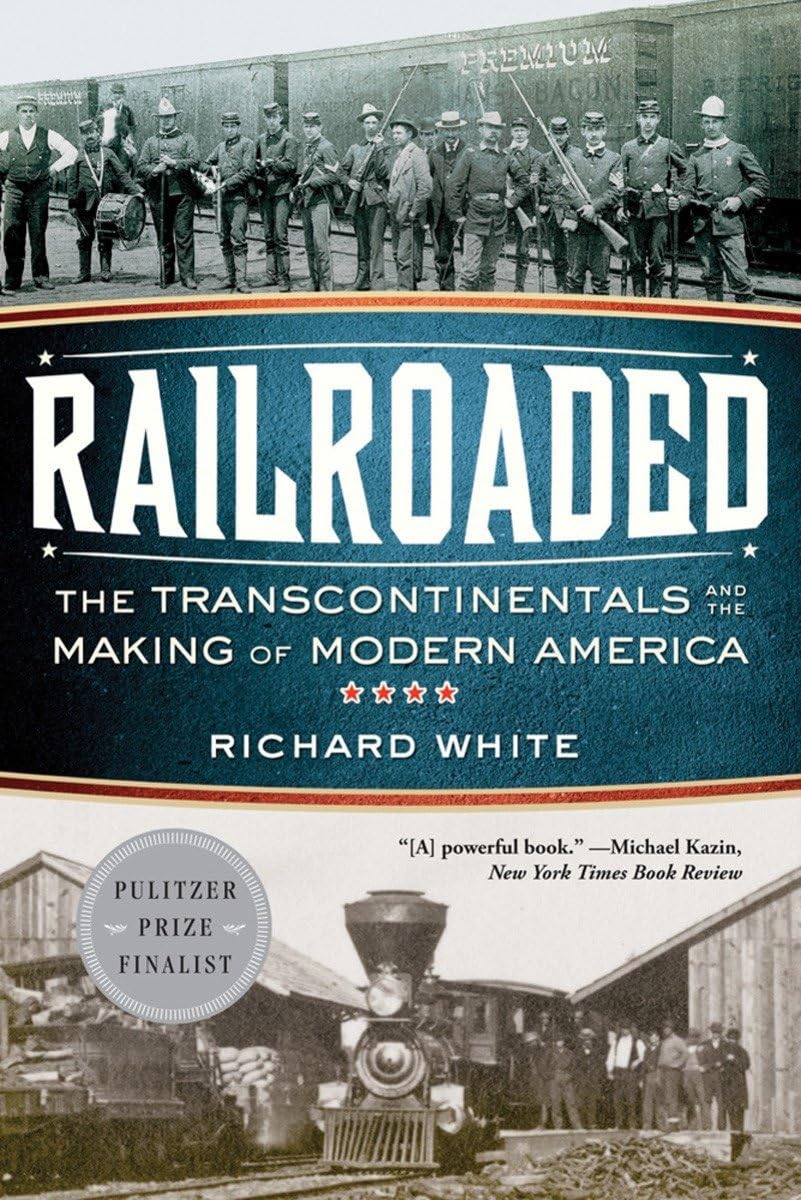
Richard White’s “Railroaded: The Transcontinentals and the Making of Modern America” (2011), which won the Parkman Prize and was a finalist for the Pulitzer Prize, argues that the transcontinental railroads of the late nineteenth century were not the inevitable engines of progress that they were often portrayed to be in earlier notable works of economic history, such as Alfred Chandler’s “The Visible Hand: The Managerial Revolution in American Business” (1977) and Robert Wiebe’s “The Search for Order” (1968). Instead, White contends that they were largely corrupt, inefficient, and built for the benefit of a small group of financiers rather than the broader public. In short, failure in the transcontinental railroad business could be wildly lucrative. The author argues that the “transcontinental railroads were not only failures but near disasters” whose “costs over the long term, and short term, exceeded their benefits.” Most notably, the Schumpetrian “creative destruction” wrought by the transcontinentals was more public than private. “Railroaded” is thus “a study of how the unsuccessful and incompetent not only survived but prospered and became powerful.” While White’s work is a critique of Gilded Age capitalism, it is not merely a Robber Barons redux. He makes several bold claims in “Railroaded,” although none of them is necessarily original.
First, the construction of the transcontinentals was misguided and economically unsustainable. “They came too early, in too great an abundance, and at too great a cost,” White says. The railroads resulted mostly in “dumb growth and environmental catastrophes.” The first transcontinentals – the Union Pacific and the Central Pacific – were built by relative amateurs (Collis P. Huntington – “a self-satisfied and wilfully obtuse bully” according to White – was a Sacramento grocer before setting out to build the Central Pacific). White says this is because no experienced railway executive would have dared build something as obviously doomed as a transcontinental railroad. Nevertheless, by the mid 1880s there were five more transcontinentals in operation: Canadian Pacific, Northern Pacific, Oregon Short Line (Union Pacific Line to Portland), Southern Pacific, and the Atchison, Topeka, and Santa Fe. These duplicative routes were “a species of insanity,” White says. Incredibly, even forty years after the first transcontinental railroad was completed in May 1869, the transcontinentals still couldn’t match the transportation rates of the Pacific Mail Steamship Company, which the railroads had to bribe to the tune of $100,000 a month (roughly $3 million) to keep their rates as high as the transcontinentals. Nonsensical competition flourished across the West. By 1889 six different companies had completed seven separate lines in an area only 120 miles wide in western Kansas, a state that by 1890 had more railroads than New England, a region with three times the population. “An overcapitalized, speculative, corrupt, and increasingly unsteady system,” White says, “railroads caromed across the continent, creating systems that in toto made no rational sense but that could yield vast personal fortunes through construction, speculation, and financial manipulation.” The “paradox at the heart of this book,” White says, is that many railroad entrepreneurs obtained great fortunes by creating “inefficient, costly, dysfunctional corporations.” The transcontinentals, he notes acidly, were “transformative failures…monuments to arrogance, ignorance, and greed.”
Second, White says that the transcontinental railroads were built on corruption, much of it enabled by the new Yankee Leviathan (the powerful federal government created by the Civil War). Railroad executives, such as Tom Scott (who White says “was not so much tainted by corruption as impregnated with it”), manipulated government subsidies, land grants, and financial markets to enrich themselves at the public’s expense. First, they leveraged the mass market sales apparatus pioneered by Jay Cooke (in one of White’s more charitable descriptions: Cooke was “self-made, patriotic, well connected, and deeply religious”) during the Civil War to sell “five-twentry” war bonds (twenty year bonds paying six percent interest that could be called in by the government after five years) to sell railroad bonds to small investors nationwide (Cooke almost single-handedly helped grow the US national debt from $65 million in 1860 to $2.75 billion in 1866). “The line between confidence men and financiers was always blurry in the nineteenth century,” White says.
Next, railroad entrepreneurs enriched themselves by setting up ostensibly independent construction companies that actually built the railroads for them. The Crédit Mobilier – a finance company that was also a construction company – is probably the best example. The scandal broke in 1872 when it was demonstrated that Union Pacific insiders were overcharging the government for railroad construction while secretly profiting from the inflated contracts. The Central Pacific was doing the same thing via the Contract and Finance Company and its successor company, the Western Development Company, which White says “performed feats of financial magic.” The Associates, as the Big Four founders (Huntington, Stanford, Hopkins, and Crocker) of the Central Pacific were called, used these companies to pay themselves $10 million in profits ($260 million today) for building their own railroad and as a screen to obscure their activities from bondholders and bankers. The railroads paid roughly twice the actual cost of construction to these companies – half in gold and half in railroad stock – so the construction was paid in full using gold and the railroad owners pocketed the stock, which they often hypothecated as security for further loans. It’s been estimated the Associates invested $275,000 (not all of it theirs) and leveraged it into a company capitalized at $135 million in 1873 (or roughly $6.5 million and $3.5 billion, respectively, in modern dollars). Thus, the fabulous mansions on Nob Hill and the famed university down the peninsula in Palo Alto were built on money fraudulently extracted from the Western Development Company and not any railroad. Meanwhile, they spent $5 million ($170 million) on political bribes, not including the employment, passes, gifts of land, and other blandishments they handed out over the years.
White’s central point is that the transcontinentals were never viable businesses on their own. “Making large amounts of money from roads that could not pay their debts was something of an artform in the 1870s,” the author says. There was nowhere near the demand necessary to support the massive fixed cost required to build the railroad across one thousand miles of desolate prairie and then over towering mountain ranges. As a business idea, the railroads only “made sense” if the backers could overcharge the government for building the rail lines that often “began nowhere and ended nowhere.” Worse yet, the railroads were saddled with huge fixed costs and interest payments, which they often were only able to sustain by taking out short term, high risk floating loans. If access to that money were closed off – as it was in the Panic of 1873 – the railroads collapsed (121 railroads with $673 million in bonded debt defaulted between 1874-1874 while railroads stocks slid 60 percent between 1873 and 1878). All of these railroads, White says, were “overcapitalized, mismanaged, and often ill conceived.” The supreme example of the hare-brained continental was the Northern Pacific, a railroad more “notable for selling paper than transportation,” White says. It was promoted and financed by the German immigrant Henry Villard, “a superhero of bad management,” in White’s estimation. In the end, White argues that the only explanation is that “ignorance was the common currency of the transcontinentals” – promoters, investors, and politicians were all “a little unclear on the specifics.” But the worst was yet to come. The Panic of 1893 – triggered by default in Argentina (which looked to Europeans a lot like the American West) and the Sherman Silver Purchase Act that threatened to devalue the dollar, both of which panicked European investors – would prove to be the deepest depression in American history other than the Great Depression. The Southern Pacific was the only transcontinental to somehow emerge from the crisis intact, although in 1890 it was doing $48 million in revenue from 6,000 miles in track, but only $44 million from 6,700 miles in 1898.
Third, government subsidies and land grants enabled waste and inefficiency. White says that the bonanza of guaranteed bonds, interest payments, and land grants that Congress heaped upon the Central Pacific and Union Pacific to incentivize the building of the first transcontinental railroad was a staggering blend of “recklessness with ineptitude.” By 1871, nearly 200 million acres had been given to railroad companies – an area larger than any state in the union except Alaska and Texas – leading to widespread land speculation and displacement of Indigenous peoples. Railroads often built unnecessary or redundant lines simply to claim more land and subsidies rather than to serve actual transportation needs. White cites the examples of North and South Dakota to show that the state with a federally subsidized transcontinental railroad (the Great Northern in North Dakota) generated rapid and often unsustainable population shifts, whereas South Dakota, which had no transcontinental railroad, grew much more slowly but efficiently.
Finally, there is the general myth of the railroads as the “Engine of Progress.” White challenges the traditional narrative that the transcontinental railroads were an unqualified success for American development. There is no denying that railroad lines doubled after the Civil War, from 35,000 miles in 1865 to 70,000 in 1873, while bonded debt on the railroads more than quintupled from $416 million to $2.2 billion during roughly the same period. But was all of this even necessary? “The transcontinentals were not so much about earning revenues from moving people and freight,” White says, “as about finance and politics.” Many transcontinental railroads were later taken over or restructured due to their financial failures, revealing that they had been poorly conceived and mismanaged from the start. He argues that alternative transportation networks, such as improved river and canal systems, might have provided a more sustainable path to Western expansion. Railroads reduced the cost of movement, but they also rendered it dramatically unstable. Between 1870 and 1885 the average rates on the original transcontinentals dropped by 65 percent, but this wasn’t because of any efficiencies nor improved understanding of the cost of service. Rather, the railroads simply charged what the falling prices of commodity crops could bear. Their high fixed costs, crippling interest payments, and cut throat competition ensured that the railroads would move freight even at money losing rates. The age of monopoly (i.e. a private entity granted special privileges by the state with the ability to destroy, limit, or distort competition in an activity that citizens could not normally avoid, and so gained the ability to extort tax or rents) ushered in a powerful new constituency in American politics: the antimonopolist. These liberal reformers advocated for competition and uniform charges by the mile for each class of goods, but ended up advocating for public regulation.
It is true that railroads pioneered corporate organization and bureaucratic rationality in America, White says, but that does not mean that they were efficient. Rather, he says, “ignorance, incompetence, and disorganization were not incompatible with the corporate form.” Even Charles Francis Adams, the nineteenth century professional manager par excellence who wanted nothing more than to provide efficient transportation at a profit (but personally a “combination of arrogance, unforgiving intelligence, and condescension,” according to White) was incapable of taming the beast. White argues that the guiding spirit of the railroads was military in nature, not corporate. Civil War veterans of various flavors exchanged a martial motivation of cause and comrades for the socio-economic Gilded Age drivers of gain and friends. White says that “masculinity, zealotry, honor, and revenge” often mattered more to the railroad men up and down the organization chart than efficiency and profits. According to the military analogy, workers were soldiers and their job was to take orders, a worldview that led to the widespread unionization of railroad workers (by 1885 it was estimated that 10,000 of the Southern Pacific’s 15,000 employees were unionized) and eventually highly costly labor revolts, such as the Great Upheaval of 1886 (1,400 strikes against 11,562 businesses, including the deadly Haymarket Riot), the Great Burlington Strike of 1888, and the Pullman Strike of 1894 that brought the economy to a virtual standstill. Even as late as the 1890s the American judiciary had not yet settled on the legitimacy of unions and the right of workers to strike.
Most Americans of the late nineteenth century had an almost blind faith in the corrective powers of market competition, “a nostrum at once universal and infallible,” according to Charles Francis Adams. This perspective undergirded the growing antimonopoly movement, which was espoused by politically powerful grass-roots interest groups, such as the Farmers’ Alliance and Knight of Labor. It was also propelled forward by the economic theory of marginalism, which rejected the labor theory of value inherent in classical economic models, including Marxism, and instead argued for the law of the final increment, emphasizing the role of diminishing marginal utility in value determination. Marginalism argued that wages were destined to be inexorably driven downward to the level that the most desperate worker was willing to take. Eventually, the antimonopolists shifted from competition as a panacea to calling on the government to regulate and control the railroads. A fragile compromise was achieved with railroad management in the late 1880s with the new Interstate Commerce Commission (ICC). It became the great hope of manager-reformers like Adams to restrain ruinous competition.
In conclusion, White’s Railroaded presents a revisionist history of the transcontinental railroads, depicting them as products of political corruption, economic waste, and social harm rather than pure symbols of progress. “Overbuilt, prone to bankruptcy and receivership, wretchedly managed, politically corrupt, environmentally harmful, and financially wasteful,” he writes, “these corporations nonetheless helped create a world where private success often came from luck, fortunate timing, and state intervention.” The brutal efficiency and competence of the fictional Pacific and South West Railroad depicted in Frank Norris’s “The Octopus” (1901) had no parallel in reality, according to White. The railroads and the men who ran them were, in White’s estimation, “almost criminally careless, obtuse, and greedy.” In the end, the real question isn’t whether or not the transcontinentals should have been built, but rather should they have been built when and where they were built. His unambiguous answer is “no.” They could have been built much less expensively and efficiently and with far less economic and social disruption if the railroad expansion had happened organically and in response to existing demand. Nor did they bring much in the way of economic growth (the per capita income from labor across the West was lower in 1900 than it had been in 1880).
 What's Tim Reading Now?
Leave a comment